
Anticholinergic Risk Calculator
Based on 2018 AUA guidelines and clinical studies, this tool estimates your risk of urinary retention when taking anticholinergics like oxybutynin or tolterodine with benign prostatic hyperplasia (BPH).
Anticholinergics can cause complete urinary retention in 2.3x more BPH patients than non-BPH patients.
Your risk calculation will appear here
Men with an enlarged prostate are often told to take anticholinergics for an overactive bladder. But here’s the truth: these drugs can turn a manageable problem into an emergency. If you’ve got benign prostatic hyperplasia (BPH), taking oxybutynin, solifenacin, or tolterodine might feel like a quick fix for urgency and leaks-but it’s actually putting you at serious risk of complete urinary retention. And once that happens, you’re headed to the ER with a catheter, not a cure.
How Anticholinergics Work (And Why They’re Dangerous for Prostate Patients)
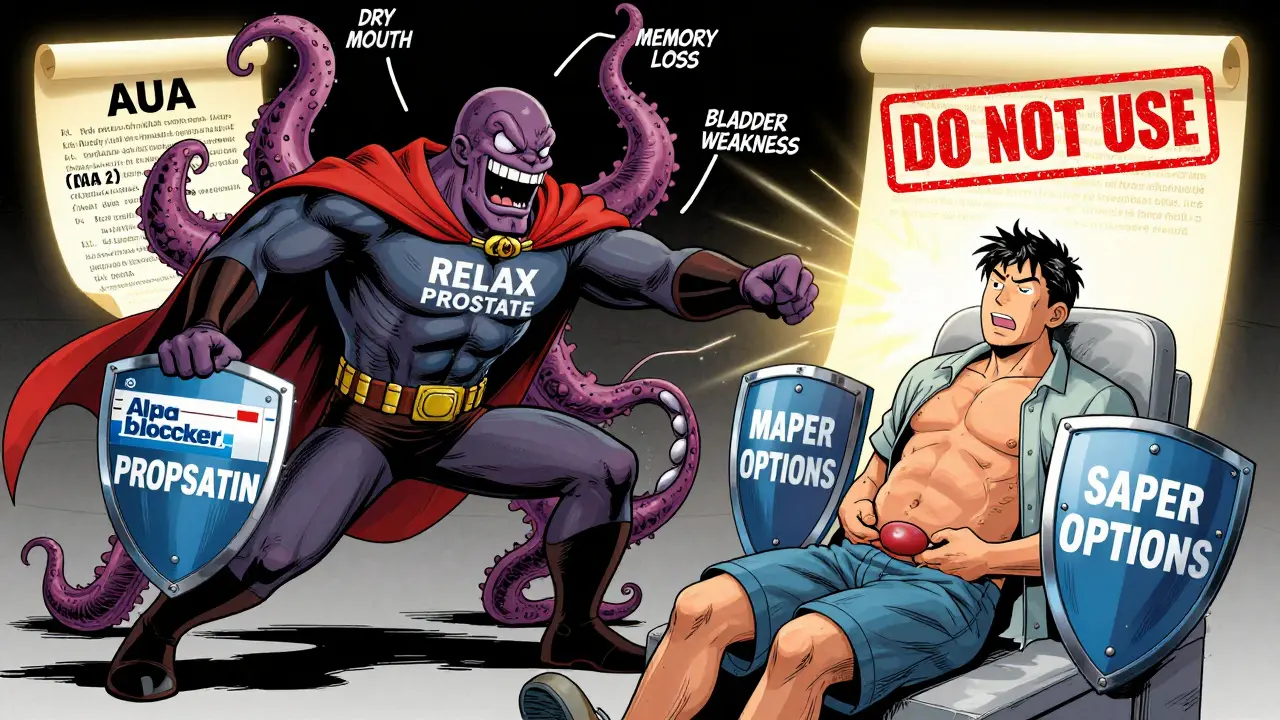
Anticholinergics block acetylcholine, a chemical that tells your bladder to squeeze. That’s why they help with sudden urges and incontinence. But here’s the catch: in men with BPH, the bladder is already working overtime to push urine past a swollen prostate. The detrusor muscle-the main bladder muscle-is stretched thin, fighting an uphill battle. Adding an anticholinergic is like taking away the engine from a car trying to climb a steep hill.
These drugs don’t just calm the bladder. They weaken it. And when the bladder can’t contract strongly enough to overcome prostate blockage, urine backs up. That’s urinary retention. Acute retention means you can’t urinate at all. Chronic retention means you’re always leaving behind a lot of urine, which can lead to infections, kidney damage, or even bladder stones.
It’s not rare. Studies show men with BPH who take anticholinergics are 2.3 times more likely to suffer acute urinary retention than those who don’t. The American Urological Association (AUA) says this isn’t just a theoretical risk-it’s a red flag. Their 2018 guidelines say outright: don’t prescribe these drugs to men with prostate enlargement over 30 grams or symptom scores above 20.
The Real Numbers Behind the Risk
Let’s talk numbers that matter. In clinical trials, 8% to 15% of people taking anticholinergics report trouble urinating. For men with BPH, that number jumps. A 2017 study in Neurourology and Urodynamics found that in carefully selected men with mild BPH, retention still happened in 12% of cases. In unselected groups? It was 28%.
The FDA’s Adverse Event Reporting System logged 1,247 cases of urinary retention tied to anticholinergics between 2018 and 2022. Over 60% of those were men over 65 with diagnosed BPH. That’s not an accident. That’s a pattern.
And it’s not just about the bladder. These drugs cause dry mouth in up to 60% of users, constipation in 30%, blurred vision in 10%, and memory problems in older adults. The FDA warned in 2012 and again in 2019 that anticholinergics increase dementia risk in seniors. So you’re trading bladder leaks for brain fog and possible hospitalization.
What Happens When You Can’t Urinate
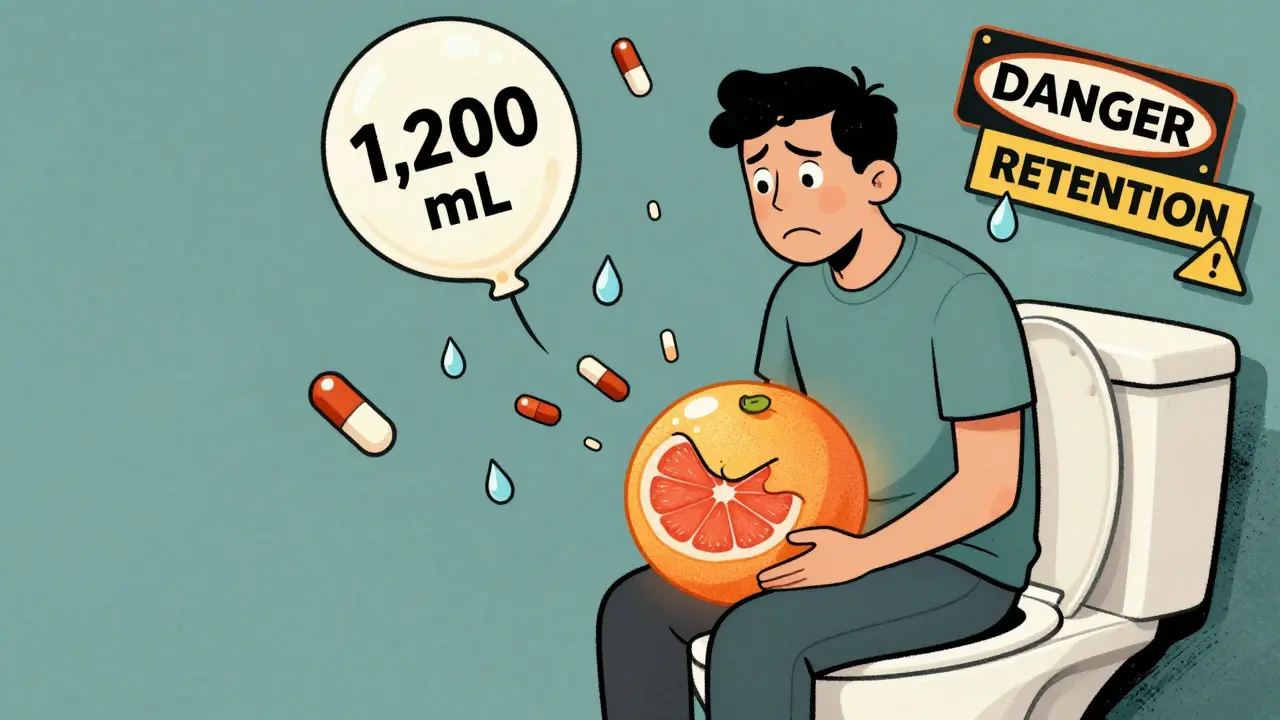
Acute urinary retention isn’t a slow decline-it’s sudden and painful. The bladder fills to bursting. People report severe lower abdominal pain, pressure, and the terrifying feeling that you *need* to go but nothing comes out. Bladder volumes can hit 1,200 mL or more-five times the normal capacity.
Emergency treatment? Immediate catheterization. A tube is inserted through the urethra to drain the bladder. In 85-90% of cases, this works. But here’s the kicker: if you just drain the bladder and walk out, you’re likely to get stuck again. Studies show 70% of men with BPH experience repeat retention within a week if no other treatment is started.
That’s why the AUA recommends starting an alpha-blocker like tamsulosin (Flomax) the moment the catheter goes in. These drugs relax the muscles around the prostate, making it easier to urinate. Men who get alpha-blockers after catheterization are 30-50% more likely to pass a voiding trial within 2-3 days than those who don’t.

Alternatives That Actually Work
You don’t need anticholinergics to manage bladder urgency if you have BPH. Safer, more effective options exist.
- Alpha-blockers (tamsulosin, alfuzosin): These are first-line for BPH. They don’t weaken the bladder-they help the prostate relax. They reduce urinary retention risk and improve flow.
- 5-alpha reductase inhibitors (finasteride, dutasteride): These shrink the prostate over time. After 4-6 years, they cut the risk of acute retention by half.
- Mirabegron and vibegron (Myrbetriq, Gemtesa): These are beta-3 agonists. They stimulate the bladder to relax *without* blocking nerve signals. In trials, they reduced urgency episodes by 92% with only a 4% retention rate in men with mild BPH-far safer than anticholinergics’ 18%.
European Urology guidelines now say anticholinergics should be avoided in men with prostate enlargement unless they’re in a tiny, tightly monitored group with confirmed detrusor overactivity and almost no obstruction. Even then, it’s a last resort.
Who Might Still Use Them-And How
Some doctors argue that if a man has mild BPH and severe bladder spasms, a low-dose anticholinergic might be okay. Dr. Kenneth Kobashi points to a 2017 study where 12% of carefully selected patients had retention. That’s still 1 in 8. And it requires constant monitoring: monthly uroflow tests, post-void residual checks, and a clear plan to stop immediately if symptoms worsen.
But here’s the reality: most patients aren’t monitored this closely. A 2019 study found that 40% of nursing home residents with BPH and urinary retention were still being prescribed anticholinergics-even though the American Geriatrics Society’s Beers Criteria calls them potentially inappropriate for exactly this group.
It’s not just about the drug. It’s about the system. Too many primary care doctors prescribe these pills without checking prostate size or bladder function. Urologists know better. But if you’re not seeing one, you’re at risk.
What You Should Do Right Now
If you’re on an anticholinergic and have BPH:
- Check your last uroflow test. Was your peak flow rate below 10 mL/sec? That’s high risk.
- Ask for a post-void residual test. If you’re leaving more than 150 mL behind after urinating, your bladder is struggling.
- Ask your doctor: ‘Is my prostate enlarged? What’s the size?’ If it’s over 30 grams, anticholinergics are dangerous.
- Request an alpha-blocker like tamsulosin. It’s safer, proven, and often covered by insurance.
- If you’re having trouble urinating, stop the anticholinergic immediately and call your doctor.
Don’t wait for an emergency. If you’ve ever felt like you *should* be able to pee but can’t, that’s not normal. That’s retention waiting to happen.
What’s Changing in the Future
Research is moving fast. The National Institute of Diabetes and Digestive and Kidney Diseases is funding studies to predict who can safely use anticholinergics using prostate MRI scans and genetic markers. But that’s still years away.
Right now, the trend is clear: prescriptions for anticholinergics in men over 65 with BPH are projected to drop 35% by 2028. Why? Because doctors are waking up. Patients are sharing their stories online. Reddit threads and support forums are full of men who ended up catheterized after being told ‘it’s just a side effect.’
One user on the Prostate Cancer Foundation forum wrote: ‘After Detrol, I ended up in the ER with a 1,200 mL bladder. Now I have a catheter and might need surgery.’ That’s not a side effect. That’s a preventable disaster.
The message is simple: if you have prostate issues, anticholinergics aren’t a solution. They’re a trap. There are better, safer ways to manage your bladder. Ask for them. Push for them. Your body will thank you.


Comments (15)