
Naranjo Scale Calculator
Naranjo Scale Assessment
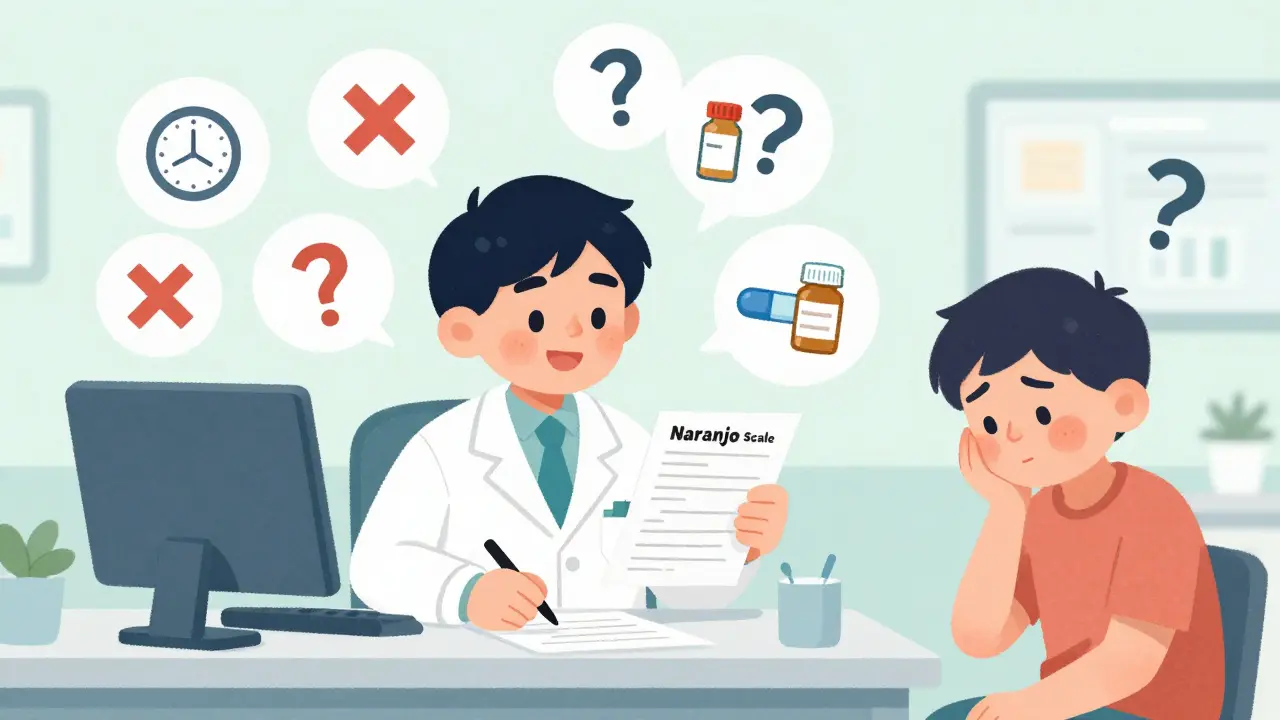
The Naranjo Scale is a 10-question tool used to assess whether an adverse drug reaction (ADR) is caused by a medication. Each question is scored, and the total determines the causality assessment category.
When a patient gets sick after taking a new medication, how do you know if the drug actually caused the problem? It’s not always obvious. Maybe it was the flu. Maybe it was something else they ate. Or maybe it really was the antibiotic they started three days ago. That’s where the Naranjo Scale comes in. It’s not magic. It’s not a lab test. It’s a simple, 10-question checklist used by doctors, pharmacists, and researchers around the world to figure out if a drug really caused an unexpected side effect.
What Is the Naranjo Scale and Why Does It Matter?
The Naranjo Scale was created in 1981 by a team of researchers led by Dr. Carlos A. Naranjo. It was born out of a need for order after the thalidomide disaster - when a drug meant to help pregnant women caused severe birth defects, and no one could reliably say which drugs were truly dangerous. Since then, it’s become the most-used tool in the world to assess whether a reaction is caused by a medication. Unlike guessing based on gut feeling, the Naranjo Scale forces you to ask specific, evidence-based questions. Each answer gives you points - positive, negative, or zero. Add them up, and you get a score that tells you how likely the drug caused the reaction: definite, probable, possible, or doubtful. It’s used in hospitals, pharmacies, drug companies, and regulatory agencies like the FDA and the European Medicines Agency. If you report a side effect to a drug safety database, chances are they used this scale to decide if it’s worth investigating.How the Naranjo Scale Works - The 10 Questions
The scale has 10 questions. Each one is designed to rule out other causes and confirm a link to the drug. You answer each one with “Yes,” “No,” or “Do Not Know.” Then you add up the points. Here’s how it breaks down:- Question 1: Were there previous reports of this reaction with the drug? +1 if yes
- Question 2: Did the reaction happen after the drug was started? +2 if yes, -1 if it happened before
- Question 3: Did symptoms improve after stopping the drug? +1 if yes
- Question 4: Did the reaction return when the drug was given again? +2 if yes, -1 if it got worse
- Question 5: Could something else have caused it? -1 if yes, +2 if no
- Question 6: Was a placebo used to test the reaction? -1 if yes, +1 if no
- Question 7: Was the drug found in toxic levels in the blood? +1 if yes
- Question 8: Did the reaction get worse when the dose was increased? +1 if yes
- Question 9: Has the patient had this reaction to the same drug before? +1 if yes
- Question 10: Is there objective evidence confirming the reaction? +1 if yes (like lab results or imaging)
That’s it. No fancy machines. Just a paper form or a digital tool. But the answers require clinical judgment. For example, Question 5 - “Could something else have caused it?” - is where most mistakes happen. A fever could be from the drug… or from pneumonia. A rash could be from the antibiotic… or from a new soap. You have to know the patient’s full history to answer correctly.
What Do the Scores Mean?
After adding up the points, you get one of four outcomes:- 9 or higher: Definite - The drug almost certainly caused it. You’ve got a clear timeline, improvement after stopping, and no better explanation.
- 5 to 8: Probable - Very likely the drug caused it, but maybe you couldn’t test rechallenge (re-giving the drug) for safety reasons.
- 1 to 4: Possible - There’s a link, but other factors could be involved. Maybe the patient had multiple drugs or a chronic illness.
- 0 or lower: Doubtful - The reaction probably wasn’t caused by the drug. Something else is to blame.
These categories aren’t just academic. They affect what happens next. A “definite” ADR might lead to a drug warning. A “possible” one might just get documented in a patient’s file. In clinical trials, these scores help decide whether to keep testing a drug or pull it from the market.
How It Compares to Other Tools
There are other ways to assess drug reactions. The WHO-UMC system is simpler - it just says “certain,” “probable,” “possible,” or “unlikely.” But it’s less precise. Studies show the Naranjo Scale gives more consistent results between different healthcare workers. But it’s not perfect. The WHO system doesn’t use numbers, so it’s easier for non-experts. The Naranjo Scale needs training. A pharmacist with 10 years of experience will score it differently than a new nurse. And then there’s the Liverpool Scale - designed for people on multiple drugs. Most older patients take five or more medications. The Naranjo Scale only looks at one drug at a time. That’s a big problem in real life. There’s also the PADRAT tool for kids. Kids react differently to drugs. Their bodies process them differently. The Naranjo Scale wasn’t made for them. Despite this, the Naranjo Scale is still used in 78% of published drug safety studies. Why? Because it’s structured. It doesn’t let you skip the hard questions. It forces you to think.Where It Falls Short - And Why It’s Still Used
Let’s be honest: some parts of the Naranjo Scale feel outdated. Question 6 asks if a placebo was used to test the reaction. In 2025, giving someone a placebo just to see if they get sick again? That’s unethical. If a drug caused liver failure, you don’t re-dose it. You don’t even consider it. So most people answer “Do Not Know” - which lowers their score. That means a real, dangerous reaction might get labeled “probable” instead of “definite.” It also doesn’t handle modern drugs well. Biologics, cancer immunotherapies, gene therapies - these work differently. Side effects can show up weeks or months later. The Naranjo Scale assumes reactions happen fast. That’s not always true. And yet, it’s still the gold standard. Why? Because it’s transparent. You can see every step. You can check the math. You can train someone to use it in an afternoon. AI tools are coming, but they’re black boxes. The Naranjo Scale? You can explain it to a patient.Real-World Use - What Clinicians Say
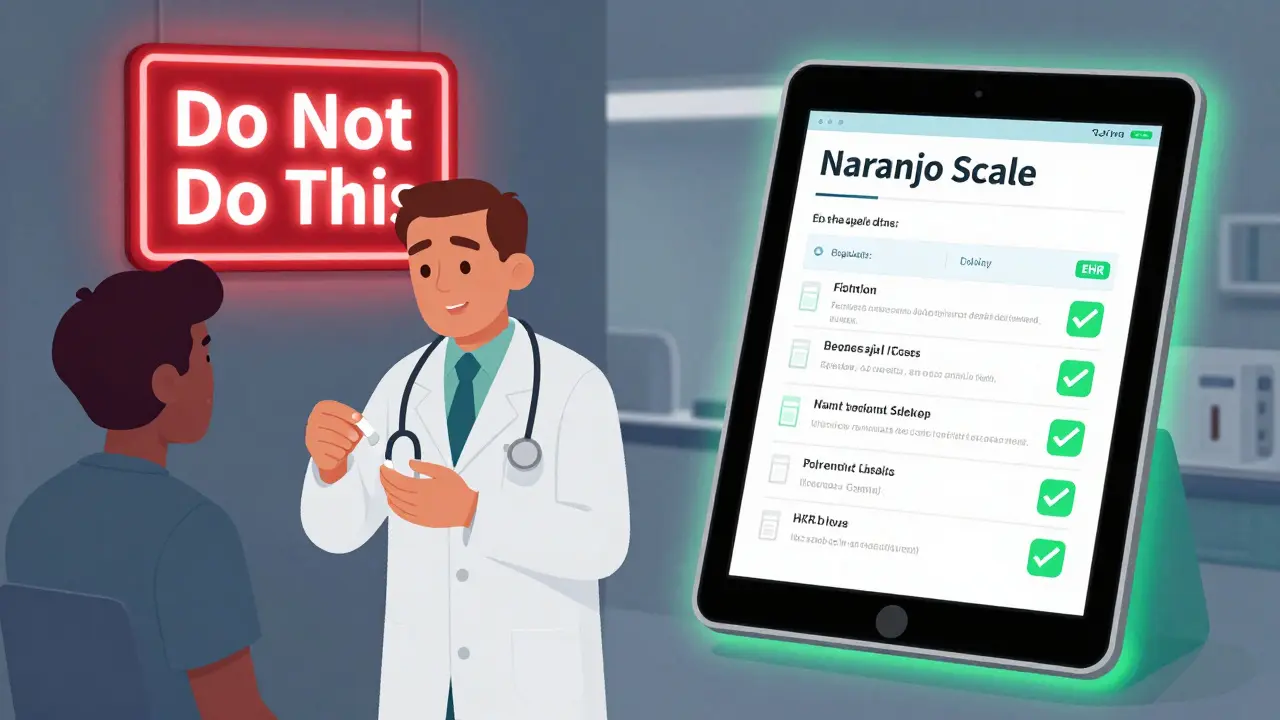
In a 2023 Reddit thread with over 40 comments from pharmacists and nurses, 68% said they use the Naranjo Scale every day. One pharmacist from Massachusetts General Hospital said: “It stops us from jumping to conclusions. We used to say ‘it’s probably the statin’ - now we have to prove it.” But others complained. A nurse from Johns Hopkins said: “We can’t rechallenge. So we always get ‘Do Not Know’ on Question 4. That makes everything ‘probable’ - even when it’s probably not the drug.” Digital tools are helping. A Python-based calculator released in 2023 cut assessment time from 11 minutes to 4 minutes. Error rates dropped from 28% to 9%. Now, EHR systems like Epic can auto-fill four of the ten questions using patient data - like when the drug was started or if labs changed. Still, the human part matters. You need to know if the patient’s fever was from an infection or a drug reaction. You need to know if the rash is hives or a fungal infection. That’s why pharmacists and clinical pharmacologists are the best at using it. Doctors with less than five years’ experience take 37% longer to get it right.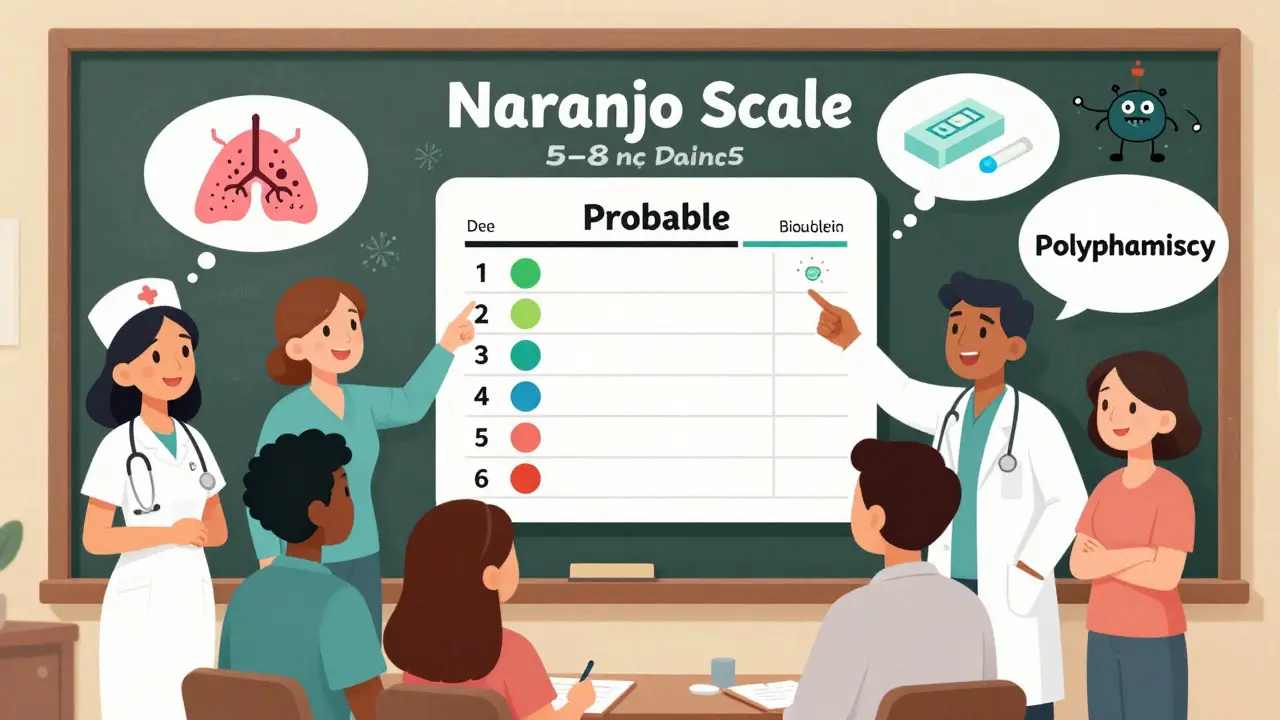
How to Learn It
You don’t need a degree to use the Naranjo Scale. But you do need to practice. Most people get comfortable after 3-5 real cases. Fiveable, a free learning platform, has 12 interactive case studies used by over 15,000 nursing and pharmacy students. The Nebraska ASAP group offers a free worksheet downloaded over 3,000 times. Start with a simple case: a 70-year-old on lisinopril who develops a dry cough. Use the scale. Ask each question. Don’t skip one. Even if you think you know the answer. The goal isn’t to get the score right. It’s to learn how to think like a pharmacovigilance expert.What’s Next for the Naranjo Scale?
In 2024, the International Council for Harmonisation (ICH) proposed changing Question 6. Instead of asking about placebo, they want to ask: “Was there therapeutic drug monitoring data?” That’s smarter. It uses existing blood levels instead of risky rechallenge. AI tools are being built to predict ADRs before they happen. The FDA’s Sentinel Initiative uses big data to spot patterns across millions of patient records. But even those systems often use the Naranjo Scale to label their findings. It won’t disappear. It’s too simple, too proven, too widely accepted. Experts predict it’ll still be in use 15-20 years from now - not as the only tool, but as the foundation.Final Thought: It’s Not Perfect, But It’s Necessary
The Naranjo Scale doesn’t replace clinical judgment. It supports it. It doesn’t make you an expert. It makes you careful. In a world full of new drugs, complex patients, and endless side effects, we need something that doesn’t guess. We need something that asks the right questions - even when the answer is hard. That’s why, in 2025, you’ll still find the Naranjo Scale on hospital walls, in pharmacy software, and in the hands of clinicians who refuse to assume. It’s old. It’s imperfect. But it’s the best tool we’ve got to answer one simple, life-changing question: Did this drug hurt this patient?”What is the Naranjo Scale used for?
The Naranjo Scale is used to assess whether an adverse drug reaction (ADR) is likely caused by a specific medication. It helps healthcare professionals determine if a patient’s symptoms are due to the drug or another factor, like an infection or underlying condition. It’s widely used in hospitals, clinical research, and drug safety reporting.
How accurate is the Naranjo Scale?
The Naranjo Scale has moderate inter-rater reliability, with studies showing agreement between clinicians around 40-60% (kappa values of 0.4-0.6). It’s more consistent than simpler tools like WHO-UMC, but accuracy depends on the user’s experience. Skilled pharmacists and clinical pharmacologists score it more reliably than general practitioners. Digital tools have reduced errors from 28% to under 10%.
Can the Naranjo Scale be used for multiple drugs?
No, the Naranjo Scale is designed to evaluate one drug at a time. It doesn’t handle polypharmacy well - which is a major limitation since most elderly patients take five or more medications. For complex cases, tools like the Liverpool ADR Probability Scale are better because they can assess multiple drugs simultaneously.
Is the placebo question (Question 6) still relevant?
No, not really. Asking if a placebo was used to test a reaction is ethically unacceptable in modern practice. Re-administering a drug that caused a serious reaction is dangerous and violates medical ethics. Most clinicians answer “Do Not Know,” which lowers the score. In 2024, regulators proposed replacing this question with one about therapeutic drug monitoring data.
Is the Naranjo Scale used in the U.S. and Europe?
Yes. The FDA and the European Medicines Agency both recognize the Naranjo Scale as an acceptable method for causality assessment. The FDA’s FAERS system and the EMA’s GVP guidelines reference it. Adoption rates are 92% in North America and 85% in Europe, making it the most commonly used tool in these regions.
Can I use the Naranjo Scale as a patient?
You can try, but it’s not designed for self-assessment. The scale requires clinical knowledge - especially to judge alternative causes, objective evidence, and drug mechanisms. Patients may misinterpret symptoms or overlook key details. It’s best used by trained professionals. However, understanding how it works can help you ask better questions about your own medications.
Are there digital tools to help use the Naranjo Scale?
Yes. Open-source tools like the Naranjo Calculator on GitHub and commercial integrations in EHR systems like Epic can automate scoring. These tools reduce errors and cut assessment time from over 10 minutes to under 5 minutes. Some can auto-fill questions using data from your electronic health record, like medication start dates and lab results.
Why hasn’t the Naranjo Scale been replaced?
Because it’s simple, transparent, and validated. Even with newer AI tools and complex drugs, no other method matches its global adoption and consistency. It doesn’t require expensive tech. You can use it on paper. It forces structured thinking. Experts predict it will evolve - not disappear - with digital upgrades and minor updates to questions, keeping it relevant for at least the next two decades.


Comments (11)