
Every pill you take - whether it’s a brand-name drug or a generic - should work the same way. But how do you know it’s real? In 2026, counterfeit drugs are still a threat, especially in online pharmacies and unstable supply chains. The truth is, generic manufacturing standards are the invisible shield keeping fake medicines off shelves. These aren’t just guidelines - they’re legally enforced rules that make counterfeiting nearly impossible for anyone without a billion-dollar lab and a team of regulatory experts.
Why Generic Drugs Must Meet the Same Standards as Brand-Name Drugs
Many people think generic drugs are cheaper because they’re lower quality. That’s a dangerous myth. The U.S. Food and Drug Administration (FDA) requires every generic drug to prove it’s identical to the brand-name version in active ingredient, strength, dosage form, and how it’s absorbed by the body. This isn’t a suggestion - it’s a legal requirement under the Abbreviated New Drug Application (ANDA) pathway. The FDA doesn’t allow generic manufacturers to cut corners. Every batch must pass bioequivalence testing, meaning the drug must release into the bloodstream at the same rate and amount as the original. The acceptable range? 80% to 125% of the brand-name drug’s performance. That’s tighter than most people realize. If a generic fails even once, the entire batch is destroyed. And if it happens repeatedly, the facility loses its license. This isn’t just about effectiveness - it’s about safety. A counterfeit pill might look identical, but if it contains the wrong crystal form of the active ingredient, it won’t dissolve properly. That’s what happened in 2018 with valsartan, a blood pressure drug. The impurity wasn’t caught because standard tests didn’t look for that specific polymorph. That’s why modern quality control doesn’t just test the final product - it controls every step of the process.What cGMP Really Means for Your Medicine
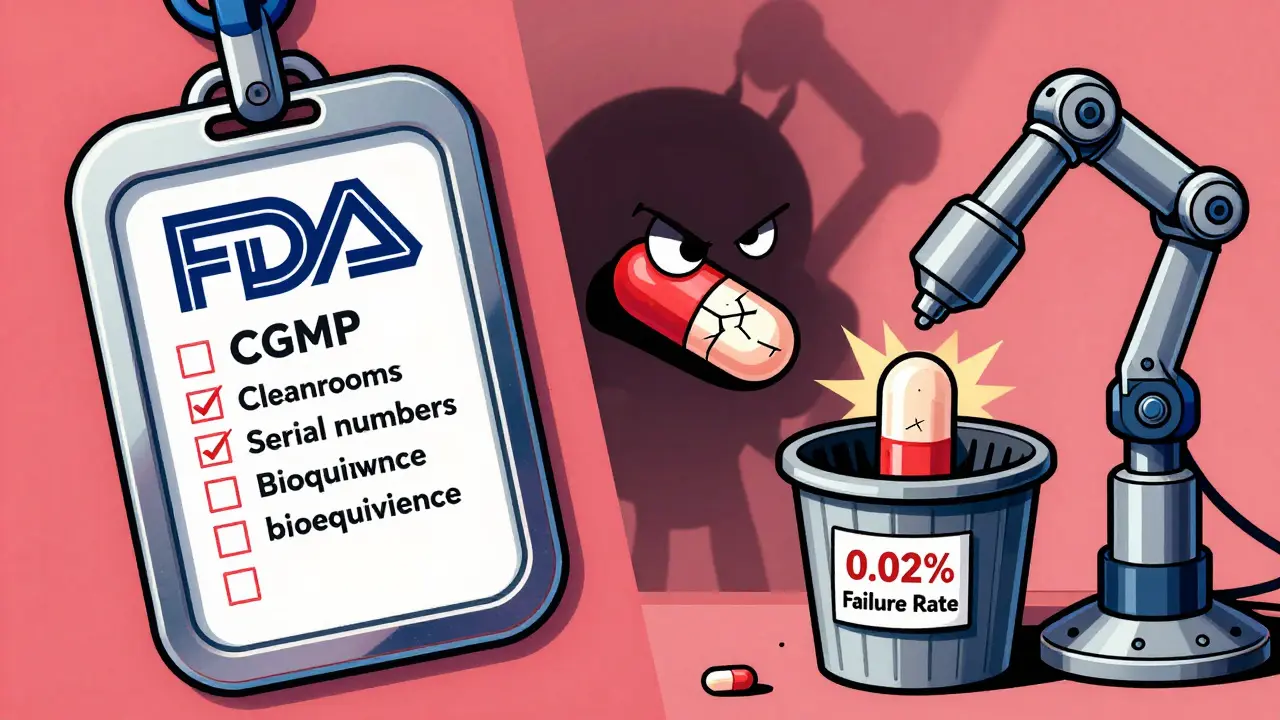
The backbone of all this is Current Good Manufacturing Practices, or cGMP. You won’t see it on the label, but it’s in every pill you swallow. The FDA says it plainly: “Quality cannot be tested into a finished product; it must be built into the design and manufacturing process at every single step.” That means:- Every raw material is tested before it touches the production line - no exceptions.
- Manufacturing rooms are kept at ISO Class 5 cleanroom standards - fewer than 3,520 particles per cubic meter of air. That’s cleaner than an operating room.
- Equipment is cleaned and validated after every batch. No residue, no cross-contamination.
- Every step is documented. If a machine runs too hot or a batch is off by 0.1%, the system flags it. Someone has to investigate why - and prove it wasn’t a mistake.
The Tech Behind Detecting Fakes Before They Reach You
Modern quality control isn’t just about lab tests. It’s about digital fingerprints. Every package of a generic drug sold in the U.S. now has a unique serial number - a digital barcode that links to a national database. This is required under the Drug Supply Chain Security Act (DSCSA), which went fully into effect in 2023. Here’s how it works:- Each bottle gets a 2D barcode with product code, serial number, lot number, and expiration date.
- Pharmacies and distributors scan it at every handoff.
- If a package doesn’t match the database, the system flags it as suspicious.
- By 2025, even small pharmacies will be required to verify every package electronically.
Why Other Products Don’t Have This Level of Protection
Compare this to dietary supplements. Under the Dietary Supplement Health and Education Act (DSHEA), supplement makers don’t need FDA approval before selling. Only 30% of supplement manufacturers test for identity. That’s why 80% of online “weight loss” or “energy” supplements tested by the FDA in 2022 contained unapproved drugs - sometimes even steroids or erectile dysfunction pills. Or look at unregulated online pharmacies. In 2022, the FDA tested 100 products from suspicious websites. 96% failed quality standards. Some had no active ingredient. Others had twice the dose. A few even contained rat poison. Generic drugs, by contrast, are among the most tightly controlled products in the world. The adverse event rate for FDA-approved generics? 0.02%. Brand-name drugs? 0.03%. That’s not a difference - it’s statistical noise. The system works.The Hidden Costs of Getting It Right
None of this is cheap. Implementing a full Electronic Quality Management System (eQMS) - the software that tracks every test, every batch, every deviation - costs between $2 million and $5 million. Smaller manufacturers struggle. Some can’t afford the $500,000 to $1 million price tag for a single mass spectrometer that detects impurities at parts-per-billion levels. Training is another hurdle. Quality control staff need 200+ hours of training every year. New hires spend 18 to 24 months learning cGMP before they’re allowed to sign off on a batch. Documentation alone can involve 5,000+ standard operating procedures per facility. But here’s the thing: the cost of failure is far higher. In 2022, a single recall of a contaminated generic antibiotic cost one manufacturer $140 million in lost sales, legal fees, and fines. The WHO estimates that counterfeit drugs cost the global economy $200 billion a year. Quality control isn’t an expense - it’s insurance.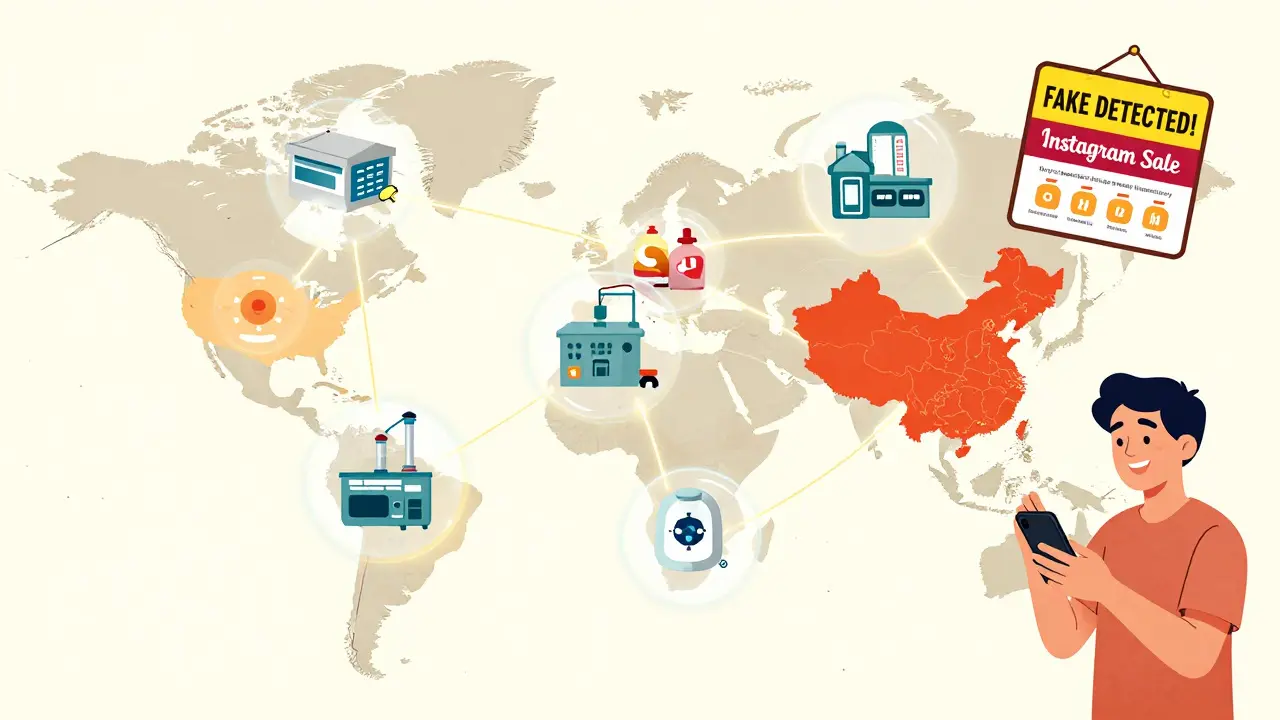
What’s Next? AI, Blockchain, and Molecular Taggants
The next wave of protection is even smarter. By 2026, the EU will require quantum-resistant cryptography on all prescription drug packaging - meaning even hackers with quantum computers won’t be able to forge serial numbers. In Africa, the WHO is testing blockchain-based verification for antimalarial generics. Each dose gets a digital “passport” that patients can scan with their phones. If it’s fake, the app warns them. Even more advanced? Molecular taggants - invisible chemicals added to pills that act like DNA markers. Only authorized scanners can detect them. IBM and Siemens are investing over $1.2 billion in AI systems that predict quality failures before they happen - using machine learning to spot patterns in temperature, pressure, and humidity data from thousands of sensors. These aren’t sci-fi ideas. They’re already in pilot programs. And they’re needed. While only 1% of medicines in the U.S. are counterfeit, the number jumps to 30% in some developing countries. That’s why global collaboration is now part of FDA’s 2023-2027 strategy - with $150 million allocated just for counterfeit detection tech.What You Can Do to Stay Safe
You don’t need to be a scientist to protect yourself:- Buy from licensed pharmacies - not websites that don’t require a prescription.
- Check the packaging. Legitimate generics have consistent color, font, and serial numbers.
- Use the FDA’s Drugs@FDA database to confirm your generic is approved.
- If a pill looks different than usual - talk to your pharmacist. It might be a reformulation, or it might be fake.
Are generic drugs as safe as brand-name drugs?
Yes. The FDA requires generic drugs to meet the same strict standards as brand-name drugs for identity, strength, purity, and performance. Studies show the adverse event rate for approved generics is actually slightly lower than for brand-name drugs - 0.02% versus 0.03%. The only difference is price.
How can I tell if my generic drug is counterfeit?
Look for inconsistencies: blurry printing, mismatched colors, missing serial numbers, or packaging that feels cheap. Buy only from licensed pharmacies - not online vendors that don’t require a prescription. If something looks off, ask your pharmacist to verify it using the FDA’s Drugs@FDA database.
Why are some generic drugs cheaper than others?
Price differences come from manufacturing location, competition, and scale - not quality. All FDA-approved generics must meet the same standards. A cheaper version isn’t necessarily lower quality. But if the price seems too good to be true - like a 30-day supply of a $200 drug for $10 - it’s likely fake.
Do all countries have the same quality standards for generics?
No. The U.S., EU, Canada, and Japan have strict cGMP enforcement. In some countries, oversight is weak or nonexistent. The WHO estimates that 1% of medicines in developed countries are counterfeit, but up to 30% in low-income regions. Always check where your drug was manufactured and whether it’s approved by a reputable agency like the FDA or EMA.
Can counterfeit drugs be detected by looking at them?
Sometimes - but not always. Sophisticated counterfeits can look identical to the real thing. That’s why quality control relies on lab testing, serialization, and digital tracking - not just visual inspection. Even experts can’t tell the difference without specialized equipment like infrared spectrometers or mass spectrometers.


Comments (14)