
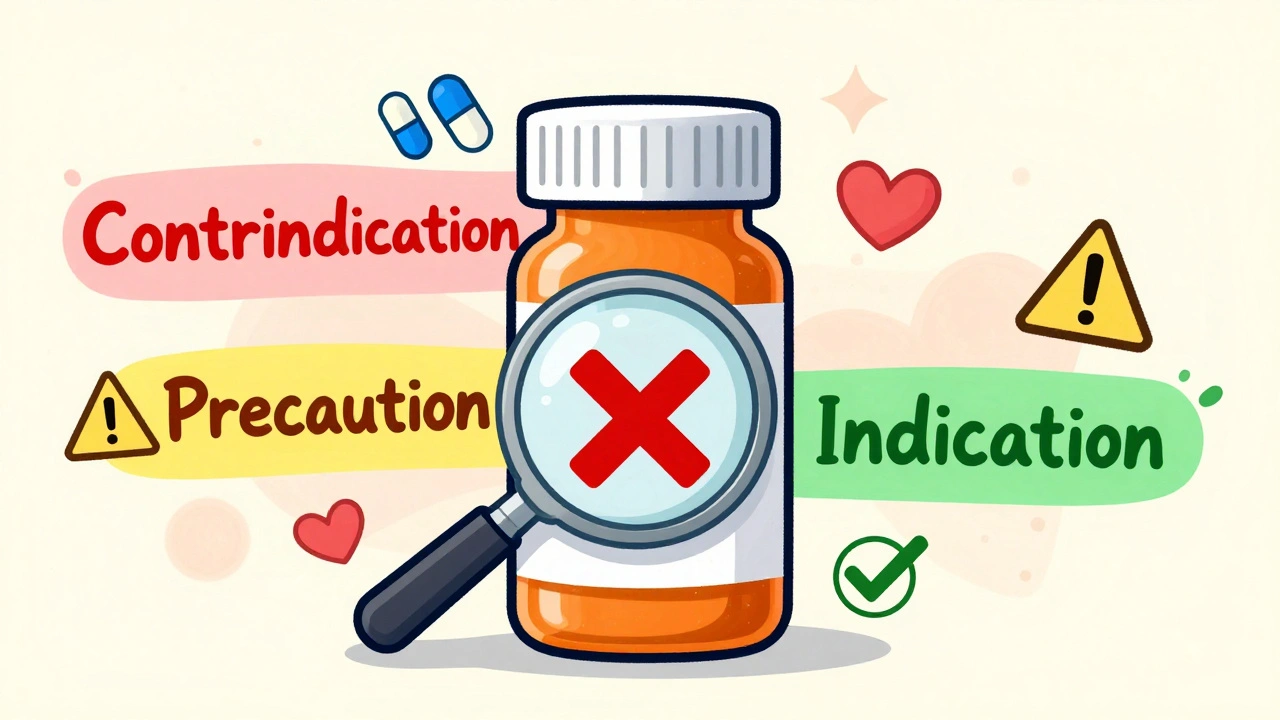
When you pick up a prescription, the tiny print on the label isn’t just fine print-it’s a legal document. The U.S. Food and Drug Administration (FDA) requires every prescription drug to carry specific, standardized information. These aren’t suggestions. They’re requirements. And if you’re a patient, caregiver, or healthcare provider, understanding terms like contraindication, precaution, and indications can make the difference between safe use and serious harm.
What FDA Drug Labels Really Mean
Every prescription drug in the U.S. must follow a strict labeling format set by the FDA. This isn’t just about listing side effects. It’s about organizing critical safety and usage information so that doctors, pharmacists, and patients can find what they need quickly. The format, known as the Physician Labeling Rule (PLR), was introduced in 2006 and has been refined since. Today, every label follows the same structure: Indications and Usage, Contraindications, Warnings and Precautions, Dosage and Administration, Drug Interactions, and Patient Counseling Information. The goal? Clarity. Speed. Accuracy. If a doctor is rushing between patients, they need to find the most urgent safety info in seconds. If a patient is reading their Medication Guide, they need to know exactly what to watch for. The FDA doesn’t leave this to chance. Every word has a specific meaning-and using the wrong term can lead to legal and clinical consequences.Indications and Usage: What the Drug Is Approved For
This is the first section you’ll see after the drug’s name. It tells you exactly what the drug is approved to treat. Not what it might help with. Not what a doctor might prescribe off-label. But what the FDA has reviewed, tested, and officially approved. For example, the label for Keytruda doesn’t just say "treats cancer." It says: "Treatment of patients with unresectable or metastatic melanoma as a single agent or in combination with ipilimumab." That specificity matters. The approval is based on clinical trials showing benefit in that exact group. If a patient has early-stage melanoma, this drug may not be appropriate-even if a doctor thinks it could help. The FDA requires that indications include: the disease or condition, the patient population (like adults, children, or those with certain biomarkers), and the treatment goal (e.g., reduce tumor size, prevent relapse). In 2023, 87% of new drug approvals included biomarker-specific indications, reflecting how precision medicine is reshaping labeling.Contraindication: When the Drug Is Absolutely Not Safe
This section is non-negotiable. A contraindication means: don’t use this drug. Period. The FDA defines it as "specific situations when the drug should not be used because it may be harmful to the patient." There are two types:- Absolute contraindications: Use is never recommended. Example: Xarelto should not be used in patients with active pathological bleeding.
- Relative contraindications: Use with extreme caution. Example: A patient with mild kidney impairment might still take Metformin, but only with close monitoring.
Precautions and Warnings: What Could Go Wrong
This is where things get nuanced. Precautions aren’t "don’t use." They’re "use carefully." Warnings are the most serious risks. Together, they form one section: Warnings and Precautions. The FDA requires this section to include:- Serious adverse reactions
- Potential safety hazards
- Steps to reduce risk
Dosage and Administration: How Much and When
This section tells you how to give the drug. Not just the dose, but how, when, and for whom. The FDA requires "step-by-step instructions" for healthcare providers. It’s not enough to say "take one pill daily." You need to specify:- Exact dose (e.g., 200 mg)
- Frequency (e.g., every 3 weeks)
- Route (e.g., IV infusion, oral, subcutaneous)
- Adjustments for special populations (elderly, kidney disease, liver impairment)
Drug Interactions: What Else Might Be in the Picture
Drugs don’t work in isolation. They interact with other drugs, supplements, even foods. The FDA defines drug interactions as situations where one substance changes how another works-making it stronger, weaker, or causing unexpected side effects. Take Eliquis. Its label says: "Concomitant use with strong dual inhibitors of CYP3A4 and P-gp (e.g., ketoconazole, itraconazole, lopinavir/ritonavir) increases apixaban exposure and should be avoided." That’s not a guess. It’s based on controlled studies showing blood levels of Eliquis can spike dangerously when taken with these antifungals or HIV meds. The FDA requires manufacturers to test interactions with drugs that affect key metabolic pathways-especially CYP enzymes and transporters like P-gp. If a drug is known to interact with 10 other common medications, all 10 must be listed. And it’s not just drugs. Grapefruit juice can interfere with over 85 medications. The label must say so. In 2019-2023, inadequate interaction warnings contributed to 12.3% of medication error reports involving new drugs. The FDA tightened its guidance in 2022 because of this.Patient Counseling Information: What the Patient Needs to Know
This section is often overlooked-but it’s critical. It’s the bridge between the doctor’s prescription and the patient’s daily life. The FDA says this section must include: "specific instructions for patients on how to take the medication, what side effects to watch for, and how to store the product properly." And it must be written in plain language-no medical jargon. For example, Jardiance tells patients: "Report symptoms of genital yeast infections, increased thirst or urination, and signs of ketoacidosis to your healthcare provider immediately." That’s actionable. A patient can recognize those symptoms and act. The FDA’s 2022 survey found that 73% of healthcare providers consider this section "critical" for patient adherence. But only 41% of patients said they received counseling based on it. That’s a gap. And it’s dangerous. This section is required to appear in both the full label and the Medication Guide handed out at the pharmacy. If the information isn’t clear, patients stop taking the drug-or worse, they don’t know when to call for help.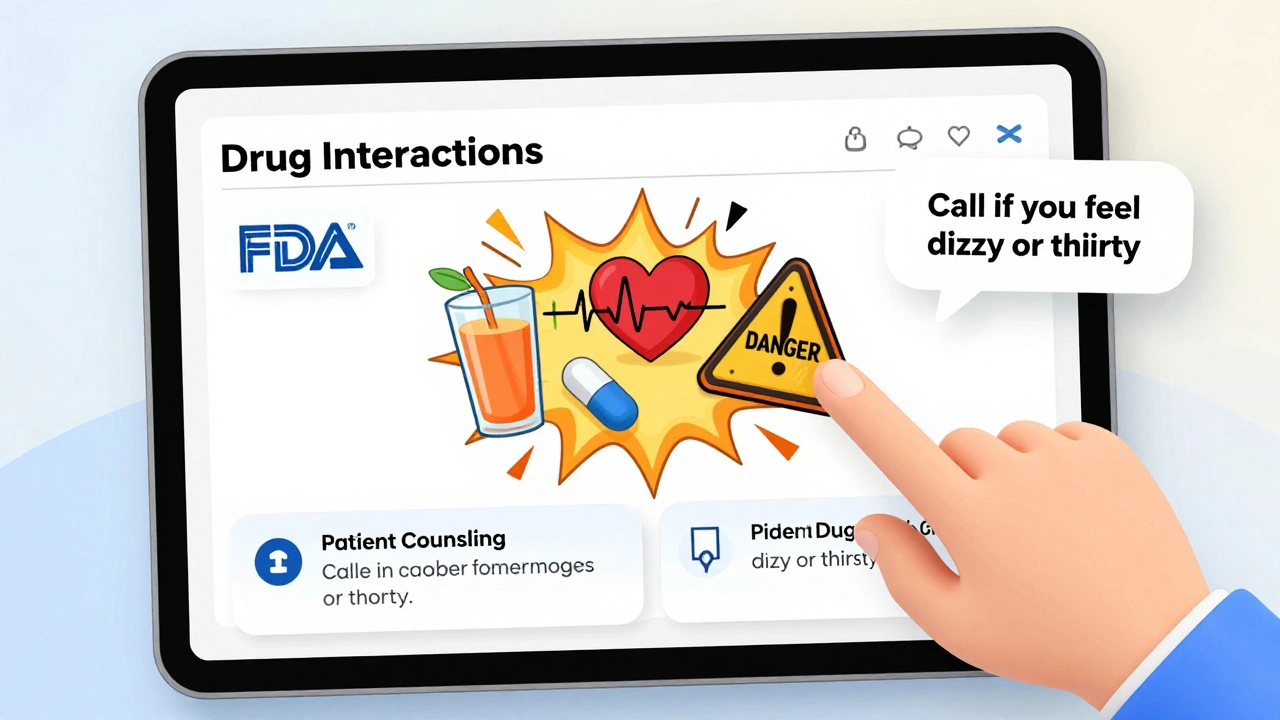
What’s Missing? The Description Section
You won’t find this in most patient materials, but it’s required in the full label. The Description section gives the chemical identity of the drug: its name, structure, molecular weight, and formulation. For example, Humira is described as "a recombinant human IgG1 monoclonal antibody." That’s not just science-it’s legal. If a generic version claims to be the same, it must match this description exactly. This section ensures biosimilars are truly equivalent. The FDA requires this to be included in both the Highlights and Full Labeling sections. In 2023, 92% of new drugs met this standard. The rest were flagged for correction before approval.How Labels Are Changing: The Digital Shift
Since 2007, all drug labels must be submitted in Structured Product Labeling (SPL) format-a digital, machine-readable format. This lets electronic health records pull key info automatically. It powers alerts in hospital systems: "This patient is on warfarin. Do not prescribe this NSAID." The FDA’s 2024 draft guidance proposes interactive labels-clickable sections, embedded videos, real-time updates. Pilots start in 2025. But there’s still a problem. In 2023, 43.6% of physicians said they had trouble finding specific info in labels during busy clinic hours. The FDA’s response? "Labeling for the Digital Age"-a plan to standardize section numbering and improve search in the Drugs@FDA database by 2026.Why This Matters to You
Whether you’re a patient, a caregiver, or a clinician, understanding these terms isn’t about memorizing jargon. It’s about safety. - A contraindication isn’t a suggestion-it’s a red line. - A precaution isn’t a warning-it’s a call to action. - An indication isn’t a general use-it’s a legal approval. The FDA doesn’t write these labels to confuse. They’re written to protect. And if you know what to look for, you can ask better questions, spot red flags, and make smarter decisions. The next time you get a new prescription, don’t just glance at the bottle. Look at the label. Read the small print. Ask your pharmacist: "What’s the contraindication? What should I watch for?" Because in medicine, the details save lives.What’s the difference between a contraindication and a precaution?
A contraindication means the drug should not be used at all because it could cause serious harm. For example, giving blood thinners to someone with active bleeding is a contraindication. A precaution means the drug can be used, but with caution-monitoring, dose adjustments, or extra testing are needed. For example, using a kidney-cleared drug in someone with mild kidney disease is a precaution. Contraindications are absolute. Precautions are conditional.
Why do drug labels have so much fine print?
The fine print isn’t there to overwhelm-it’s there to protect. Every line is legally required by the FDA and based on clinical data. Omitting a risk could lead to patient harm and legal liability for the manufacturer. The structure is designed so that the most critical information-like contraindications and boxed warnings-is easy to find, even in a busy clinic. The rest ensures comprehensive safety reporting.
Can a drug be prescribed for something not listed in the indications?
Yes. Doctors can prescribe drugs for uses not listed on the label-that’s called off-label use. But the FDA only approves a drug for the indications listed. Off-label prescribing is legal and common, especially in cancer and pediatric care. However, the label doesn’t support it. Patients should know that if a doctor prescribes a drug off-label, the safety and effectiveness data may be limited compared to the approved use.
What happens if a drug’s label changes after approval?
Manufacturers must submit label updates to the FDA when new safety data emerges. Most changes (97% between 2015-2020) happen through a Category 2 process, which allows updates without waiting for full re-review. These can include new warnings, dosage adjustments, or added contraindications. The FDA reviews these changes and approves them within 30-90 days. Once approved, pharmacies and providers are legally required to follow the updated label.
Are generic drugs required to have the same labeling as brand-name drugs?
Yes. Generic drugs must have the same active ingredient, strength, dosage form, and labeling as the brand-name version. The FDA requires this to ensure equivalent safety and effectiveness. The only differences allowed are in inactive ingredients (like fillers or dyes) and the manufacturer’s name. If the brand-name label changes, the generic must change too-within 18 months.


Comments (14)