
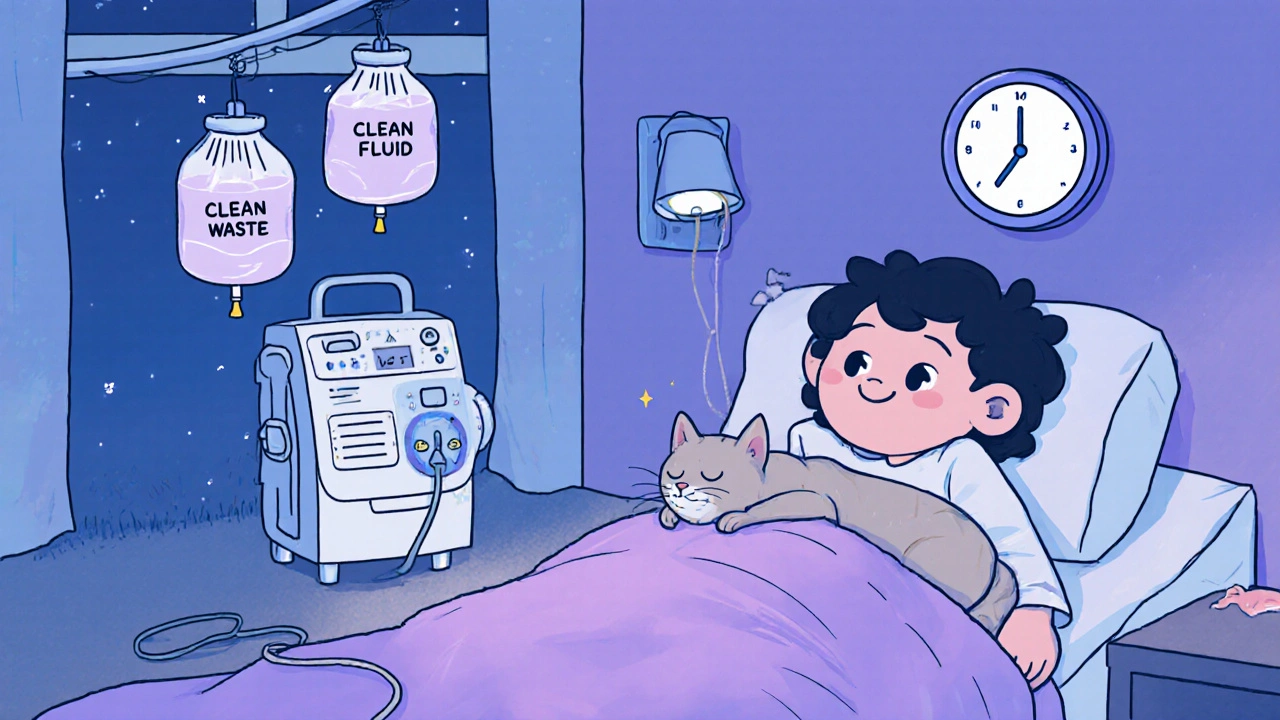
When your kidneys fail, your body can’t clean itself anymore. That’s when dialysis becomes life-saving.
Two main treatments exist: hemodialysis and peritoneal dialysis. Both remove waste and extra fluid from your blood, but they work in completely different ways. One uses a machine outside your body. The other uses the lining of your belly as a natural filter. Choosing between them isn’t about which is better overall-it’s about which fits your life, health, and goals.
How hemodialysis works: Machines do the work
Hemodialysis pulls your blood out of your body, cleans it through a filter called a dialyzer, and sends it back in. This happens in a clinic, usually three times a week, for 3 to 5 hours each session. You’re hooked up to a machine with needles in your arm, connected by tubes. The blood flows at 300-500 mL per minute. That’s fast. And it’s intense.
To make this possible, your doctor needs to create a vascular access. The best option is an arteriovenous (AV) fistula-a direct connection between an artery and vein in your arm. It takes 6 to 8 weeks to heal before it’s ready to use. If that’s not possible, a graft or a central catheter may be used. Catheters are quicker to set up but carry higher infection risks.
The big trade-off? You get clean blood quickly, but you pay for it later. Many people feel exhausted for hours after treatment. Blood pressure can drop suddenly. Fluid and potassium build up between sessions, leading to cravings, swelling, and heart strain. Studies show hemodialysis patients have higher rates of hospitalization for heart issues compared to those on peritoneal dialysis.
How peritoneal dialysis works: Your belly does the filtering
Peritoneal dialysis (PD) uses your peritoneum-the membrane lining your abdomen-as a natural filter. A soft, flexible catheter is surgically placed in your belly. It stays there permanently. You fill your belly with dialysis fluid, let it sit for 4 to 6 hours, then drain it out. The fluid pulls out waste and extra water through your abdominal wall.
There are two types: Continuous Ambulatory Peritoneal Dialysis (CAPD) and Automated Peritoneal Dialysis (APD). CAPD means you do 3 to 5 exchanges by hand every day, usually during normal activities. APD uses a machine-called a cycler-that does the exchanges while you sleep. You plug in at night, wake up with clean fluid out and waste gone.
Unlike hemodialysis, PD works slowly and continuously. That means fewer spikes in toxins and fluid. Blood pressure stays steadier. Studies from the First People’s Hospital of Tonglu County (2020-2021) showed PD patients had significantly lower systolic and diastolic blood pressure than hemodialysis patients. Their hearts didn’t have to work as hard.
Which one protects your kidneys longer?
One major advantage of PD is that it helps preserve your remaining kidney function. Hemodialysis can cause rapid shifts in fluid and chemicals that damage the tiny blood vessels in your kidneys. PD avoids those shocks. A 2023 study in PMC10626077 found PD patients kept more of their own kidney function over time.
That matters because even a little bit of natural kidney function improves survival, reduces fluid overload, and lowers the need for medications. For younger, healthier patients, keeping those last bits of kidney function can mean years of better quality of life.
Side effects and risks: What you might not expect
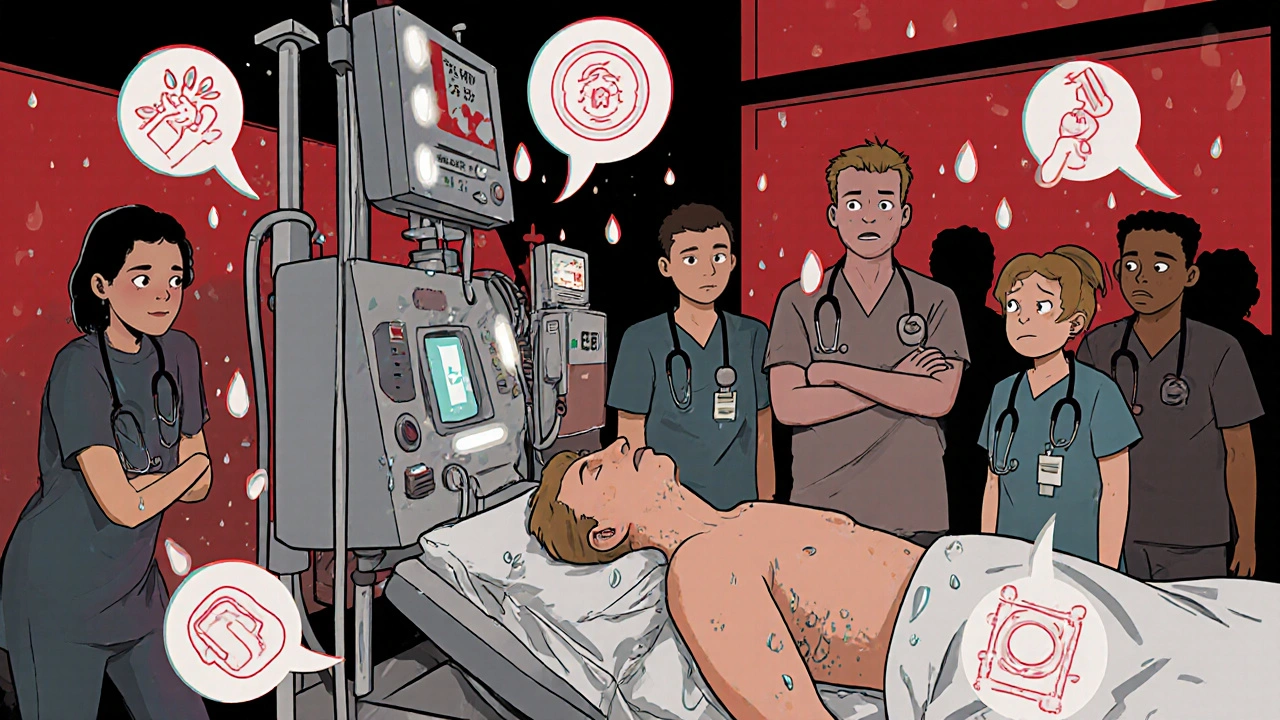
No dialysis is risk-free. Hemodialysis brings risks like low blood pressure during treatment, muscle cramps, and infections at the access site. AV fistulas can clot or become infected. Catheters are even riskier-about 1 in 5 patients get bloodstream infections from them.
Peritoneal dialysis has its own dangers. The biggest is peritonitis-an infection inside your belly. It happens when bacteria get in through the catheter or during exchanges. Rates are low-0.3 to 0.7 episodes per patient per year-but one infection can land you in the hospital. That’s why strict handwashing and sterile technique are non-negotiable.
PD also isn’t for everyone. If you’ve had major abdominal surgery, you might have scar tissue that blocks fluid flow. If you’re morbidly obese (BMI over 35), it’s harder to do exchanges safely. If you have arthritis, tremors, or poor eyesight, handling the bags and tubes might be too hard.
Lifestyle impact: Flexibility vs. routine
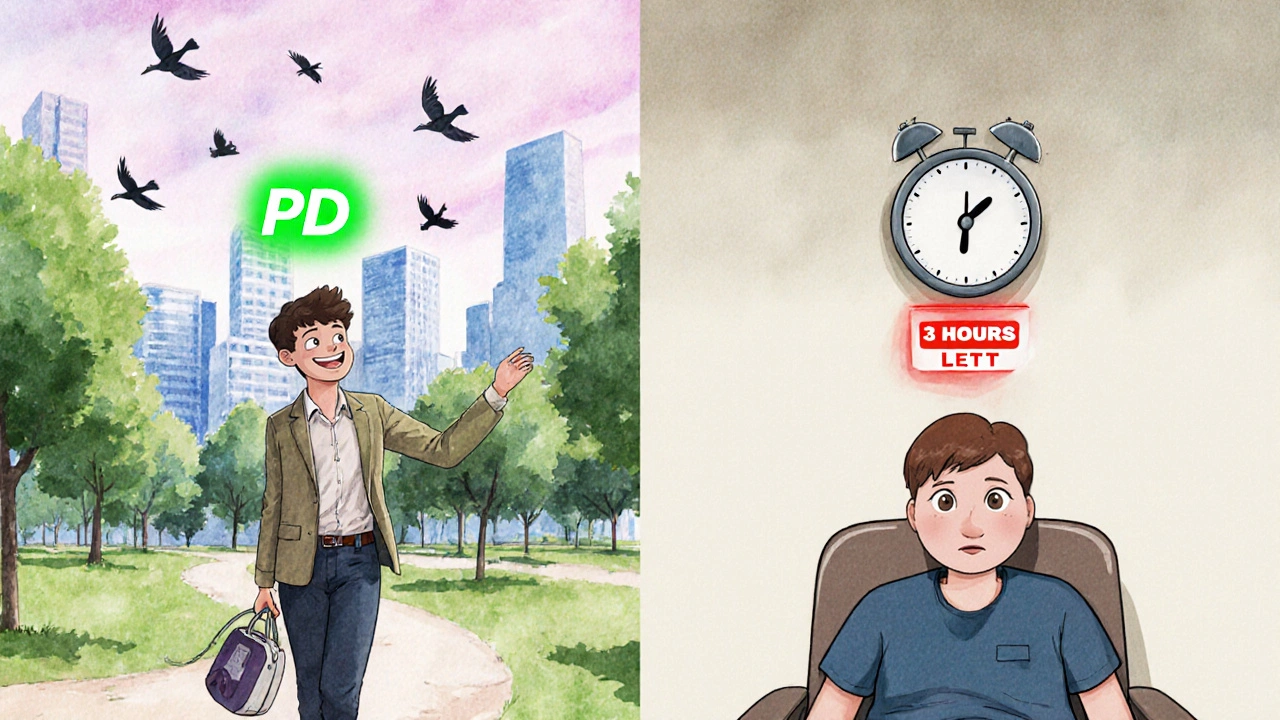
If you hate being tied to a schedule, PD wins. You can do exchanges at home, at work, even while traveling. No more three-day-a-week clinic visits. You can work, go to school, or take care of kids without rearranging your life around dialysis.
But PD demands discipline. You need to do 3 to 5 exchanges every day. You need space to store dialysis fluid bags. You need to be able to follow a strict hygiene routine. If you’re not comfortable managing your own care, this can feel overwhelming.
Hemodialysis is the opposite. The clinic staff handles everything. You sit, relax, read, or nap. But you’re locked into their schedule. Miss a session? You feel terrible. Travel? You have to plan months ahead to find a dialysis center. Many patients say the biggest complaint isn’t the treatment-it’s the lack of freedom.
Cost and accessibility: Why PD is underused
Despite its benefits, only about 10-12% of dialysis patients in the U.S. use PD. Why? Because hemodialysis has been the default for decades. Clinics are everywhere. Doctors are trained to push it. Insurance systems are built around it.
But PD is cheaper. A 2023 study in the Journal of Peritoneal Therapy and Clinical Practice found PD offers better value for money. It reduces hospital stays, avoids costly vascular access surgeries, and lowers long-term complications. In countries like Hong Kong and the UK, over 20% of patients use PD. In the U.S., it’s still under 12%.
Part of the problem? Training. Only 34% of U.S. nephrology fellows get proper PD training. Many doctors don’t know how to teach it well-or don’t believe it’s as effective. That’s changing. The Centers for Medicare & Medicaid Services now pushes home dialysis, aiming for 80% of new patients to get education on PD or transplant by 2025.
Who should choose which?
There’s no one-size-fits-all. But here’s a simple guide:
- Choose PD if: You’re medically stable, want independence, can manage daily care, have no major abdominal scarring, and prefer home-based treatment.
- Choose hemodialysis if: You have severe heart problems, can’t do sterile exchanges safely, have advanced age with limited mobility, or prefer letting professionals handle everything.
Some people start with PD and switch to HD later. Others try HD first and move to PD once they’re comfortable. It’s not a forever decision. Your needs change. Your health changes. Your life changes.
What’s next for dialysis?
Technology is improving both options. New PD fluids like icodextrin last longer and cause less damage to the belly lining. Automated dialysis machines are smarter, quieter, and easier to use. Home hemodialysis is growing too-faster, gentler treatments done at night.
But the real shift? It’s not about machines. It’s about choice. More patients are asking: “What fits my life?” Not “What’s the most common?”
That’s why the future of dialysis isn’t about picking one over the other. It’s about matching the right tool to the right person. And that starts with knowing your options-really knowing them.
Can you switch from hemodialysis to peritoneal dialysis?
Yes, many people switch. If you’re on hemodialysis and want more flexibility, or if you’re having problems with your vascular access, PD can be a good next step. You’ll need to be medically stable and have no abdominal scarring. Your care team will help you transition, usually over a few weeks, with training and catheter placement.
Is peritoneal dialysis painful?
The catheter placement is done under local anesthesia, so you won’t feel pain during surgery. Afterward, there’s some soreness for a few days. During exchanges, you might feel pressure or fullness, but it shouldn’t hurt. If you feel sharp pain during fluid exchange, stop and call your doctor-it could be a sign of infection or catheter misplacement.
How long can you live on peritoneal dialysis?
Life expectancy on PD is similar to hemodialysis for most patients. Studies show no consistent survival advantage for either method over the long term. But PD patients often have fewer hospital stays, better blood pressure control, and better quality of life. How long you live depends more on your age, other health conditions, and how well you follow your treatment plan than on the type of dialysis you choose.
Do you need to follow a special diet on peritoneal dialysis?
Yes, but it’s different than with hemodialysis. Because PD removes waste slowly, you can usually eat more potassium-rich foods like bananas and potatoes. But PD fluid contains sugar, which can raise your blood sugar and cause weight gain. You’ll need to watch calories, salt, and fluids more closely. A renal dietitian will help you adjust your meals based on your lab results and treatment type.
Can you travel with peritoneal dialysis?
Absolutely. Many PD patients travel regularly. You can pack dialysis fluid in coolers or ship it ahead. For APD users, the cycler is small and portable. You’ll need to plan for storage and sterile conditions wherever you go, but there’s no need to find a dialysis center. Some patients even do exchanges in hotel rooms or on planes-using portable supplies and following strict hygiene rules.
Is peritoneal dialysis better than a kidney transplant?
A transplant is still the best option for most people with kidney failure. It restores normal kidney function, eliminates the need for dialysis, and improves survival and quality of life. But not everyone is eligible. If you’re waiting for a transplant, PD is often the best bridge-it keeps you healthier and more active while you wait. Many transplant centers prefer patients to be on PD before transplant because it preserves blood vessels and overall health better than hemodialysis.
Final thought: It’s your body, your choice
Dialysis isn’t a cure. But it’s not just a stopgap, either. It’s a way to keep living. And how you live matters. Whether you choose the machine or your belly, the goal is the same: more time, more control, more life.


Comments (9)