
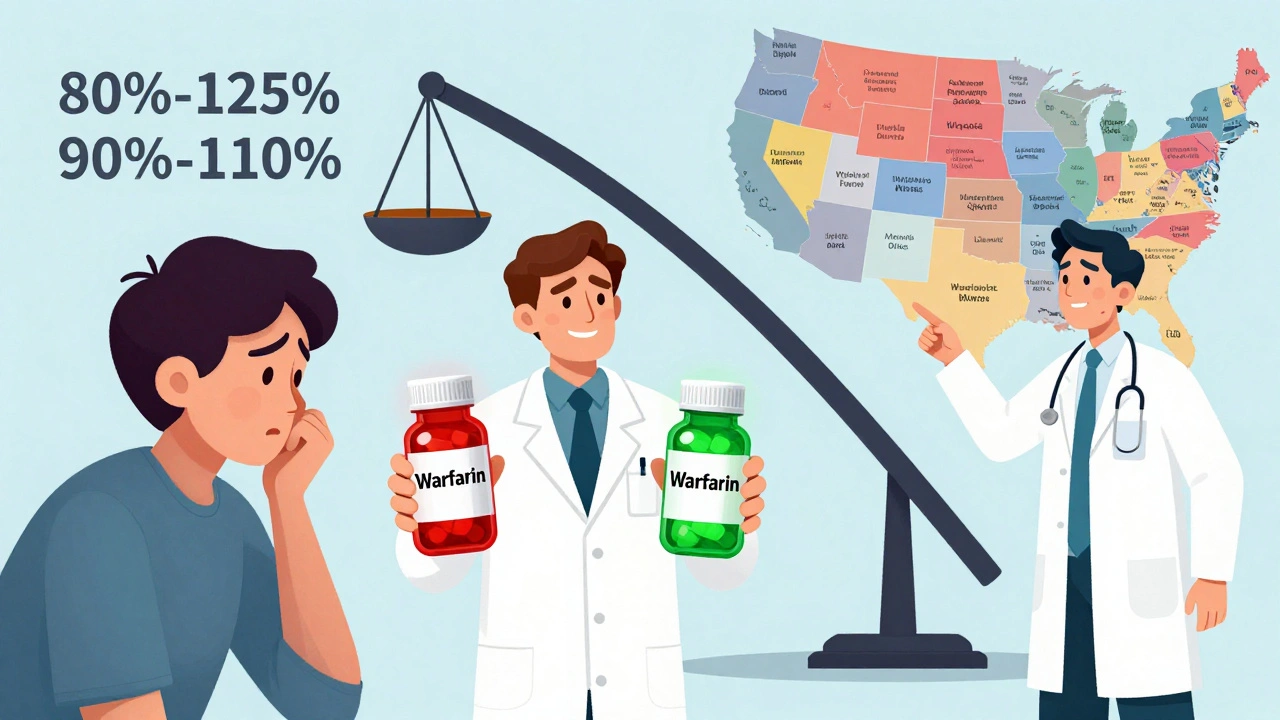
NTI generics aren’t just another type of generic drug. They’re the ones where a tiny change in dosage can mean the difference between healing and hospitalization. Think warfarin, phenytoin, levothyroxine, or digoxin. These drugs have razor-thin safety margins. If the generic version isn’t exactly right - even a 5% difference in absorption - patients can suffer seizures, blood clots, or thyroid crashes. That’s why regulators around the world treat them differently than regular generics.
Why NTI Generics Need Special Rules
Most generic drugs are approved using standard bioequivalence criteria: 80% to 125% similarity in blood levels compared to the brand-name drug. That’s fine for antibiotics or blood pressure pills where the body can handle some variation. But for NTI drugs, that range is too wide. A patient on warfarin who gets a slightly more potent generic might develop internal bleeding. Another on levothyroxine might end up with a heart rate too high or too low.
The FDA first laid out specific rules for NTI generics in 2010 after reviewing cases where patients had adverse events following generic switches. Their conclusion? The same standards used for other generics simply don’t cut it. Since then, the U.S. has required tighter limits - often 90% to 110% for bioequivalence, and sometimes even narrower. The quality control for active ingredient content is also stricter: 95% to 105% instead of the usual 90% to 110%.
The U.S. Approach: Tight Limits, Patchwork Rules
The FDA is the strictest regulator when it comes to testing NTI generics. They require more volunteers in bioequivalence studies, use more sensitive analytical methods, and often demand multiple-dose studies instead of single-dose. Healthy volunteers are preferred over patients to remove clinical variability from the equation.
But approval isn’t the end of the story. Once a generic is on the market, states get to decide if pharmacists can substitute it for the brand. Twenty-six U.S. states have special laws for NTI drugs. North Carolina requires both the doctor and patient to sign off before switching. Connecticut and Illinois demand extra notifications for anti-seizure meds. Some states even ban substitution entirely for certain NTI drugs.
That creates confusion. A 2019 survey found 67% of U.S. pharmacists get calls from doctors asking them not to substitute NTI generics. Patients on levothyroxine report thyroid level swings after switching - even when the FDA says the generic is equivalent. One pharmacist on Reddit wrote: “I’ve had three cases this year where patients’ TSH levels jumped after a generic switch. The FDA says it’s fine. Their doctor says it’s not.”
Europe: Fragmented but Harmonizing
The European Medicines Agency (EMA) doesn’t have one single rulebook for all 27 member states. Instead, companies can choose between three paths: the Centralized Procedure (CP), National Procedure (NP), or Mutual Recognition. The CP is the gold standard - it’s reviewed by EMA experts and approved across all EU countries. But it’s voluntary for most generics, and only 68% of new NTI applications used it in 2022, up from 42% in 2018.
Even when approved centrally, pricing rules vary wildly. In Spain, the first generic must be priced at least 40% below the brand. Other generics follow at or below that price. In Germany and Denmark, prices are negotiated freely. Meanwhile, 24 of 27 EU countries cap generic prices based on the original brand drug’s cost.
Pharmacists across Europe face the same problem as in the U.S.: inconsistent rules. A 2022 survey by the European Association of Hospital Pharmacists found 58% of respondents were unsure if they could substitute a generic approved under the Decentralized Procedure versus one approved nationally. Patients don’t know what’s allowed. Doctors don’t know what’s safe. The system is technically advanced but operationally messy.
Canada and Japan: Pragmatic but Precise
Health Canada takes a flexible approach. They’ll accept a foreign brand-name drug as the reference product for bioequivalence studies - if it matches the Canadian version in formulation, solubility, and dissolution profile. That’s a smart workaround when the local brand isn’t available. They also require multi-point dissolution testing, which shows how the drug releases over time - critical for extended-release NTI drugs.
Japan’s Pharmaceuticals and Medical Devices Agency (PMDA) is equally meticulous. They’ve published detailed guidance for topical NTI products - something only a handful of countries have done. Their focus is on consistency across batches and long-term stability. Stress testing under heat, humidity, and light is mandatory. Their approval timelines are longer than the FDA’s, but rejection rates are lower because companies know exactly what’s expected.
Global Efforts to Align Standards
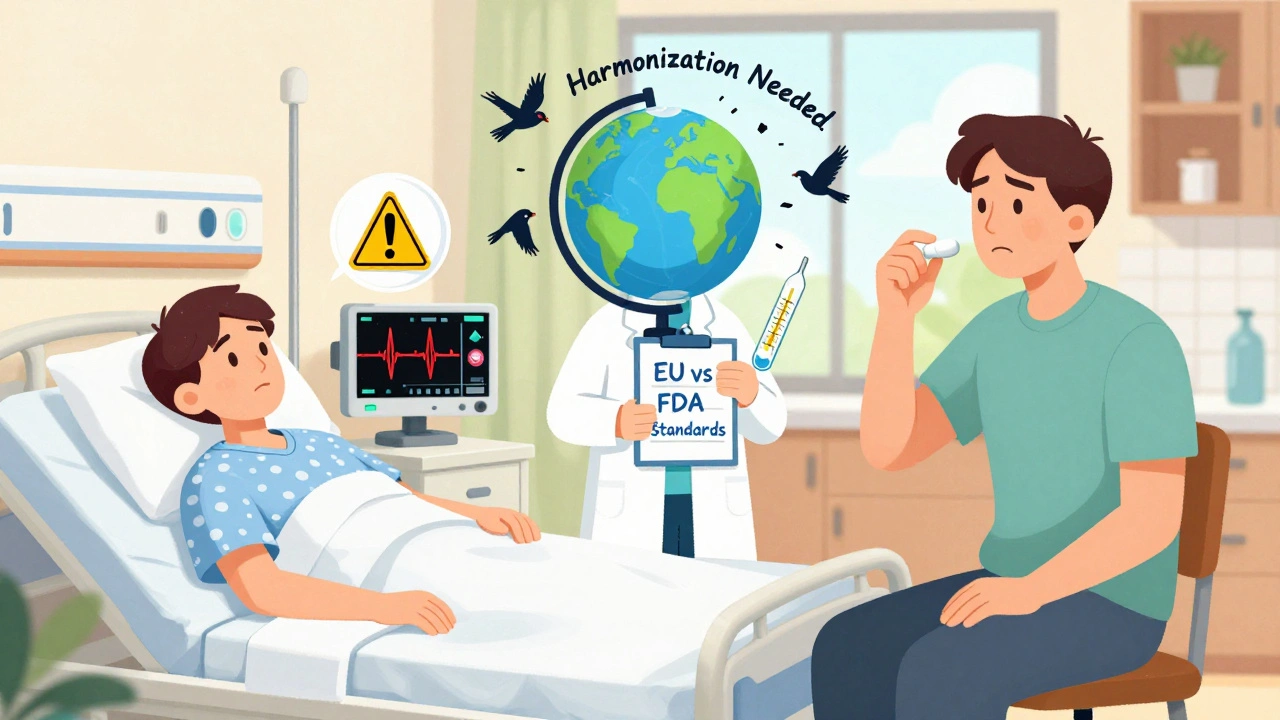
Recognizing the risks of mismatched rules, regulators from the U.S., EU, Canada, Japan, South Korea, Switzerland, Singapore, and Taiwan formed the International Generic Drug Regulators Pilot (IGDRP) in 2012. Their goal? Harmonize testing methods and acceptance criteria.
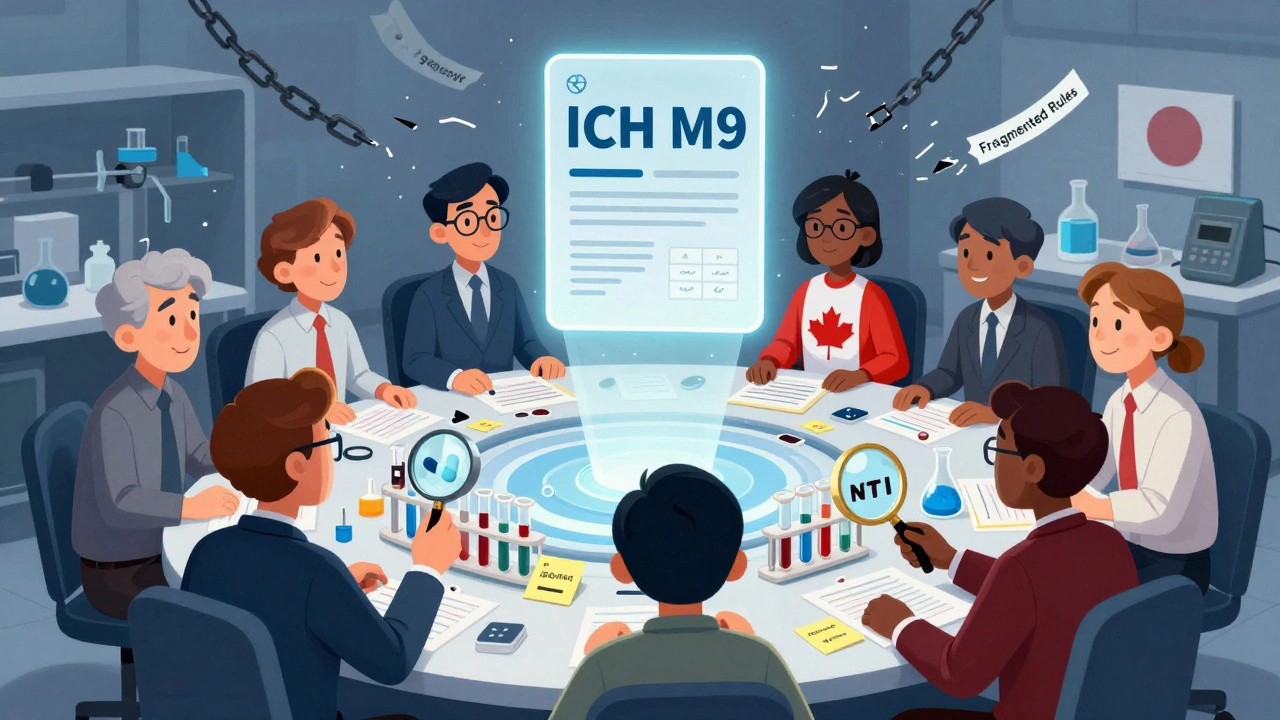
Progress has been slow but real. In 2023, the International Council for Harmonisation (ICH) adopted ICH M9, a new guideline on using biopharmaceutics classification to waive bioequivalence studies for certain drugs. While not yet fully applied to NTI drugs, it’s a step toward smarter, science-based approvals.
The FDA’s GDUFA III, launched in early 2023, includes new requirements for post-market monitoring of NTI generics. That means more real-world data on patient outcomes - not just lab results. The EMA is also moving toward more centralized approvals, reducing the burden on companies and improving consistency.
The Cost and Time of Getting NTI Generics Right
Developing a regular generic takes 12 to 18 months and $2 to $4 million. For NTI generics? It’s 18 to 24 months and $5 to $7 million. Why? More complex studies. More batches tested. More analytical validation. More regulatory meetings.
Companies that skip early engagement with regulators pay dearly. A 2021 recall of nitrosamine-contaminated antihypertensive generics - many of which were NTI drugs - cost manufacturers hundreds of millions. Experts now advise early talks with the FDA’s Complex Generic Drug Product Development Meetings or EMA’s Scientific Advice program. Those meetings can cut approval time by 30 to 45 days.
Market Reality: Growth Amid Risk
The global NTI generics market hit $48.7 billion in 2022 and is expected to grow to $72.3 billion by 2027. The U.S. leads with 42% of sales, followed by Europe at 34%. Teva dominates the market with nearly 19% share, followed by Mylan and Sandoz.
But adoption isn’t uniform. Warfarin generics are used in 92% of U.S. prescriptions. Levothyroxine? Only 67%. Why? Prescribers still don’t trust the generics. Even when studies show clinical equivalence - like the 2021 IMS Institute study that found 94.7% success rates across 15 European countries - skepticism lingers.
What’s Next? Better Science, Fewer Surprises
The future of NTI generics lies in smarter science. The FDA plans to adopt population bioequivalence methods by 2025. Instead of testing 24 healthy volunteers, they’ll use statistical models to predict how a drug behaves across a diverse population. That could reduce the need for large, expensive trials.
Experts agree: harmonization is the key to safer, cheaper access. If every major regulator used the same testing standards, companies wouldn’t need five different dossiers. Patients wouldn’t get different versions depending on where they live. Pharmacists wouldn’t be caught in the middle.
Right now, NTI generics are a triumph of science and a failure of coordination. The technology to make them safe exists. The data proves they work. What’s missing is a unified system that lets patients get the right medicine - no matter where they are.


Comments (8)