
When you start a new medication, it’s normal to feel unsure about what’s happening in your body. Maybe you got a rash. Or felt dizzy. Or your stomach got upset. You might think, Is this an allergy? Or just a side effect? The difference matters more than you think - and how you talk about it with your care team can change your treatment, your health, and even your future medication options.
Side effects and allergic reactions are not the same thing. Yet, many people use the word "allergy" to describe any uncomfortable reaction. That’s a problem. Mislabeling a side effect as an allergy can lead to worse outcomes - like being put on stronger antibiotics, getting stuck with less effective drugs, or even missing out on a treatment that could work perfectly for you.
What’s the real difference?
A side effect is a known, predictable reaction to a drug. It doesn’t involve your immune system. It’s just your body responding to the chemistry of the medicine. For example, statins (used for cholesterol) can cause muscle aches in 5-10% of people. Antibiotics like amoxicillin often cause diarrhea or nausea in 15-30% of users. These aren’t dangerous in most cases - they’re just annoying. And here’s the good news: 60-70% of initial side effects go away on their own within 2-4 weeks as your body adjusts.
An allergic reaction is your immune system overreacting. It’s not about dosage. Even a tiny amount can trigger it. Symptoms include hives, swelling of the lips or tongue, trouble breathing, or a sudden drop in blood pressure. These are medical emergencies. If you’ve ever had anaphylaxis after a medication, you need to avoid it forever.
Penicillin is the classic example. About 10% of Americans say they’re allergic to it. But studies show 90% of those people can actually take penicillin safely after proper testing. Why? Because they mistook a rash from a virus or a mild side effect for an allergy. That mislabeling leads to 63% more use of broad-spectrum antibiotics - which fuels antibiotic resistance and increases your risk of dangerous infections like C. diff.
How to tell them apart
Timing and symptoms are your best clues.
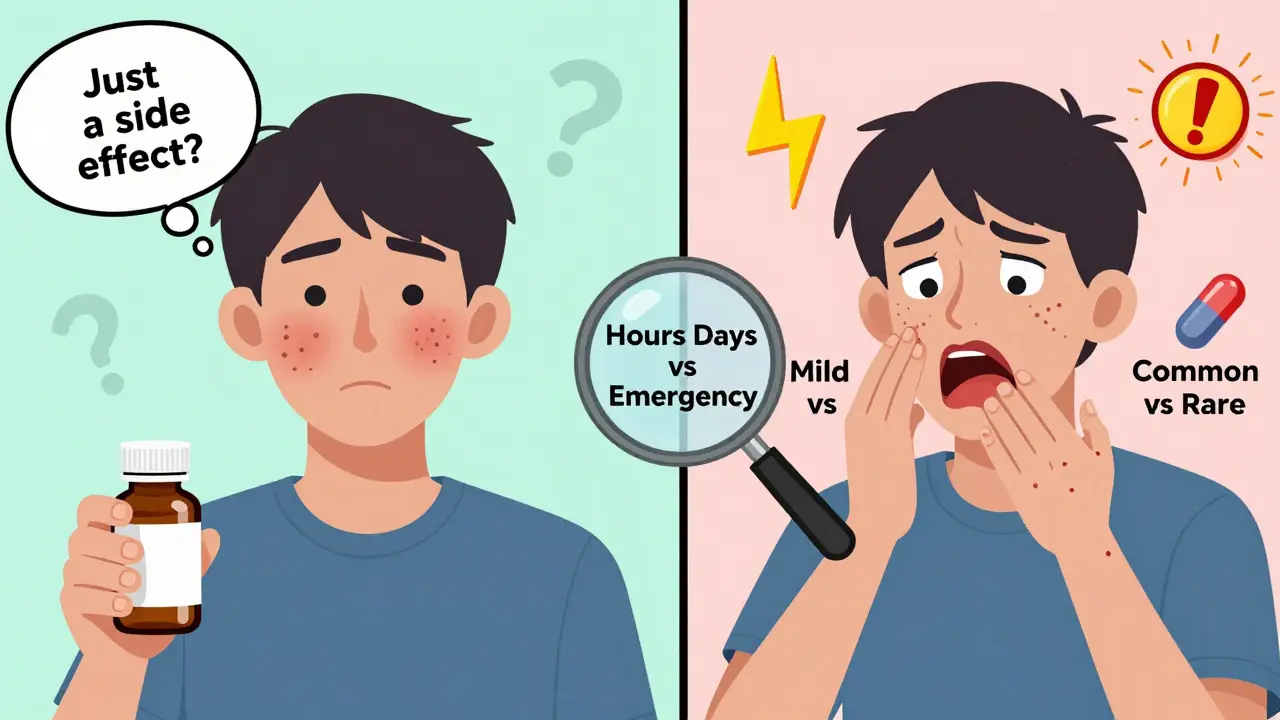
- Side effects usually show up within hours or days of starting the drug. They’re often mild and get better over time. Think: nausea, drowsiness, dry mouth, headache, or mild rash that doesn’t spread.
- Allergic reactions hit fast - often within minutes to a few hours. They’re more dramatic: itching, swelling, hives, wheezing, or a feeling like your throat is closing. If you’ve ever felt like you couldn’t breathe after taking a pill, that’s not a side effect. That’s an allergy.
Also, side effects usually come back every time you take the drug. Allergies can get worse with each exposure. A rash from a side effect might fade if you skip a dose. An allergic rash? It’ll come back - and might get worse.
What to say to your doctor
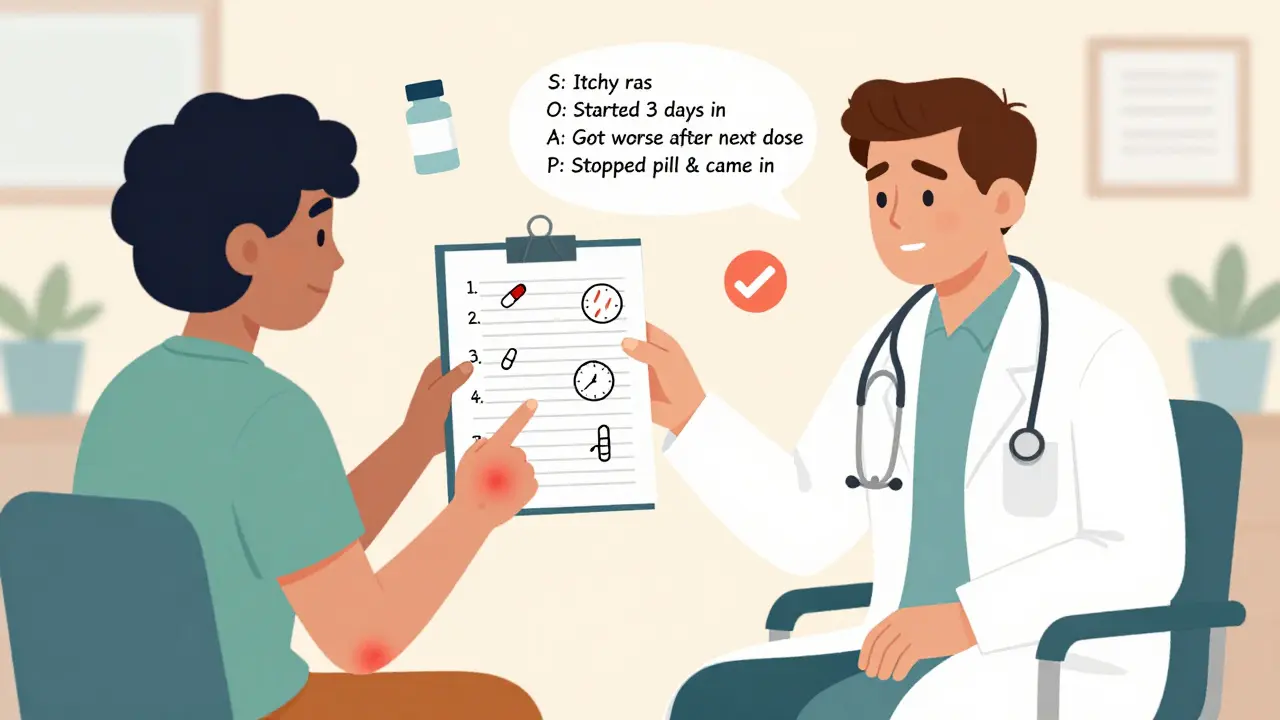
Don’t just say, “I had an allergic reaction.” That’s too vague. Doctors hear that all the time - and they can’t tell if it’s real or not. Instead, be specific. Use this simple structure:
- Name the medication - exactly what you took, including the dose. Don’t say “that pill.” Say “50 mg of metoprolol taken on March 1.”
- Describe the symptom - not just “I felt bad.” Say: “I got a red, itchy rash on my arms,” or “I felt like my tongue was swelling,” or “I had nausea and vomiting for two days.”
- Timing matters - “It started 30 minutes after I took the pill,” or “It began on day 5 of treatment.”
- What happened after? - “The rash went away after I skipped the next dose,” or “I went to the ER because I couldn’t breathe.”
That’s the S.O.A.P. method: Subjective (what you felt), Objective (what you saw), Assessment (when it happened), Plan (what you did or want to do next). Patients who use this method are 41% more likely to get accurate advice from their provider.
Bring proof, not just stories
Memory is unreliable. People forget dates, doses, or symptoms. That’s why bringing your medication bottles to appointments helps. Seeing the exact name, dose, and manufacturer cuts confusion. Studies show this reduces errors by 28%.
Even better: keep a symptom log. For three days before your appointment, write down:
- When you took each medication
- What symptoms you had
- How bad they were (on a scale of 1-10)
- How long they lasted
- Whether they got better after skipping a dose
Patients who do this are 3.2 times more likely to get the right treatment. One woman in Sydney thought she was allergic to her blood pressure pill because she got headaches. Her log showed the headaches only happened on days she took the pill - and disappeared when she skipped a dose. Her doctor switched her to a different class of medication. No more headaches. No mislabeled allergy.
Ask the right questions
Your care team can’t read your mind. Ask these directly:
- “Is this symptom a known side effect of this medication? How common is it?”
- “Could this be an allergic reaction? What symptoms should I watch for that mean I need to stop immediately?”
- “Are there other medications in a different chemical class that might work instead?”
- “If I had a rash, is it possible it was from a virus, not the drug?”
- “Can I be tested to confirm if this is a true allergy?”
These questions aren’t just polite - they’re lifesavers. Research shows patients who ask them reduce mislabeling by 45%.

The cost of confusion
Misunderstanding side effects vs. allergies doesn’t just hurt your health - it hurts the system. When someone is wrongly labeled as penicillin-allergic, they’re often given stronger, more expensive antibiotics. That drives up costs by $1,200-$2,500 per person each year. It also increases antibiotic resistance - a global health threat.
Hospitals are catching on. Many now use electronic alerts to flag unclear allergy entries. One study found that using a structured interview - asking about rash timing, location, and symptoms - reduced penicillin allergy mislabeling by 62%.
And here’s something you might not know: the FDA now requires patient medication guides to clearly separate side effects (common, expected) from allergic reactions (dangerous, immediate). That means your pill bottle or pharmacy handout should already tell you what’s normal and what’s not.
What to do next
Don’t wait until you’re in a crisis to sort this out. If you’ve ever had a reaction to a medication - even a mild one - take action:
- Start a symptom log today. Just a few notes each day.
- Bring all your pill bottles to your next appointment.
- Write down the questions above and ask them.
- If you’ve been told you’re allergic to penicillin or another common antibiotic - ask if you can be tested. A simple skin test can clear up years of confusion.
You’re not just a patient. You’re the expert on your own body. The more clearly you describe what’s happening, the better your care will be. And that’s how you stop being a statistic - and start taking control.
Can I outgrow a drug allergy?
Yes, especially with penicillin. Many people are labeled allergic as children after a rash from a virus, and never get tested again. Studies show up to 80% of those people lose their allergy over 10 years. A simple skin test by an allergist can confirm whether it’s still active. If it’s gone, you can safely use penicillin again - and avoid unnecessary antibiotics.
What if my doctor says it’s just a side effect, but I’m still worried?
It’s okay to ask for a second opinion or a referral to a specialist. If a symptom is affecting your quality of life - even if it’s "common" - you deserve better. Ask if there’s a different medication in another class. For example, if statins cause muscle pain, you might switch to ezetimibe or a PCSK9 inhibitor. Don’t accept "it’s normal" as the only answer.
Can I have an allergic reaction to a medication I’ve taken before?
Yes. Allergies can develop at any time, even after years of safe use. Your immune system can suddenly start reacting. That’s why it’s important to report new symptoms - even if you’ve taken the drug before. Don’t assume safety just because you’ve used it before.
Do all rashes from medications mean an allergy?
No. Many rashes are side effects - especially with antibiotics. A flat, red, non-itchy rash that appears after several days is often a non-allergic reaction. A raised, itchy, spreading rash that comes on quickly is more likely to be allergic. If you’re unsure, take a photo and show it to your provider. Timing and appearance matter more than the word "rash."
Is there a tool to help me track this?
Yes. The American Pharmacists Association launched the "Medication Reaction Tracker" app in January 2023. It guides you through logging symptoms, timing, and severity using clinical criteria. It’s free, available on iOS and Android, and has helped over 87,000 users distinguish side effects from true allergies.


Comments (10)