
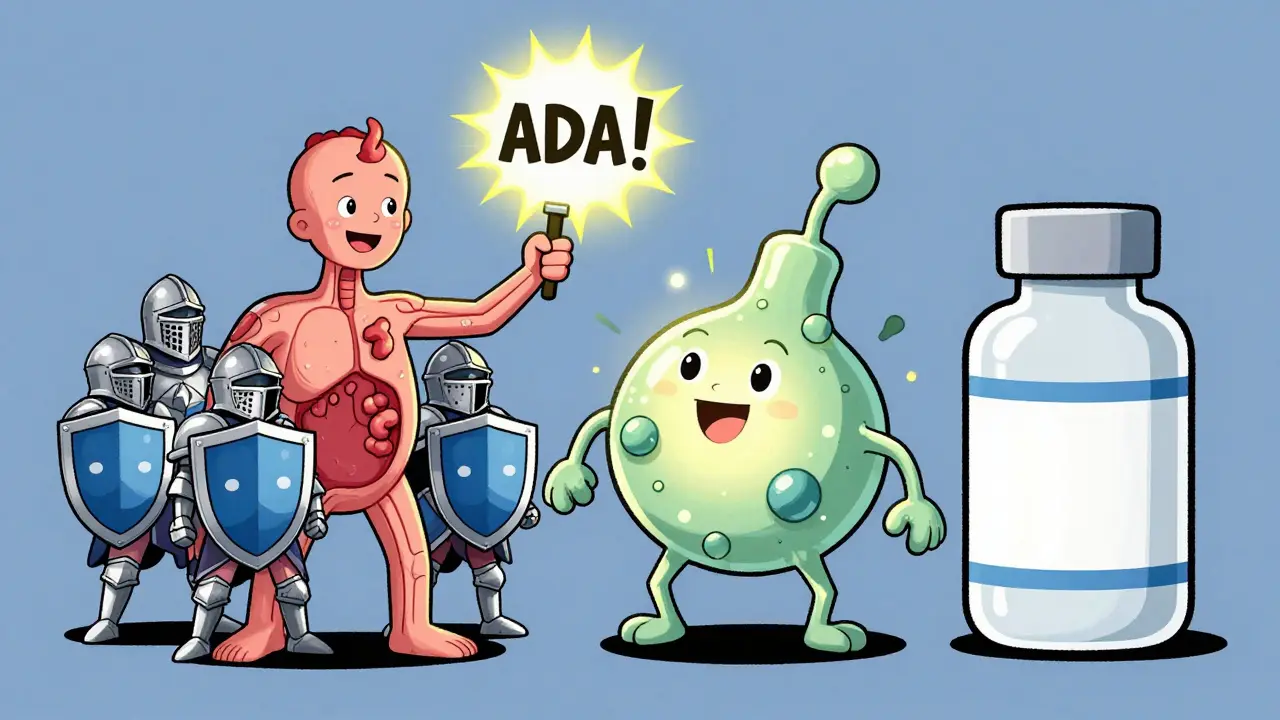
When you hear the word biosimilar, you might think it’s just like a generic drug-cheaper, same effect, no surprises. But that’s not quite right. Unlike small-molecule generics that are chemically identical to their brand-name versions, biosimilars are made from living cells. That means even tiny differences in how they’re made can change how your body reacts to them. One of the biggest concerns? Immunogenicity-your immune system deciding to fight back against a drug meant to help you.
What Is Immunogenicity, Really?
Immunogenicity is when your body sees a biologic drug as a threat and starts making antibodies against it. These are called anti-drug antibodies, or ADAs. They don’t always cause problems. Sometimes they just show up on a lab test and do nothing. But sometimes, they stick to the drug and block it from working. Or worse-they trigger a reaction like swelling, rash, or even anaphylaxis. This doesn’t happen with most generics. A pill with the same chemical structure every time? Your immune system doesn’t care. But a protein made in a lab using hamster or human cells? That’s a whole different story. Even a small change in sugar molecules attached to the protein-called glycosylation-can make your immune system notice it’s not quite the same as the original.Why Do Biosimilars Trigger Different Responses?
It’s not about being "bad" or "unsafe." It’s about biology being messy. Here’s what can cause differences:- Manufacturing differences: Biosimilars are made in bioreactors using living cells. If one company uses Chinese hamster ovary cells and another uses human cell lines, the sugar patterns on the protein can vary slightly. Even a 5% difference in sialic acid or galactose can change how the drug behaves in your body.
- Impurities: Tiny bits of leftover host cell proteins (from the cells used to make the drug) can sneak in. If there’s more than 100 parts per million, studies show ADA rates jump by 87%. That’s not a lot-but it’s enough to matter.
- Formulation: The liquid in the syringe matters too. One biosimilar might use polysorbate 80 as a stabilizer, while the original uses polysorbate 20. These can affect how the protein folds or clumps, and clumps? They’re a red flag for the immune system.
- Storage and handling: If a biosimilar is exposed to heat or shaken too much during transport, proteins can unfold or aggregate. That’s like waving a flag in front of your immune cells saying, "Hey, something’s off here."
Compare that to a generic pill. It’s the same molecule, made the same way, every time. No living cells. No sugars. No proteins folding wrong. No surprises.
How Your Body Reacts Matters Too
It’s not just the drug. Your body plays a huge role. Two people can get the same biosimilar and have totally different outcomes.- Disease state: People with rheumatoid arthritis have 2.3 times higher risk of making ADAs than healthy volunteers. Their immune systems are already on high alert.
- Genetics: If you carry the HLA-DRB1*04:01 gene variant, your risk of developing ADAs to certain biologics jumps nearly fivefold.
- Other meds: Taking methotrexate with a TNF inhibitor cuts ADA risk by 65%. It’s like putting a brake on your immune system.
- How you get the drug: Injecting under the skin (subcutaneous) leads to 30-50% more immunogenicity than getting it through an IV. Why? The skin is packed with immune cells waiting to react.
- Duration of treatment: The longer you’re on the drug, the more likely your immune system is to notice it. After six months, tolerance starts to break down.
So even if two biosimilars are structurally nearly identical, one might trigger more ADAs in a patient with arthritis and the HLA variant, while the other doesn’t bother someone on methotrexate with normal genes.

What Do the Studies Say?
Real-world data is mixed, and that’s the point.In 2021, a study of over 1,200 rheumatoid arthritis patients found no meaningful difference in ADA rates between the original infliximab and its biosimilar CT-P13. Both hovered around 12%. Another trial, NOR-SWITCH, followed 481 people who switched from the originator to the biosimilar. ADA rates went up slightly-11.2% vs. 8.5%-but no one had worse symptoms or more side effects.
But then came the Danish registry data on adalimumab. The original Humira had a 18.7% ADA rate. The biosimilar Amgevita? 23.4%. The difference was statistically significant. Yet, both groups still had similar disease control. No drop in effectiveness. No spike in serious side effects.
And then there are patient stories. On Reddit, one person described severe injection site reactions after switching from Humira to a biosimilar. Another said they switched back and forth between originator and biosimilar rituximab for three years and felt zero difference.
That’s the pattern: statistically detectable differences in antibody levels don’t always mean clinically meaningful differences in outcomes. The immune system is complex. Sometimes it notices, sometimes it doesn’t. And sometimes, even when it notices, it doesn’t care.
How Do Regulators Handle This?
The FDA and EMA don’t just say "it’s similar enough." They demand proof. Here’s what biosimilar makers must show:- Head-to-head analytical studies comparing protein structure, purity, and function.
- Animal studies to check toxicity.
- Clinical trials with immunogenicity as a key endpoint.
- Identical assay methods to compare ADA rates between biosimilar and reference product.
They use tiered testing: first screen for any antibodies, then confirm they’re real, then check if they block the drug (neutralizing antibodies). The gold standard? Cell-based assays that mimic how the drug works in your body-even though they’re less precise than lab tests.
And here’s the catch: if one study uses a super-sensitive electrochemiluminescence (ECL) assay and another uses a basic ELISA, you can’t compare them. That’s why regulators insist on identical methods in comparative trials. Otherwise, you’re not measuring the drug-you’re measuring the test.

The Bigger Picture: Are Biosimilars Safe?
Yes. For the vast majority of people, biosimilars are safe and effective. Over 40 have been approved in the U.S. alone. In Europe, 85% of infliximab prescriptions are now biosimilars. And patients aren’t dropping out. They’re saving money-sometimes 80% less than the original.The real issue isn’t safety. It’s perception. Some doctors still hesitate. Some patients worry. And that’s understandable. You’re not just taking a pill. You’re getting a complex biological product that your body might react to in ways we’re still learning to predict.
But the evidence keeps growing. More real-world data. Better testing. Improved manufacturing. By 2027, advanced mass spectrometry will let manufacturers check sugar patterns on proteins with 99.5% accuracy. That means fewer surprises.
Right now, the message is simple: Immunogenicity differences can exist, but they rarely lead to clinical problems. The goal isn’t to make biosimilars identical to the original. It’s to make them similar enough that your body can’t tell the difference-and your health doesn’t suffer for it.
What Should Patients and Doctors Do?
If you’re considering switching to a biosimilar:- Ask about the specific biosimilar. Not all are made the same way.
- Check if you’re on methotrexate or another immunosuppressant. That lowers risk.
- Monitor for new side effects-especially injection site reactions, fatigue, or rashes-after switching.
- Don’t panic if an ADA test comes back positive. Most don’t affect outcomes.
- If you feel worse after switching, talk to your doctor. It might be coincidence. Or it might be worth switching back.
For doctors: Don’t assume biosimilars are risk-free. Track your patients. Use consistent testing methods. And remember: immunogenicity isn’t a yes-or-no question. It’s a spectrum.
Can biosimilars cause more side effects than the original biologic?
In most cases, no. Clinical trials and real-world studies show that overall side effect rates are nearly identical between biosimilars and their reference products. However, some patients report new or different reactions-like injection site pain or mild rashes-after switching. These are usually mild and temporary. If symptoms are severe or persistent, switching back to the original product is an option.
Do all biosimilars have the same risk of immunogenicity?
No. Immunogenicity risk varies based on manufacturing, formulation, and the specific biologic. For example, biosimilars made using different cell lines or stabilizers (like polysorbate 80 vs. 20) may have different ADA profiles. Even small differences in glycosylation patterns can affect immune recognition. That’s why regulators require direct comparisons to the reference product for each biosimilar.
Is immunogenicity testing routine for patients on biosimilars?
Not routinely. Most guidelines don’t recommend regular ADA testing because most antibodies don’t impact treatment. Testing is usually done in research settings or if a patient loses response to treatment or develops new symptoms. If a doctor suspects immunogenicity, they may order an ADA test-but it’s not standard practice.
Can switching from a biologic to a biosimilar cause loss of effectiveness?
In the majority of cases, switching doesn’t lead to loss of effectiveness. Large studies like NOR-SWITCH and real-world registries show similar disease control before and after switching. However, a small subset of patients may experience reduced response. This is often due to individual immune factors, not the biosimilar itself. If effectiveness drops, switching back to the original biologic usually restores control.
Why are biosimilars cheaper if they’re so complex to make?
Biosimilars are cheaper because they don’t require the same costly clinical trials as new biologics. Developers don’t need to prove safety and efficacy from scratch-they only need to show similarity to an approved reference product. This reduces development costs by 50-70%. Also, competition among multiple biosimilars drives prices down. While manufacturing is complex, the regulatory pathway is streamlined, making them more affordable without sacrificing quality.


Comments (9)