

Two kids come home from school with red, crusty sores around their noses. A parent notices their leg is swollen, hot, and red after a small cut got infected. These aren’t just rashes. They’re two of the most common bacterial skin infections: impetigo and cellulitis. Both look alarming, both need antibiotics, but they’re not the same. Mixing them up can delay treatment - or worse, make things worse.
What Impetigo Really Looks Like
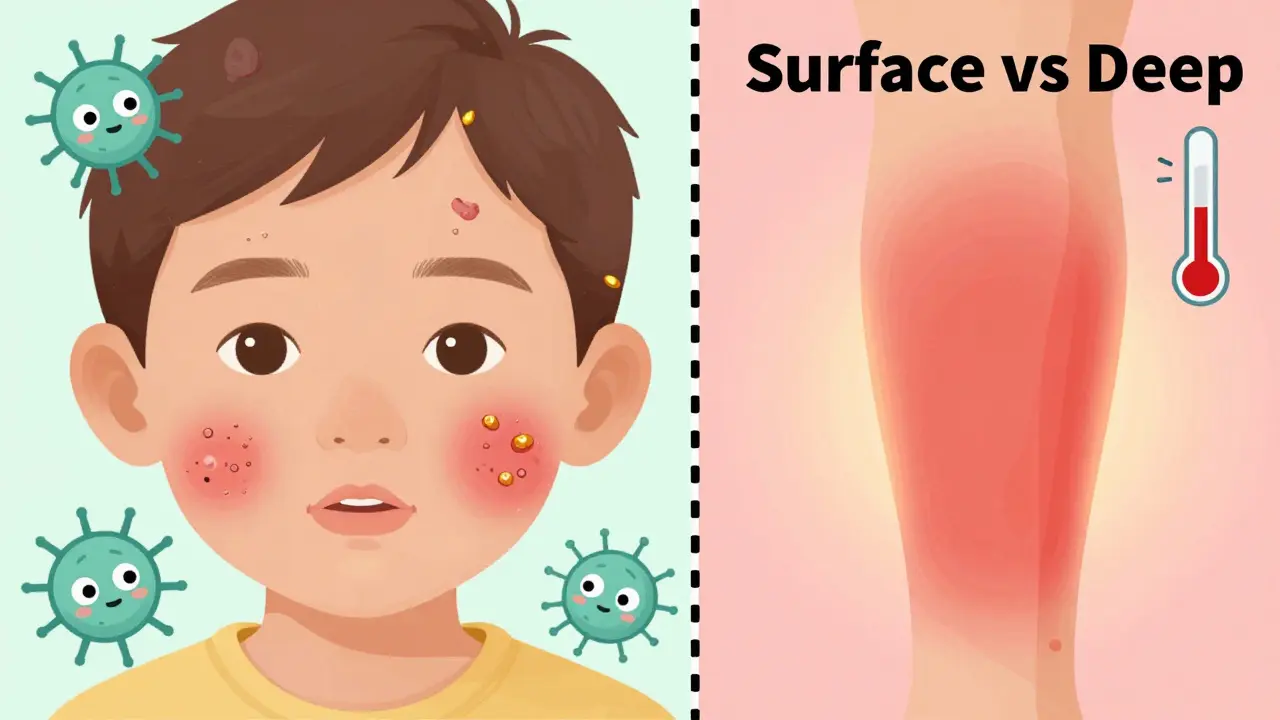
Impetigo is the classic "school sores" infection. It’s everywhere in daycare centers and primary schools, especially in kids aged 2 to 5. You’ll see small red bumps that turn into blisters, then burst and leave behind a sticky, honey-colored crust. It’s not painful, but it’s itchy - and incredibly contagious. One child scratching their face can spread it to siblings, toys, towels, even the family dog.
There are two types. The most common (70% of cases) is nonbullous impetigo, caused by Staphylococcus aureus or Streptococcus pyogenes. The other, bullous impetigo, shows up as larger, fluid-filled blisters (2-5 cm) that pop easily, leaving a ring-like border. These are usually just Staphylococcus. Both types sit on the surface of the skin - they don’t dig deep. That’s why they’re rarely dangerous, but they spread fast.
It doesn’t always start with a cut. Sometimes Staph just invades healthy skin. But most often, it follows eczema flare-ups, insect bites, or minor scrapes. If you see crusted sores around the nose or mouth, especially in a child who’s been scratching, it’s almost certainly impetigo.
Cellulitis: When the Infection Goes Deeper
Cellulitis is the opposite. It’s not a surface problem. It’s an infection that burrows into the dermis and fat layer under the skin. It starts as a red, swollen, warm patch - usually on the legs or arms - with blurry, uneven edges. The skin feels tight and tender to the touch. Sometimes, you’ll see clear or yellow fluid oozing. Fever, chills, or feeling generally sick? That’s a red flag.
Unlike impetigo, cellulitis doesn’t form crusts or blisters. It just swells and spreads. The main culprit? Streptococcus bacteria. Staphylococcus can cause it too, especially if there’s a wound or recent surgery. People with diabetes, poor circulation, or swollen legs from venous insufficiency are at higher risk. It can happen to anyone, but it’s more common in adults over 50.
And here’s the scary part: if you ignore it, cellulitis can turn into sepsis. That’s why it’s one of the top 28 diagnoses for hospital admissions in the U.S. A small patch on the leg can turn into a life-threatening infection in under 48 hours if not treated.
Key Differences: Impetigo vs. Cellulitis at a Glance
| Feature | Impetigo | Cellulitis |
|---|---|---|
| Depth of infection | Surface only (epidermis) | Deep (dermis and subcutaneous tissue) |
| Typical appearance | Honey-colored crusts, small blisters | Red, swollen, warm patch with blurry borders |
| Common locations | Face, especially nose and mouth | Legs, arms, anywhere with a break in skin |
| Primary bacteria | Staphylococcus aureus | Streptococcus pyogenes |
| Pain level | Mild itching, rarely painful | Significant tenderness, often painful |
| Contagious? | Highly contagious | Not directly contagious |
| Typical age group | Children 2-5 years | Adults over 50, people with diabetes |
Antibiotics: What Works, What Doesn’t
Antibiotics are the only way to clear these infections. But not all antibiotics work the same for both.
For impetigo, if it’s limited to a few spots, a topical cream like mupirocin works in 90% of cases. Apply it three times a day for 7-10 days. If the infection is widespread, or if the person has eczema or a weakened immune system, oral antibiotics are needed. In the UK and Belgium, flucloxacillin is the go-to. In France, they often use amoxicillin-clavulanate or pristinamycin. Why the difference? Antibiotic resistance. In places where flucloxacillin is overused, MRSA (methicillin-resistant Staphylococcus aureus) is common - and it laughs at flucloxacillin.
For cellulitis, oral antibiotics are always required. The first-line choice in the UK is still flucloxacillin. In the U.S., doctors often pick cephalexin or dicloxacillin. In France, amoxicillin is now the top pick, even though it doesn’t cover Staph as well - because most cases are caused by Streptococcus, and amoxicillin is cheaper and safer for kids.
But here’s the catch: if you don’t get better in 48 hours, or if you have a fever, swelling that’s spreading fast, or you’re diabetic, you might need hospital treatment. That means IV antibiotics like vancomycin or clindamycin - especially if MRSA is suspected.
MRSA: The Bacteria That Won’t Quit
MRSA used to be mostly a hospital problem. Now it’s in gyms, locker rooms, and homes. It causes both impetigo and cellulitis - and it doesn’t respond to penicillin, amoxicillin, or flucloxacillin. If someone has a skin infection that keeps coming back, or doesn’t improve after 2-3 days of standard antibiotics, MRSA is likely.
Doctors now test for it in recurrent cases. A simple swab can tell if it’s MRSA. If yes, they switch to clindamycin, doxycycline, or trimethoprim-sulfamethoxazole. In severe cases, vancomycin is used. The good news? Most MRSA skin infections still respond to the right antibiotic - if caught early.

What You Can Do: Prevention and Home Care
Antibiotics fix the infection, but hygiene stops it from spreading.
- Wash hands often - especially after touching infected skin.
- Don’t share towels, clothing, or razors.
- Cover sores with a clean bandage until they heal.
- Keep nails short to reduce scratching.
- Wash bedding and clothes in hot water if someone has impetigo.
- For cellulitis, elevate the swollen limb and keep the area clean and dry.
Don’t try to pop blisters or scrape off crusts. That spreads the bacteria. Let the antibiotic do the work.
Children with impetigo should stay home from school or daycare until they’ve been on antibiotics for at least 24 hours. That’s the rule in Australia, the UK, and the U.S. It’s not about being "cured" - it’s about stopping the chain of transmission.
When to See a Doctor
You don’t need to panic over a small red spot. But here’s when to act:
- Redness spreading fast - especially if it’s hot and painful
- Fever, chills, or feeling dizzy or sick
- Sores that don’t improve after 3 days of home care
- Diabetes or a weak immune system - any skin break needs attention
- Recurrent infections - this means you need testing for MRSA or underlying issues
Waiting too long can turn a simple skin infection into a hospital stay. Most people feel better in 3-5 days with the right antibiotic. But the window to stop it from getting worse? It’s 48 hours.
What’s Changing in Treatment
Doctors are moving away from blanket antibiotic use. Instead, they’re starting to ask: "What’s the resistance pattern in your area?" In Sydney, MRSA is rising in community settings. In rural areas, strep is still the main problem. That’s why treatment isn’t one-size-fits-all anymore.
Research is pushing for faster tests - like PCR swabs that can identify bacteria and resistance genes in under 2 hours. That means you could get the right antibiotic on your first visit, not after waiting days for a culture.
Topical treatments are getting better too. New ointments with antiseptic properties are being tested to replace mupirocin in places where resistance is high. The goal? Use antibiotics only when needed - and only the right ones.
For now, the rule is simple: if you see crusted sores, think impetigo. If you see a hot, swollen patch that’s spreading, think cellulitis. And don’t wait. Get it checked.
Can impetigo turn into cellulitis?
Yes, but it’s rare. Impetigo stays on the surface. If you scratch it badly and introduce bacteria deeper into the skin - especially if you have eczema or diabetes - it can lead to cellulitis. That’s why it’s important not to scratch and to treat impetigo early.
Is impetigo contagious after 24 hours of antibiotics?
No. After 24 hours of proper antibiotic treatment, the bacteria are significantly reduced, and the risk of spreading drops dramatically. That’s why schools and daycare centers allow children to return after one full day of antibiotics - as long as the sores are covered.
Can I treat cellulitis at home with just antibiotics?
Only if it’s mild and you’re otherwise healthy. If you have a fever, swelling that’s spreading fast, or you’re diabetic or over 65, you need to see a doctor immediately. Many cases require hospital IV antibiotics. Home treatment works only when caught early and monitored closely.
Why do some people get cellulitis over and over?
Recurrent cellulitis usually points to an underlying issue - like poor circulation, swollen legs (lymphedema), athlete’s foot, or uncontrolled diabetes. The skin breaks easily, and bacteria get in. Treating the infection isn’t enough. You need to fix the root cause: compression stockings, foot care, blood sugar control, or even surgery in severe cases.
Are natural remedies like tea tree oil effective for these infections?
No. There’s no good evidence that tea tree oil, honey, or essential oils can treat impetigo or cellulitis. These are bacterial infections that require antibiotics. Delaying proper treatment to try natural remedies can lead to serious complications like sepsis. Always see a doctor for a confirmed diagnosis.
How long does it take to recover from cellulitis?
Most people start feeling better in 2-3 days. The redness and swelling can take 7-10 days to fully go down. You need to finish the full course of antibiotics - even if you feel fine. Stopping early increases the chance of the infection coming back or becoming resistant.


Comments (9)