
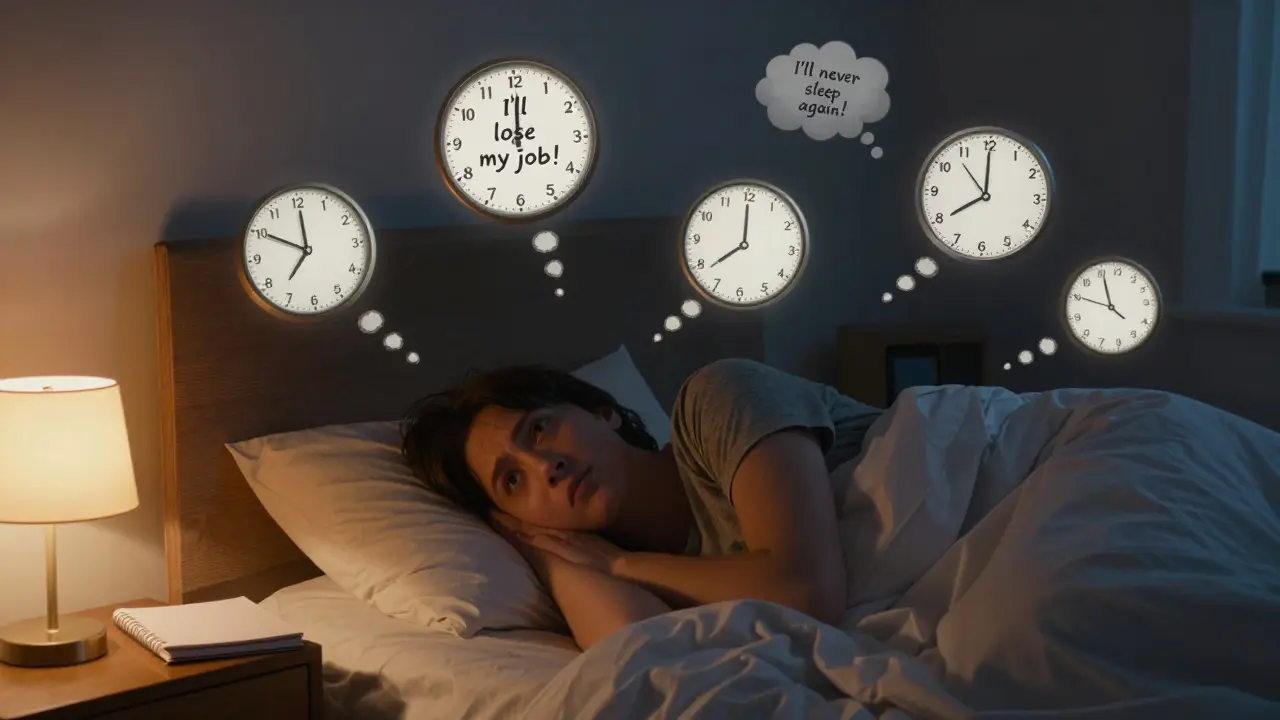
Imagine lying awake at 2 a.m. again. Your mind races. You check the clock. Again. You know you need sleep, but the harder you try, the more it slips away. If you’ve been stuck in this loop for weeks-or months-you’re not alone. Over 30% of adults struggle with chronic insomnia, and too many turn to pills hoping for a quick fix. But here’s the truth: sleep medication doesn’t fix the root problem. It just masks it. And when you stop taking it, the insomnia often comes back-worse than before.
There’s a better way. A proven, science-backed method that doesn’t involve pills, side effects, or dependency. It’s called Cognitive Behavioral Therapy for Insomnia, or CBT-I. And it works. Not just a little. Studies show that 70% to 80% of people who stick with it see major improvements in their sleep. Better still? The gains last. Long after therapy ends, people keep sleeping better. That’s because CBT-I doesn’t just help you fall asleep-it rewires the habits and thoughts that kept you awake in the first place.
What Exactly Is CBT-I?
CBT-I isn’t a single trick. It’s a structured, multi-step program built on decades of research. Developed by sleep scientists like Dr. Arthur Spielman and Dr. Jack Edinger in the 1980s and ’90s, it’s now the first-line treatment recommended by the American College of Physicians. That means doctors should offer it before prescribing sleeping pills.
Unlike medication, which affects your brain chemistry temporarily, CBT-I teaches you skills. You learn how your body naturally regulates sleep-and how your own behaviors might be sabotaging it. The goal? To restore your body’s internal sleep rhythm without relying on anything external.
It’s not magic. It’s mechanics. And it works because it targets the real causes of insomnia: poor sleep habits, anxiety around sleep, and a brain that’s learned to associate your bed with wakefulness instead of rest.
The Five Core Techniques
CBT-I is made up of five key components. You don’t need to do them all at once, but most people benefit from using at least three. Here’s how each one works in real life.
1. Stimulus Control Therapy
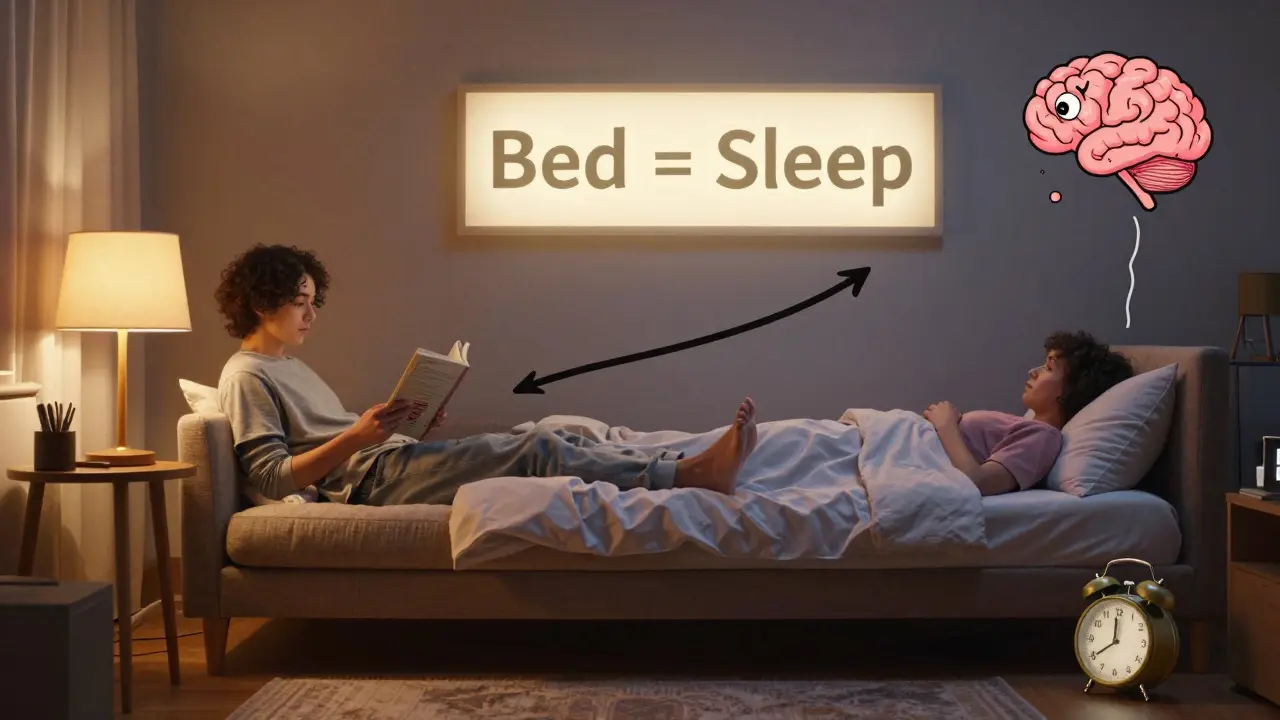
This is about breaking the mental link between your bed and wakefulness. If you’ve been tossing and turning for hours, your brain starts thinking: Bed = stress. CBT-I flips that.
- Only go to bed when you’re sleepy-not tired, not bored, not because it’s "time."
- If you’re not asleep after 20 minutes, get up. Go to another room. Do something quiet and calm-read under dim light, listen to soft music. No screens.
- Don’t return to bed until you feel sleepy again.
- Use your bed only for sleep and sex. No working, no scrolling, no watching TV in bed.
- Get up at the same time every day, even on weekends. This is non-negotiable.
This might feel strange at first. But within a week, your brain starts to relearn: Bed = sleep. The anxiety fades. Falling asleep gets easier.
2. Sleep Restriction Therapy
This sounds counterintuitive: sleep less to sleep better. But here’s why it works.
Your sleep drive builds up the longer you’re awake. If you spend 8 hours in bed but only sleep 5, your sleep efficiency is low-62.5%. That’s not enough pressure to keep you asleep. Sleep restriction increases that pressure.
Here’s how:
- Track your sleep for a week. Write down how long you actually sleep each night (not how long you lie in bed).
- Find your average total sleep time. If you’re sleeping 5.5 hours a night, that’s your starting point.
- Limit time in bed to that number-no more. So if you sleep 5.5 hours, you’re only allowed to be in bed 5.5 hours.
- Set a fixed wake-up time. Then calculate your bedtime backward. Example: Wake at 6 a.m., sleep 5.5 hours → bedtime = 12:30 a.m.
- Do not nap. Ever.
Yes, you’ll feel tired the first few days. That’s normal. You’re creating mild sleep deprivation to reset your drive. Within 7-10 days, your body starts consolidating sleep. You fall asleep faster. You wake up less. Your sleep efficiency climbs from 60% to 85% or higher.
3. Cognitive Restructuring
Your thoughts about sleep are probably sabotaging you.
"I need 8 hours or I’ll be useless tomorrow." "If I don’t sleep tonight, I’ll lose my job." "I’ll never be able to sleep again." These aren’t facts. They’re fears dressed up as truths. CBT-I helps you challenge them.
Start by writing down your sleep-related thoughts. Then ask:
- Is this thought based on evidence, or fear?
- What’s the worst that could happen if I sleep 6 hours instead of 8?
- Have I ever functioned after a bad night? What happened?
Most people find they’ve overestimated how much sleep they need-and underestimated their resilience. Replace catastrophic thoughts with realistic ones: "I can function on less sleep than I think. My body will adjust."
4. Sleep Hygiene Education
This isn’t about fancy routines or lavender sprays. It’s about removing obvious sleep disruptors.
- Avoid caffeine after 2 p.m. (Yes, even tea and chocolate.)
- Don’t drink alcohol close to bedtime. It might make you drowsy, but it fragments sleep later.
- Limit fluids 90 minutes before bed to avoid bathroom trips.
- Get bright light exposure in the morning-ideally natural sunlight. This sets your circadian rhythm.
- Keep your bedroom cool, dark, and quiet. Use blackout curtains if needed.
These aren’t "rules." They’re environmental tweaks that make it easier for your body to do what it already knows how to do: sleep.
5. Relaxation Training
An anxious body can’t sleep. CBT-I teaches you how to calm your nervous system.
Two techniques work best:
- Diaphragmatic breathing: Breathe in slowly through your nose for 4 counts. Hold for 2. Exhale through your mouth for 6. Repeat for 5 minutes. Focus only on the breath.
- Progressive muscle relaxation: Starting at your toes, tense each muscle group for 5 seconds, then release. Move up your body-feet, calves, thighs, abdomen, shoulders, face. The contrast between tension and release signals safety to your brain.
Do this for 10 minutes before bed. Not to force sleep. Just to quiet your system. Often, sleep arrives naturally after.
Digital CBT-I: The New Normal
You don’t need a therapist to start CBT-I. Digital platforms like Sleepio and CBT-i Coach have made it accessible to millions.
A 2023 study in JAMA Network Open tracked over 1,200 people using digital CBT-I. Results? 77% improved at 1 month. 82% at 3 months. And 76% were still sleeping better at 6 months. That’s better than medication alone.
These apps guide you step-by-step. They track your sleep diary, adjust your schedule, and give feedback. Some are even covered by insurance-including Medicare and 85% of private insurers in the U.S. Australia’s Medicare is also expanding coverage.
For people who can’t find a sleep specialist (there are fewer than 1,500 in the U.S.), digital CBT-I is a game-changer. It’s like having a sleep coach in your phone.
Why It Beats Pills
Medication works fast. In the first week, you might fall asleep 20-30 minutes faster. But here’s what happens after:
- You build tolerance. You need more to get the same effect.
- You risk dependence. Stopping can cause rebound insomnia.
- Side effects: dizziness, memory issues, next-day grogginess, increased fall risk in older adults.
- It doesn’t fix the underlying problem. The insomnia returns.
CBT-I? It takes longer to start working-usually 2-4 weeks. But once it clicks:
- No side effects.
- No dependence.
- Improvements keep growing after treatment ends.
- You gain lifelong skills.
A 2015 meta-analysis of 20 studies found CBT-I reduced time to fall asleep by 19 minutes and nighttime wakefulness by 26 minutes. That’s as good as medication. But with no risk.
Who Can Benefit?
CBT-I works for almost everyone with chronic insomnia:
- Adults over 18
- Adolescents (a 2024 study showed strong results for teens)
- Pregnant women (medications are often unsafe)
- People with PTSD, cancer, or chronic pain
- Older adults (who are more sensitive to medication side effects)
It’s not for acute insomnia (a few nights of stress). But if you’ve had trouble sleeping for 3 months or more-CBT-I is your best shot.
What to Expect in the First Week
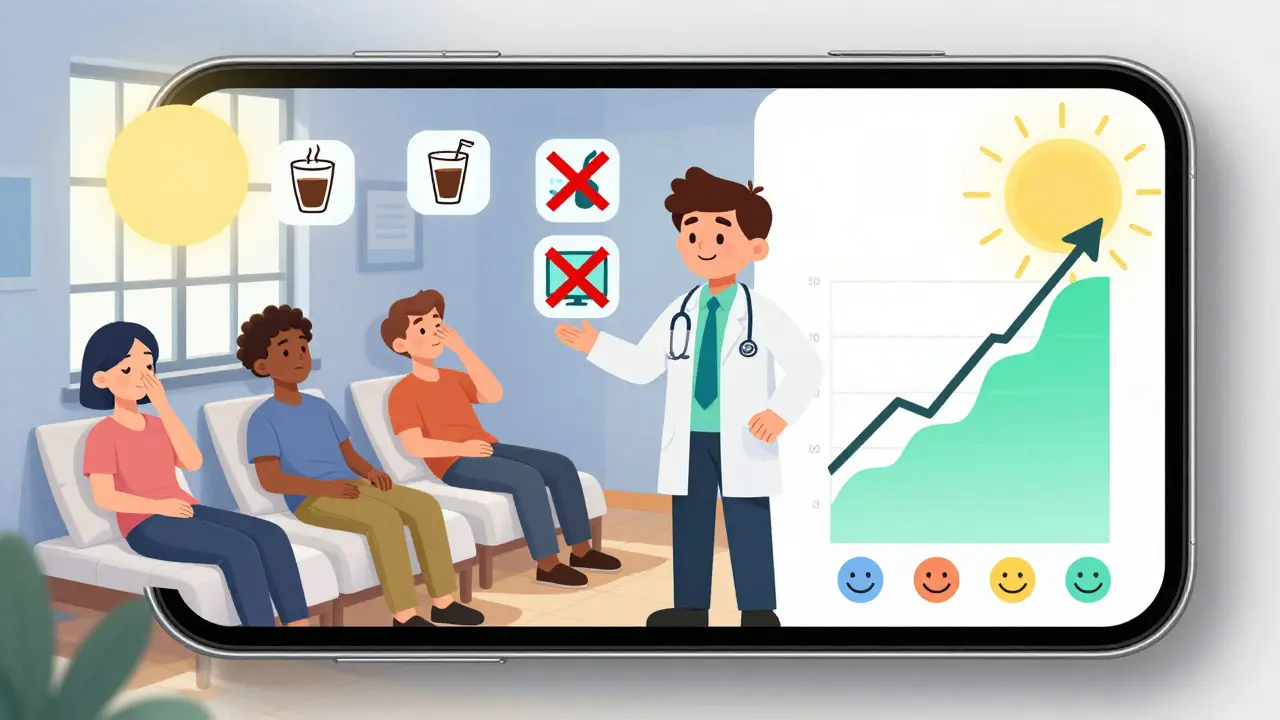
Be honest: the first week is hard. That’s normal.
During sleep restriction, you’ll likely feel exhausted. You might be irritable. You might think it’s not working. You’re not failing-you’re adapting.
Most people report their sleep quality improves after day 5-7. By week 3, they’re falling asleep faster. By week 6, they’re sleeping 7-8 hours without effort.
One woman in Sydney, 42, told her therapist: "I thought I was going to collapse from exhaustion. But on day 6, I woke up at 6 a.m. without an alarm. I hadn’t done that in 5 years." That’s the turning point.
Common Mistakes and How to Avoid Them
- Skipping the sleep diary: You can’t improve what you don’t measure. Track every night-even weekends.
- Napping: Naps reduce sleep drive. If you absolutely must nap, keep it under 20 minutes and before 3 p.m.
- Changing wake-up times: Your body needs consistency. Even on weekends, stay within 30 minutes of your usual time.
- Expecting overnight results: CBT-I is a marathon, not a sprint. Stick with it for at least 4 weeks.
- Trying to force sleep: The more you try, the harder it gets. Let go. Sleep will come when your body is ready.
Next Steps
You don’t need to wait for a doctor. Start today:
- Download a free sleep diary app or use a notebook.
- For 7 days, record: bedtime, wake time, time to fall asleep, number of awakenings, total sleep time.
- Calculate your average sleep time.
- Set your new bedtime based on that number.
- Get up at the same time every day.
- Leave bed if you’re not asleep after 20 minutes.
That’s it. No pills. No cost. Just consistency.
If you want more structure, try a digital CBT-I program. Many are free or covered by insurance. Look for ones with clinical validation-like Sleepio, CBT-i Coach, or Somryst.
Insomnia doesn’t have to be a life sentence. The tools to fix it are already inside you. You just need to use them.
Can CBT-I help if I’ve been on sleeping pills for years?
Yes. Many people successfully transition off sleeping pills using CBT-I. The key is to do it gradually and under guidance. Start CBT-I while still taking medication, then work with your doctor to reduce doses over weeks or months. Most people find they can stop pills within 2-3 months of starting CBT-I, with better sleep than before.
How long does CBT-I take to work?
Most people notice changes in 2-4 weeks. The biggest improvements usually happen between weeks 4 and 8. It’s not instant, but the results are lasting. Studies show people continue to sleep better even 6 months to a year after finishing treatment.
Is CBT-I only for people with severe insomnia?
No. CBT-I works for mild, moderate, and severe insomnia. In fact, people with mild insomnia often respond faster because they haven’t developed as many ingrained habits. The goal isn’t to be "bad enough" to qualify-it’s to be ready to change.
What if I can’t stick to the schedule?
It’s okay. Consistency matters more than perfection. If you sleep in on Saturday, aim to get up within 30 minutes of your usual time. If you nap, don’t beat yourself up-just avoid it the next day. The goal isn’t flawless adherence. It’s progress. Most people who stick with it-even imperfectly-see improvement.
Can I do CBT-I without a therapist?
Absolutely. Digital programs like CBT-i Coach and Sleepio are clinically proven to be as effective as in-person therapy. They guide you through each step, track your progress, and adjust your plan. Many are covered by insurance. If you’re motivated and willing to track your sleep, you can succeed on your own.


Comments (8)