
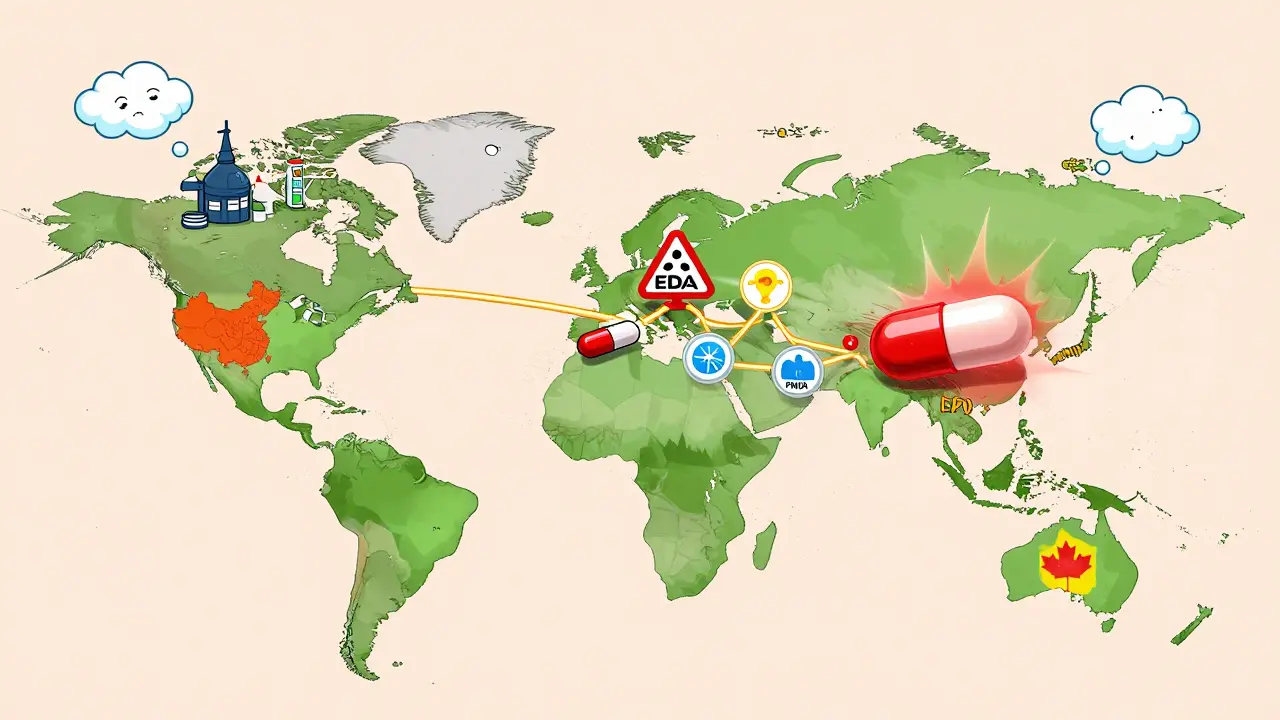
Every year, millions of people take generic medicines manufactured across the world. A pill made in India might end up in a pharmacy in Brazil, Canada, or Australia. But if something goes wrong - if a patient has a serious reaction - how do we know? And how do regulators in different countries share that information fast enough to stop harm? That’s where pharmacovigilance harmonization comes in.
Why Global Drug Safety Needs to Be Aligned
Pharmacovigilance isn’t just about collecting reports. It’s about connecting dots across borders. Before global standards, a drug reaction in Germany might take months to reach the FDA in the U.S. Meanwhile, the same drug was still being sold in 12 other countries. The result? Delayed recalls, duplicated efforts, and avoidable harm. The push for alignment started in 1990 with the International Council for Harmonisation (ICH), formed by regulators and drugmakers from the U.S., EU, and Japan. Their goal was simple: make drug safety rules the same everywhere. Today, that means using the same forms, the same codes, and the same timelines for reporting bad reactions. The ICH E2B(R3) standard is now the global language for submitting adverse event reports. It replaced messy paper forms and inconsistent digital systems. Companies no longer need to reformat the same report five different ways. That’s cut processing time by 25-30% for most large drugmakers.How the Big Three Regulators Compare
Even with harmonization, differences remain. The U.S. FDA, the European Medicines Agency (EMA), and Japan’s PMDA all follow ICH guidelines - but they interpret them differently. The EMA requires every serious adverse event to be reported within 15 days, no exceptions. The FDA only demands that for events they consider “unexpected and serious” and tied to the drug. That means a company might report the same reaction to Europe and the U.S. - but with different timing, different labels, and different justifications. Japan’s system is unique. It pulls real-world data from 12 million patient records using its J-STAR system. That’s more data than most countries have access to. But it also means companies must adapt to Japan’s internal algorithms and reporting triggers, which don’t always match EMA or FDA rules. Canada’s Health Canada sits somewhere in between. It follows ICH closely but still requires 30-day reporting for serious events - a longer window than Europe. This creates headaches for global teams. One pharmacovigilance manager told a 2024 industry survey: “I spend 35-40% of my time just reformatting reports for different regions.”
The Tech Revolution in Drug Safety
Old-school pharmacovigilance relied on humans reading case reports. Now, machines are doing the heavy lifting. Since 2022, both the EMA and FDA have used machine learning to scan safety data. These tools cut signal detection time by 30-40%. Instead of waiting weeks to spot a pattern, regulators now get alerts in days. Japan’s PMDA took it further. In 2023, they launched an AI model that reduces false alarms by 25%. That’s huge. Too many false signals mean teams waste time chasing ghosts. Fewer false positives mean real dangers get faster attention. Real-world data is now central. The EU requires health records to feed into safety monitoring. The FDA’s Sentinel Initiative tracks 300 million patient records across 12 U.S. networks. EMA’s DARWIN EU covers 100 million patients in seven countries. These systems don’t just collect reports - they watch what actually happens when drugs are used in the wild. But not every country can keep up. In Brazil, South Africa, and parts of Southeast Asia, less than 15% of potential real-world data can be processed. Why? No electronic health records. No digital infrastructure. No funding.The Hidden Cost of Not Being Aligned
Harmonization saves money - but only if everyone plays by the same rules. TransCelerate Biopharma, which includes Pfizer and Johnson & Johnson, found that mismatched reporting rules increase global pharmacovigilance costs by 22%. Why? Duplicate work. Teams in London, Chicago, and Tokyo all build separate systems to handle the same data. That’s not efficiency - that’s redundancy. Novartis fixed this by building one global safety database. Result? 92% fewer duplicate entries. And critical safety signals were detected 38 days faster. But small companies and emerging markets struggle. Only 42% of pharmaceutical firms in low- and middle-income countries have fully adopted ICH E2B(R3). Compare that to 95% in the U.S. and EU. The Access to Medicine Foundation found that 74% of pharmacovigilance staff in poorer nations lack the tools to even meet basic standards. The result? A two-tiered system. Drugs are monitored well in rich countries. In others, reactions go unnoticed - until it’s too late.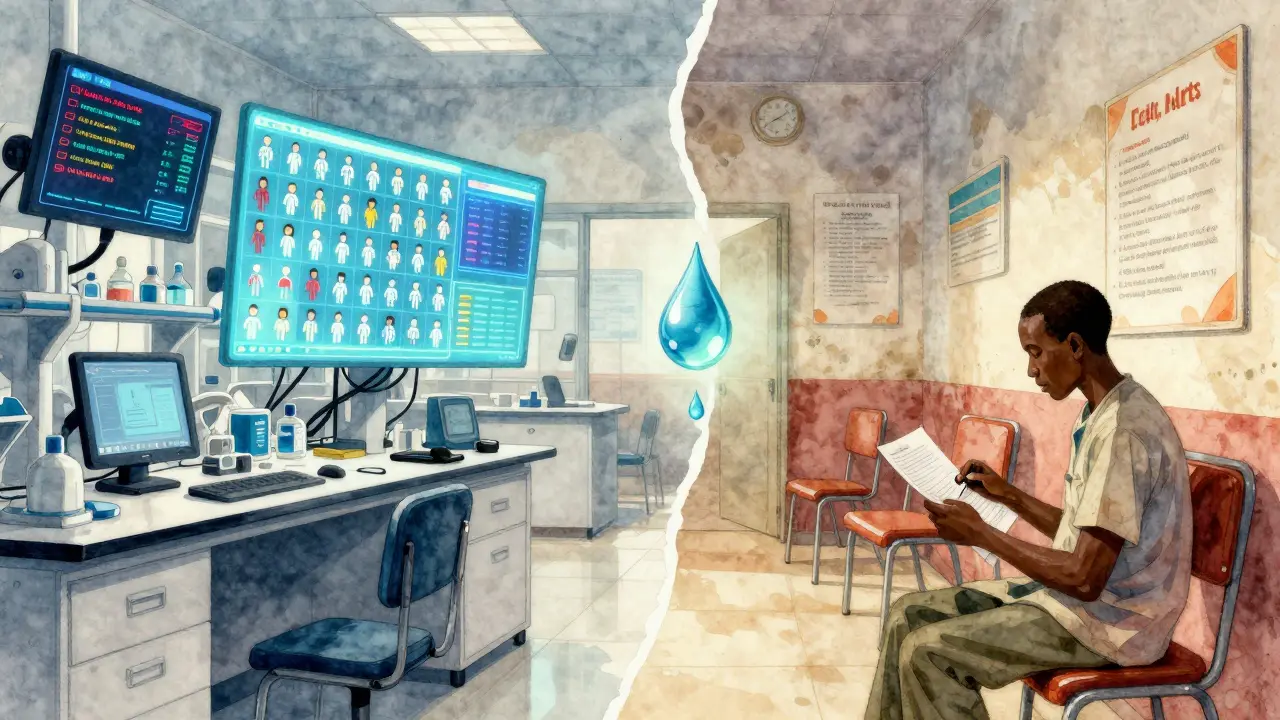


Comments (8)