
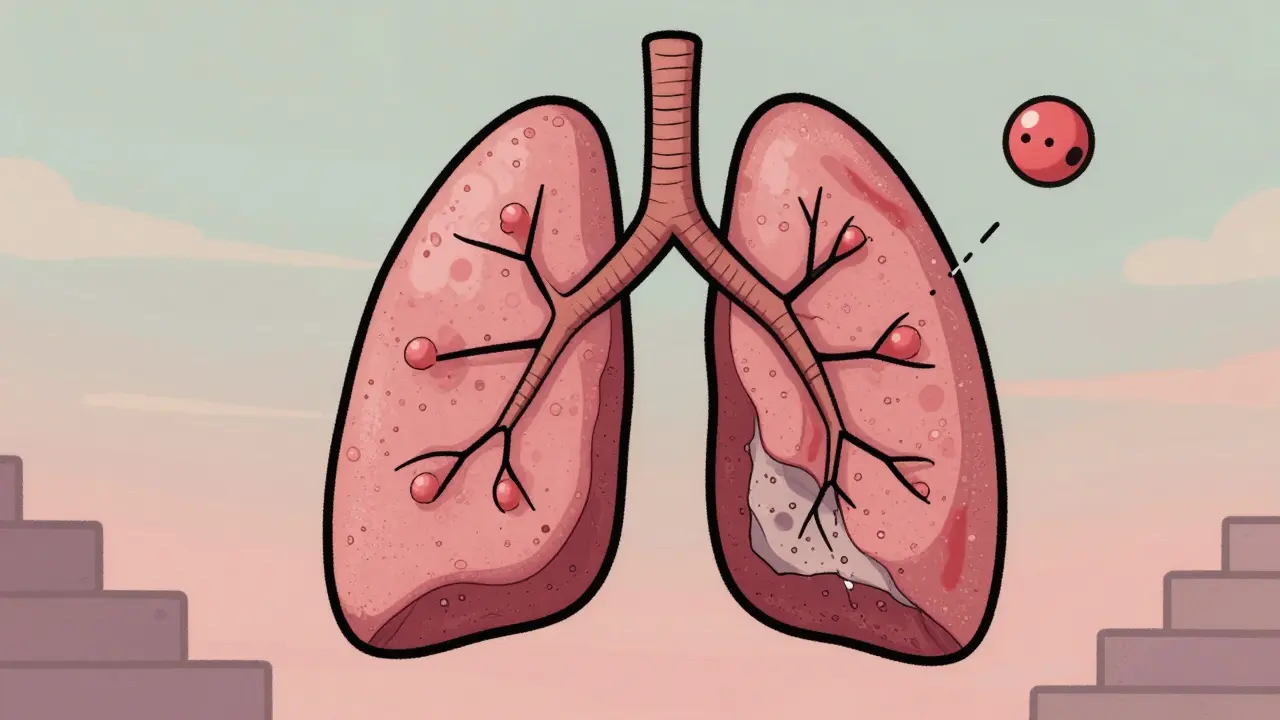
When your lungs start to stiffen and scar, breathing becomes a struggle-not just during exercise, but even at rest. This isn’t asthma, and it’s not just getting older. It’s interstitial lung disease, a group of more than 200 conditions that slowly destroy the delicate tissue between your air sacs. Unlike infections or allergies, this damage doesn’t heal. Once the scar tissue forms, it’s permanent. But that doesn’t mean nothing can be done. Today’s treatments can slow the scarring, help you stay active longer, and even extend life-if caught early.
What Exactly Is Happening in Your Lungs?
Your lungs are made up of millions of tiny air sacs called alveoli. Between them is a thin layer of tissue called the interstitium. In healthy lungs, this layer is less than 0.1mm thick-barely there. It lets oxygen pass easily into your blood. In interstitial lung disease (ILD), that tissue thickens, hardens, and turns into scar tissue. Think of it like rubber bands inside your lungs turning into concrete. Your lungs can’t expand properly. Oxygen can’t move through. You feel out of breath, even when you’re sitting still. This isn’t one disease. It’s a family of disorders. Some are caused by autoimmune conditions like rheumatoid arthritis. Others come from long-term exposure to dust, asbestos, or certain medications. But the most common type-idiopathic pulmonary fibrosis (IPF)-has no known cause. It just happens. And it’s aggressive. About 20-30% of all ILD cases are IPF, and it affects roughly 1 in 5,000 people over 75. The scarring doesn’t stop. It creeps forward, one breath at a time.How Do You Know If It’s ILD?
Symptoms don’t show up overnight. They creep in slowly. You might notice you’re winded climbing stairs when you used to breeze up them. Or you’re coughing more-dry, hacking, no mucus. Fatigue sets in. You feel like you’ve been run over by a truck every morning. By the time you see a doctor, you’ve probably been ignoring it for months. The signs are clear if you know what to look for:- Shortness of breath during activity, then at rest
- Chronic dry cough
- Fatigue that doesn’t go away
- Chest tightness or discomfort
- Clubbing of fingers-tips widening and rounding
- Weight loss without trying
Over 90% of people with ILD report breathlessness. Nearly 80% have that persistent dry cough. If you’re over 60, have smoked, or have an autoimmune disease, these symptoms should raise red flags. Many patients go through two or three misdiagnoses before getting the right answer. Doctors often mistake it for asthma, heart failure, or just aging.
How Is ILD Diagnosed?
There’s no single blood test. Diagnosis takes time-on average, 11 months from first symptom to confirmed diagnosis. That’s too long. But the tools are powerful if used correctly. The gold standard is a high-resolution CT scan (HRCT). It shows the scarring in fine detail, down to 1mm slices. A radiologist can spot patterns: honeycombing, reticulation, traction bronchiectasis-signs that tell them it’s fibrosis, not inflammation. But even the best scans miss early cases. One study found 20% of early ILD cases are overlooked because the scarring is too subtle. That’s why multidisciplinary teams matter. A pulmonologist, radiologist, and pathologist review the scan, lung function tests, and sometimes a biopsy together. This reduces misdiagnosis from 30% down to under 10%. Pulmonary function tests show a restrictive pattern: your lungs can’t hold as much air (FVC drops), and oxygen can’t transfer well (DLCO falls by 30-60%).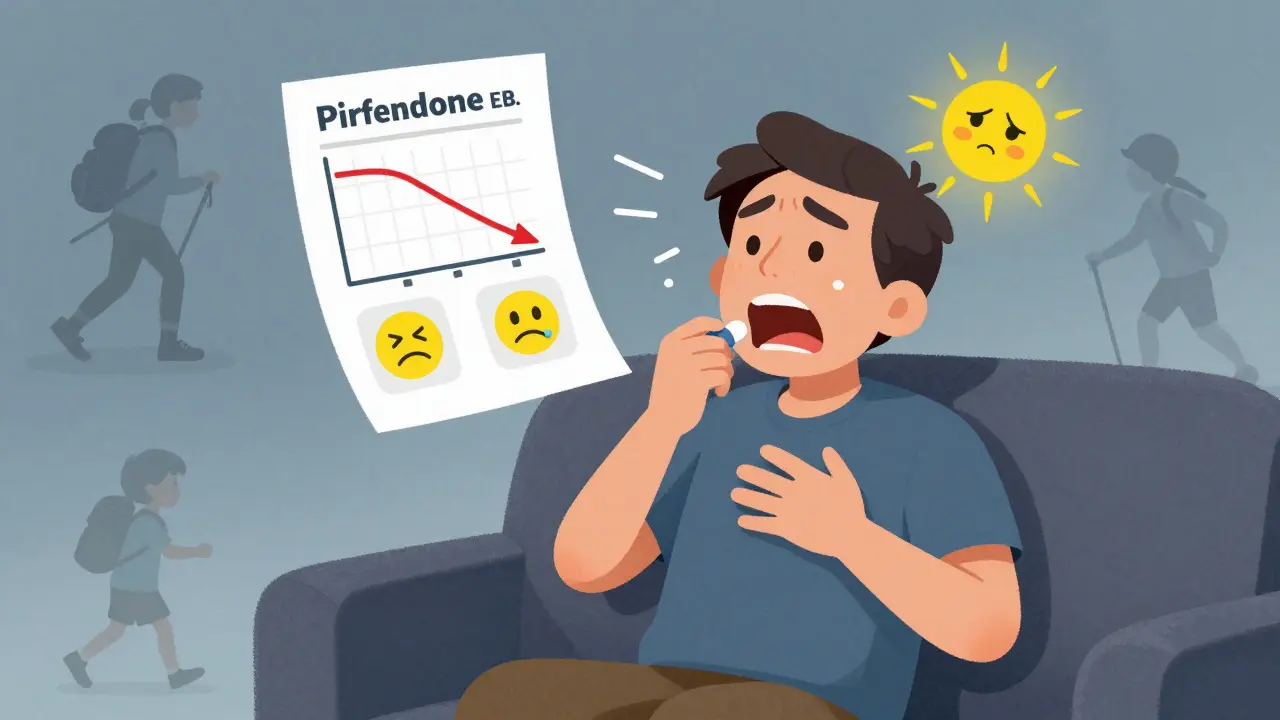
What Are the Treatment Options?
There’s no cure. But there are treatments that change outcomes. The two FDA-approved antifibrotic drugs-nintedanib (Ofev®) and pirfenidone (Esbriet®)-are the backbone of treatment for IPF and some other progressive forms. They don’t reverse scarring. They slow it down. In clinical trials, they cut the rate of lung function decline by about half over one year. That’s huge. For someone losing 250mL of lung capacity per year, these drugs might reduce that to 125mL. That’s months, sometimes years, of extra time before needing oxygen or a transplant. But they’re not easy to take. Pirfenidone causes nausea, dizziness, and severe sun sensitivity-you have to wear sunscreen, hats, long sleeves even on cloudy days. Nintedanib gives you diarrhea in nearly 60% of users. Dose adjustments are common. Still, 70% of patients who stick with them report better quality of life than those who don’t. For non-IPF ILD, like that caused by rheumatoid arthritis or sarcoidosis, immunosuppressants like prednisone or azathioprine are often used. But they don’t work for everyone. And they come with their own risks: bone loss, infections, high blood sugar.What About Oxygen and Rehab?
When your blood oxygen drops below 88% at rest, you need supplemental oxygen. About half of IPF patients need it within two years. Oxygen isn’t a cure-it’s a lifeline. It lets you move without turning blue. It helps you sleep. It reduces strain on your heart. Pulmonary rehabilitation is equally important. It’s not just exercise. It’s a full program: supervised breathing techniques, strength training, nutrition advice, and energy-saving strategies. People who complete 8 to 12 weeks of rehab typically walk 45 to 60 meters farther in a 6-minute test. That might sound small, but it means you can get groceries without stopping. You can play with your grandkids. You can leave the house without panic.
What’s New in 2026?
The field is moving fast. In late 2023, the FDA approved zampilodib, the first new antifibrotic drug in nearly a decade. It works differently than nintedanib or pirfenidone, targeting another pathway in the scarring process. Early results show a 48% reduction in lung function decline-better than the older drugs. Blood tests are getting smarter too. Testing for the MUC5B gene variant now helps predict who’s likely to have fast-progressing IPF. If you test positive, your doctor can start treatment earlier-before you’re even severely symptomatic. Artificial intelligence is stepping in. Mayo Clinic’s AI tool analyzes HRCT scans and spots fibrosis patterns with 92% accuracy-better than most human radiologists. That means faster, more accurate diagnosis. Less waiting. Less guesswork.What Can You Do Now?
If you’ve been told you have ILD, here’s what matters most:- Stop smoking-immediately. Even if you quit 20 years ago, smoking accelerates scarring.
- Get vaccinated. Flu, pneumonia, and COVID-19 can trigger deadly flare-ups.
- Join a pulmonary rehab program. It’s the single most effective non-drug intervention.
- Find a specialist center. Community hospitals miss ILD more often than academic centers.
- Track your symptoms. Note when you’re more breathless, how far you walk, your oxygen levels. Bring this to every appointment.
Don’t wait for a crisis. Early action makes all the difference. The goal isn’t to cure-it’s to live as fully as possible for as long as possible.
What About the Future?
Researchers are exploring stem cell therapies, gene editing, and drugs that target specific proteins involved in fibrosis. Over 25 clinical trials are active right now. One big focus: finding biomarkers that predict who will progress fast-and who won’t. That could mean personalized treatment plans: aggressive for fast progressors, watchful waiting for slow ones. The big shift? From treating symptoms to stopping the scarring before it takes over. And that’s where the real hope lies.Is interstitial lung disease the same as pulmonary fibrosis?
Pulmonary fibrosis is one type of interstitial lung disease (ILD). ILD is the umbrella term for over 200 conditions that cause lung scarring. Idiopathic pulmonary fibrosis (IPF) is the most common and most aggressive form, making up 20-30% of all ILD cases. So all IPF is ILD, but not all ILD is IPF.
Can you live a normal life with interstitial lung disease?
You can live well, but not necessarily “normally.” Many people manage symptoms effectively with oxygen, rehab, and medication. They work, travel, and spend time with family. But breathing becomes harder over time. Oxygen dependence, reduced stamina, and fatigue are common. The goal isn’t to return to your old life-it’s to build a new one that works with your lungs.
Do antifibrotic drugs work for all types of ILD?
No. Nintedanib and pirfenidone are approved only for idiopathic pulmonary fibrosis and a few other progressive fibrosing ILDs. They don’t help much in ILD caused by autoimmune diseases like lupus or sarcoidosis. Those often respond better to steroids or immunosuppressants. Treatment must be tailored to the specific subtype.
How fast does interstitial lung disease progress?
It varies widely. IPF typically progresses faster-median survival is 3 to 5 years without treatment. Some people decline quickly; others stay stable for years. Connective tissue disease-related ILD often progresses slower, with 70-80% surviving five years. Sarcoidosis may even resolve on its own. Progression is measured by lung function tests-especially FVC decline. A drop of more than 10% in six months signals rapid progression.
Can you prevent interstitial lung disease?
You can’t prevent all types, especially IPF. But you can reduce your risk. Avoid smoking. Wear protective gear if you work with dust, asbestos, or chemicals. Control autoimmune conditions like rheumatoid arthritis. Get regular check-ups if you’re over 60 or have a family history. Early detection through HRCT and biomarker testing is becoming more common and can catch ILD before major damage occurs.
What’s the role of lung transplant in ILD?
Lung transplant is the only option that can restore lung function in advanced ILD. It’s considered when medications and oxygen aren’t enough, and life expectancy is less than 18-24 months. About 1,000 ILD transplants are done yearly in the U.S. Survival rates are around 80% at one year and 50% at five years. But it’s not for everyone-you must be physically strong enough, and there’s a long waitlist.


Comments (13)