
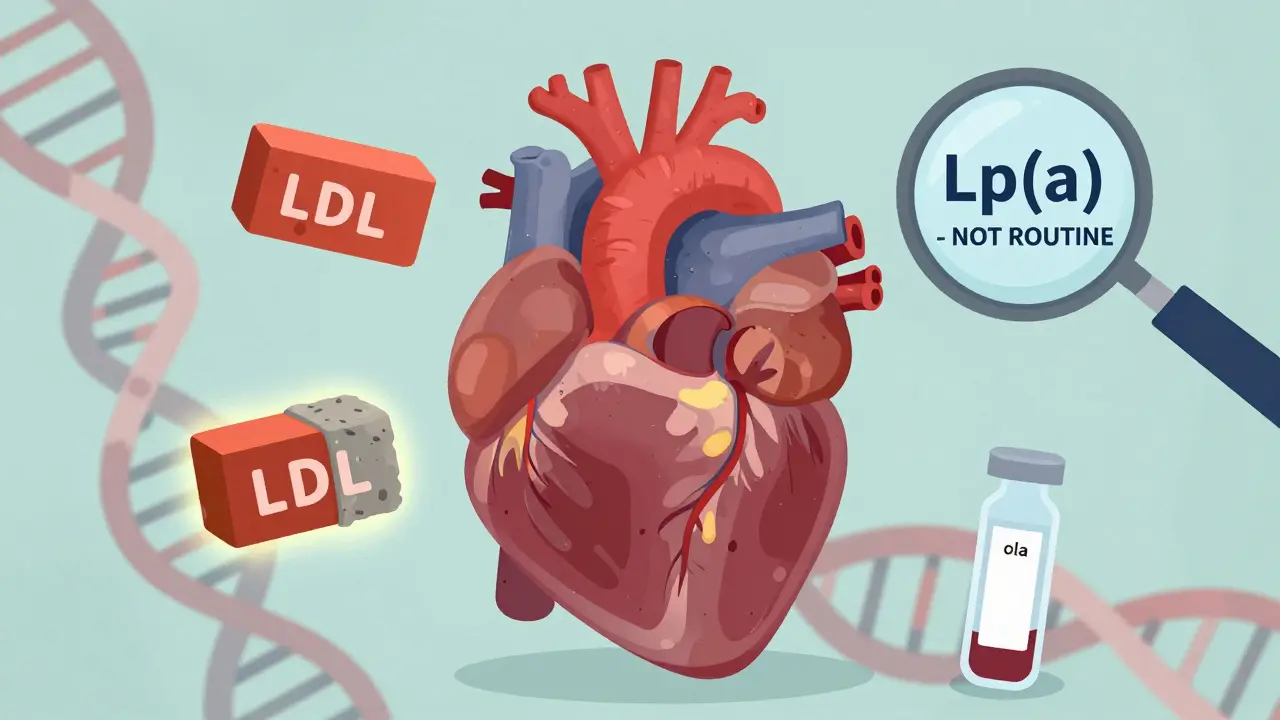
Most people know about LDL cholesterol - the "bad" kind that clogs arteries. But there’s another cholesterol particle hiding in plain sight, one that’s just as dangerous and completely out of your control: lipoprotein(a), or Lp(a). It’s not on your regular cholesterol test. Your doctor probably hasn’t mentioned it. Yet, if you have high levels, your risk of a heart attack or stroke jumps significantly - no matter how healthy you eat or how much you exercise.
What Exactly Is Lipoprotein(a)?
Lipoprotein(a), or Lp(a), is a type of lipoprotein that carries cholesterol through your blood. It looks a lot like LDL - the kind linked to plaque buildup - but it has one extra protein attached: apolipoprotein(a). This extra piece makes Lp(a) uniquely dangerous. It doesn’t just deliver cholesterol to artery walls; it also sticks to the sites where blood clots form, making clots bigger and harder to break down.
Think of it like this: LDL is the brick that builds plaque. Lp(a) is the brick, the glue, and the cement all in one. It promotes inflammation, speeds up plaque growth, and blocks your body’s natural ability to dissolve clots. That’s why high Lp(a) is linked not just to heart attacks and strokes, but also to aortic valve stenosis - a condition where the heart’s main valve narrows and can’t open properly.
Unlike regular cholesterol, Lp(a) levels are almost entirely set by your genes. About 70% to 90% of your Lp(a) level is determined by the LPA gene you inherited from your parents. This makes it one of the most genetically fixed risk factors for heart disease known to science. You can’t change it with diet, and you can’t sweat it out at the gym.
How Common Is High Lp(a)?
One in five people - 20% of the global population - has elevated Lp(a). That’s over 1.4 billion people worldwide. And yet, most don’t know it. Why? Because standard cholesterol tests don’t measure it. You have to specifically ask for an Lp(a) blood test.
Levels above 50 mg/dL (or 125 nmol/L) are considered high risk. At levels above 90 mg/dL (190 nmol/L), your risk becomes equivalent to someone with familial hypercholesterolemia - a serious inherited condition that causes extremely high LDL from birth. Some people have levels over 300 mg/dL, putting them at risk for heart disease as early as their 30s or 40s.
And here’s something important: Lp(a) levels don’t change much over time. If you have high Lp(a) at age 25, you’ll likely still have it at 65. That’s why early testing matters.
Who Should Get Tested?
If you have any of these, you should ask your doctor for an Lp(a) test:
- A family history of early heart disease (before age 55 in men, before 65 in women)
- A personal history of heart attack, stroke, or peripheral artery disease without obvious causes like smoking or diabetes
- A diagnosis of familial hypercholesterolemia
- A family member with known high Lp(a)
- Unexplained aortic valve stenosis
Black individuals are more likely to have higher Lp(a) levels than white, Hispanic, or Asian populations. Women often see their Lp(a) levels rise after menopause, likely because estrogen - which helps keep Lp(a) low - drops. That doesn’t mean Lp(a) is less dangerous in men; it just means women face a new risk window later in life.

Why Don’t Doctors Test for It More Often?
Lp(a) has flown under the radar for decades. One reason? Testing wasn’t standardized. Different labs used different methods, so results varied wildly. A level that looked high at one hospital might seem normal at another.
That’s changing. In 2024, the American College of Cardiology and other major groups pushed for standardized testing. Now, labs are using consistent units - either mg/dL or nmol/L - and the conversion formula is well established: Lp(a) in nmol/L = 2.18 × Lp(a) in mg/dL - 3.83. This makes results more reliable.
Still, most primary care doctors don’t order the test unless prompted. If you’re concerned, bring it up. Say: "I’ve heard Lp(a) is a hidden genetic risk for heart disease. Can I get tested?"
Can You Lower Lp(a) with Lifestyle Changes?
Here’s the hard truth: diet, exercise, weight loss, and quitting smoking won’t significantly lower your Lp(a) levels. That’s why it’s so frustrating. You do everything right, and your genetic risk stays the same.
But that doesn’t mean you do nothing. Lowering your overall heart risk still matters - a lot. Even if your Lp(a) is high, managing other factors can reduce your chance of a heart event.
- Keep your LDL cholesterol below 70 mg/dL - this is critical. Statins help here, even if they don’t touch Lp(a).
- Control blood pressure. High pressure damages arteries, making it easier for Lp(a) to cause harm.
- Don’t smoke. Smoking makes plaque unstable and increases clotting risk - a double threat with high Lp(a).
- Manage diabetes if you have it. High blood sugar worsens inflammation and artery damage.
- Aim for 150 minutes of moderate exercise a week. It doesn’t lower Lp(a), but it improves circulation and heart function.
Some people wonder about niacin or fish oil. Niacin can lower Lp(a) by 20-30%, but it causes flushing, liver issues, and doesn’t clearly reduce heart attacks in trials. Fish oil has no proven effect on Lp(a). Don’t waste money on supplements that promise to "fix" it.
What’s New in Treatment? The Hope on the Horizon
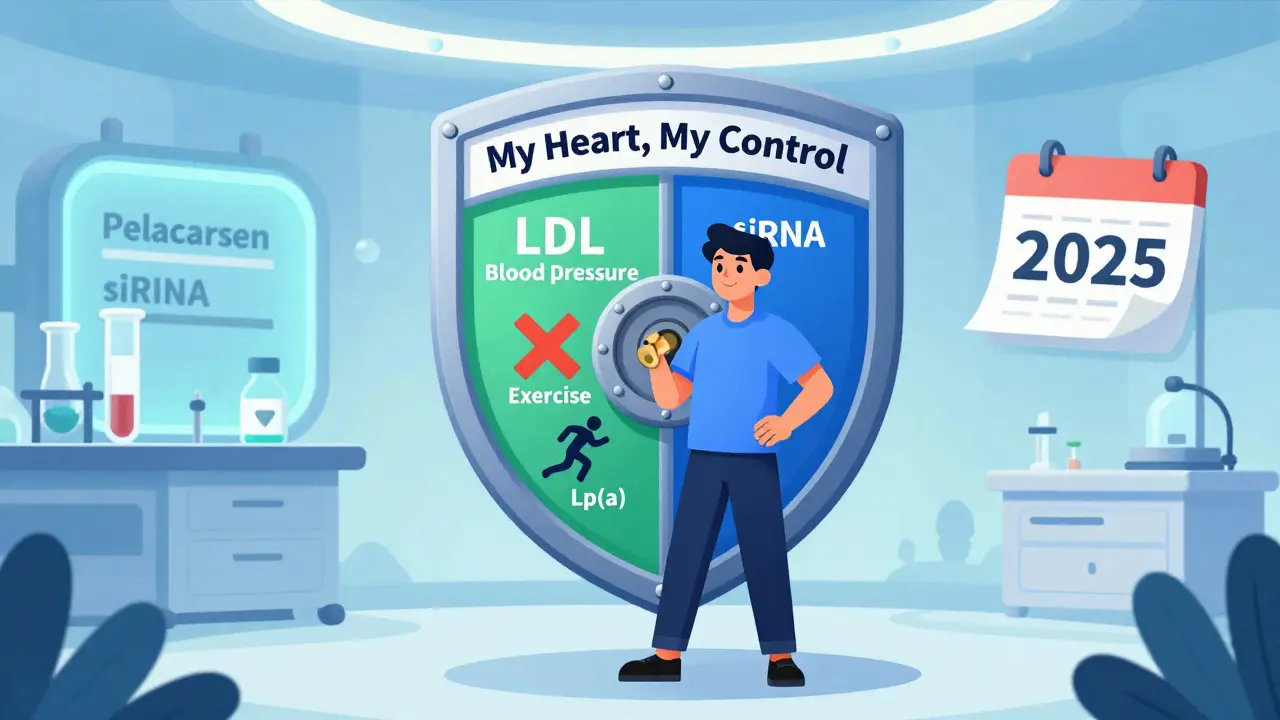
For the first time ever, there’s real hope for direct Lp(a) lowering. A new class of drugs called antisense oligonucleotides (ASOs) is showing dramatic results. One drug, called pelacarsen, reduces Lp(a) by up to 80% in clinical trials.
The big news? The Lp(a) HORIZON Outcomes Trial - a phase 3 study involving over 7,000 people with high Lp(a) and existing heart disease - is testing whether lowering Lp(a) with pelacarsen actually prevents heart attacks, strokes, and death. Results are expected in 2025. If positive, this could be the first treatment approved specifically to target Lp(a).
Other drugs are in development too, including small interfering RNA (siRNA) therapies that work similarly. These aren’t available yet, but the pipeline is active. Within the next few years, we may have targeted, safe, and effective Lp(a)-lowering drugs.
What Should You Do Right Now?
If you’ve never been tested:
- Check your family history. Did a parent, sibling, or grandparent have a heart attack before age 55 or 65? If yes, get tested.
- Ask your doctor for an Lp(a) blood test. Don’t wait for them to bring it up. Say: "I’d like to check my Lp(a) level - it’s genetic, and I want to know my risk."
- If your level is high, don’t panic. It’s not a death sentence. It’s a warning.
- Work with your doctor to aggressively manage your LDL, blood pressure, and other risks.
- Consider genetic counseling if you have very high levels - it may help your children understand their risk.
If you already know your Lp(a) is high:
- Get your LDL below 70 mg/dL. You may need a statin plus a PCSK9 inhibitor like evolocumab or alirocumab.
- Keep your blood pressure under 120/80.
- Don’t smoke. Ever.
- Stay informed. The next 12-18 months could bring major breakthroughs in treatment.
Final Thought: Knowledge Is Power
Lp(a) is not your fault. You didn’t cause it. You can’t fix it with kale or yoga. But you can control the rest. You can lower your LDL. You can control your blood pressure. You can avoid smoking. You can get tested and know your numbers.
For the first time, science is catching up to Lp(a). In 2025, we may have the first drug that directly targets it. Until then, awareness is your best tool. Don’t let this silent genetic risk slip through the cracks. Ask for the test. Know your number. Take charge of what you can.
Is lipoprotein(a) the same as LDL cholesterol?
No. Lp(a) is a separate particle that contains an LDL-like core but has an extra protein called apolipoprotein(a) attached. This makes it more likely to cause plaque buildup, inflammation, and blood clots than regular LDL. Standard cholesterol tests don’t measure Lp(a) - you need a specific test for it.
Can diet and exercise lower Lp(a)?
No. Unlike LDL cholesterol, Lp(a) levels are mostly determined by your genes - over 90% of the variation comes from your DNA. Diet, exercise, weight loss, and even fasting won’t significantly reduce Lp(a). That’s why it’s called a "genetic cholesterol risk." But managing other risk factors like LDL, blood pressure, and smoking still reduces your overall heart attack risk.
Should everyone get tested for Lp(a)?
Major heart organizations now recommend testing at least once in adulthood for people with a personal or family history of early heart disease, stroke, aortic stenosis, or familial hypercholesterolemia. Some experts, including the American Heart Association, now suggest universal screening because Lp(a) affects 1 in 5 people. If you’re unsure, ask your doctor - especially if you’ve had unexplained cardiovascular events.
What’s a normal Lp(a) level?
Levels below 30 mg/dL (75 nmol/L) are considered low risk. Levels above 50 mg/dL (125 nmol/L) are considered high risk for heart attack and stroke. Severe risk starts at 90 mg/dL (190 nmol/L). Some labs report in nmol/L, others in mg/dL - make sure you know which one you’re seeing. The conversion is: nmol/L = 2.18 × mg/dL - 3.83.
Is there a new drug for high Lp(a)?
Yes. A drug called pelacarsen, part of a new class called antisense oligonucleotides (ASOs), has shown the ability to lower Lp(a) by up to 80% in clinical trials. The final results of the Lp(a) HORIZON Outcomes Trial - which tests whether lowering Lp(a) reduces heart attacks and strokes - are expected in 2025. If successful, this could become the first FDA-approved treatment specifically for high Lp(a).
Does Lp(a) run in families?
Yes. Lp(a) is inherited in an autosomal dominant pattern. If one parent has high Lp(a), each child has a 50% chance of inheriting it. It’s not just a family history of heart disease - it’s a specific genetic trait. If you have high Lp(a), your siblings and children should consider getting tested.
Can Lp(a) cause stroke?
Yes. High Lp(a) increases the risk of both heart attacks and ischemic strokes. It contributes to plaque in brain arteries and promotes clot formation. Studies show that elevated Lp(a) is linked to a higher risk of stroke, especially in younger people without traditional risk factors like smoking or diabetes.
Why is Lp(a) higher in Black populations?
Research shows that Black individuals tend to have higher average Lp(a) levels than white, Hispanic, or Asian populations. This is due to genetic differences in the LPA gene, particularly the number of kringle IV repeats. Higher levels don’t mean higher risk is inevitable - but they do mean Black individuals may need earlier and more aggressive screening and management of other risk factors like LDL and blood pressure.
For now, the best defense against Lp(a) is knowing your level and controlling everything else. The science is moving fast. In the next few years, we may finally have a way to directly fight this silent genetic threat.


Comments (8)