
Why Medication Adherence Matters More Than You Think
If you’ve ever forgotten to take your blood pressure pill, skipped a dose because you felt fine, or let your diabetes meds sit untouched for days-you’re not alone. More than half of people with chronic conditions don’t take their meds as prescribed. And it’s not just about forgetfulness. Life gets busy. Side effects creep in. Costs add up. Pills get lost in the shuffle. But here’s the real problem: skipping doses doesn’t just make treatment less effective-it can land you in the hospital.
The U.S. spends between $100 billion and $300 billion every year on avoidable hospital visits and complications caused by people not taking their medications properly. That’s not a small number. That’s the cost of ignoring something simple: showing up for your own health.
Measuring your adherence isn’t about being judged. It’s about catching patterns before they turn into crises. You don’t need fancy tech or a doctor’s order to start tracking. You just need a clear way to see what’s really happening with your meds.
What Does “Adherence” Actually Mean?
Adherence isn’t just about taking pills. It’s a three-part process:
- Initiation - Did you start the medication at all?
- Implementation - Are you taking the right dose, at the right time, the right number of times per day?
- Persistence - Did you keep taking it for the full length of time your doctor intended?
Many people think they’re adherent because they filled the prescription. But filling it and taking it are two different things. A 2023 JAMA study found that nearly 40% of patients who picked up their cholesterol meds never actually took them. That’s why measuring adherence requires looking beyond pharmacy records.
How to Track Your Own Adherence (No Tech Required)
You don’t need an app, a smart pill bottle, or a $50 device to know if you’re sticking to your plan. Here’s a simple, practical checklist you can start today:
- Keep a daily log - Use a notebook, phone notes, or a printed calendar. Write down each medication, the dose, and the time you took it. If you miss a dose, mark it. No judgment. Just facts.
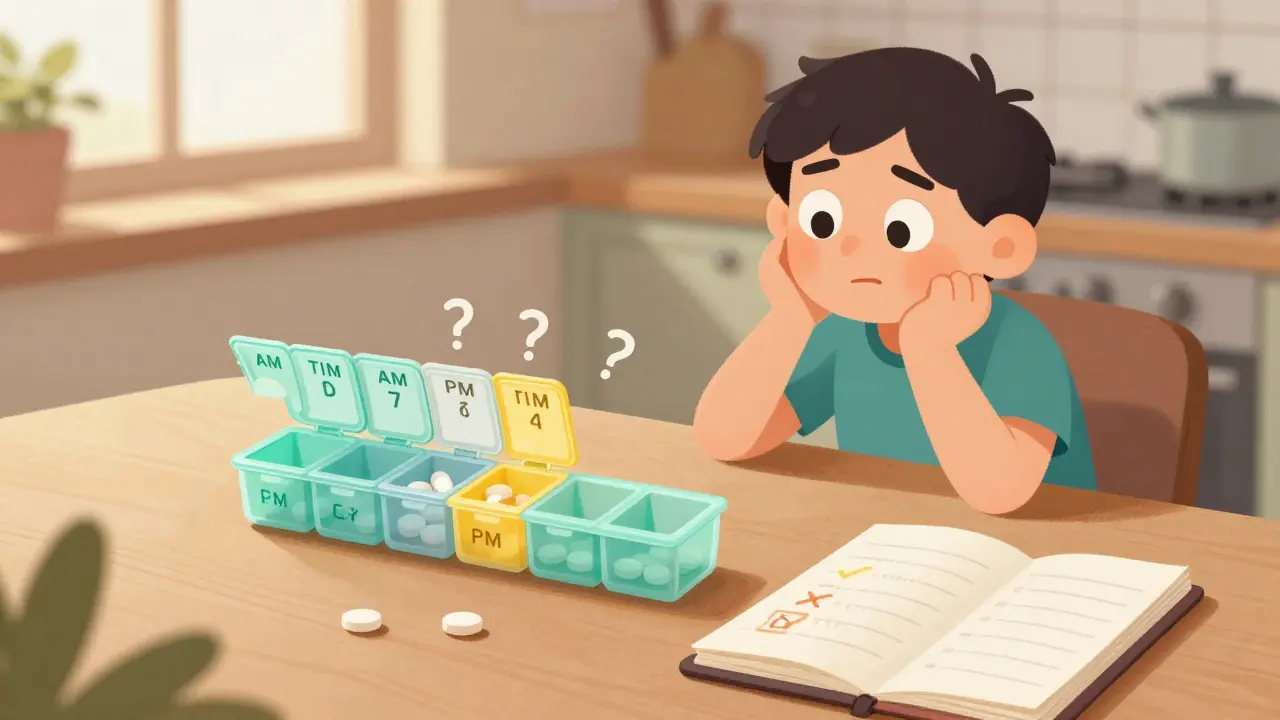
- Use a pill organizer - A seven-day box with morning, afternoon, evening, and night compartments makes it obvious when you’ve skipped a dose. If it’s still full on Wednesday, you know you missed Monday and Tuesday.
- Set phone alarms - Name them something specific: “Take Lisinopril 10mg AM” or “Take Metformin with breakfast.” Don’t just say “Meds.” The more specific, the harder it is to ignore.
- Check your refill patterns - Look at your pharmacy receipts. If you refill your blood pressure med every 30 days but your prescription is for 90 days, you’re likely not taking it daily. That’s a red flag.
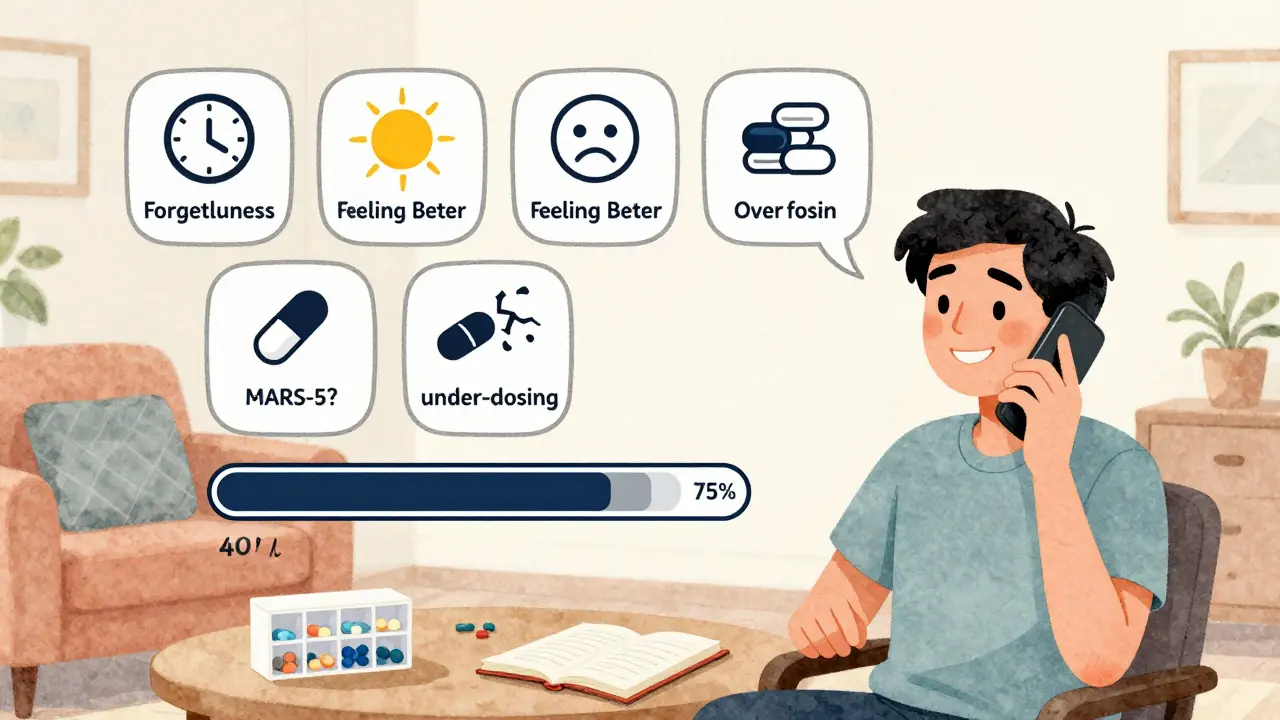
- Ask yourself the MARS-5 questions - These five simple questions, developed by researchers, help you honestly assess your behavior:
- How often do you forget to take your medication? (Never / Rarely / Sometimes / Often / Very often)
- How often do you stop taking your medication when you feel better? (Never / Rarely / Sometimes / Often / Very often)
- How often do you stop taking your medication because of side effects? (Never / Rarely / Sometimes / Often / Very often)
- How often do you take less than the prescribed dose? (Never / Rarely / Sometimes / Often / Very often)
- How often do you take more than the prescribed dose? (Never / Rarely / Sometimes / Often / Very often)
Score each answer: 1 = Very often, 2 = Often, 3 = Sometimes, 4 = Rarely, 5 = Never. Add them up. A total below 20 means you’re struggling. Below 15? You’re at high risk for complications.
The Numbers That Matter: PDC and MPR Explained Simply
If you’ve heard terms like PDC or MPR from your doctor or insurer, here’s what they mean-without the jargon.
Proportion of Days Covered (PDC) is the gold standard used by insurance companies and clinics to measure adherence for long-term meds like those for diabetes, high blood pressure, or cholesterol. It answers: “Out of all the days you were supposed to take your med, how many days did you actually have it?”
Example: You’re on a 30-day supply of metformin. You refill it on day 25. Then again on day 55. That’s two fills covering 60 days total. You were supposed to take it for 90 days. So your PDC is 60 ÷ 90 = 67%. That’s below the 80% threshold most insurers use to consider you adherent.
Medication Possession Ratio (MPR) is similar, but it can give false high scores. If you refill early and end up with extra pills, MPR says you’re over 100% adherent. That’s misleading. PDC caps it at 100%. That’s why experts say PDC is better.
Bottom line: If your insurer says you’re “adherent,” ask them how they calculated it. If they used MPR, it might not mean what you think.
When Tech Helps-And When It Doesn’t
Smart pill bottles, apps, and AI trackers sound great. And they do help some people. But they’re not magic.
Devices like AdhereTech or MEMS caps record when you open your bottle. That’s useful data. But opening the bottle doesn’t mean you took the pill. You could have dumped it out. You could have given it to someone else. You could have just been curious.
AI tools that analyze your EHR data-like Flatiron Health’s-can predict who’s likely to miss doses with 87% accuracy. That’s powerful for clinics. But for you, the patient? It’s still just a prediction. It doesn’t change your behavior unless you act on it.
Real-world adoption is low. Only 32% of independent doctors track adherence systematically. Why? Time, cost, and complexity. Most practices don’t have the staff or software to do it well.
So if you’re relying on tech to fix your adherence, you’re putting the burden in the wrong place. The real fix is you, your routine, and your awareness.
What to Do If You’re Falling Behind
If your checklist shows you’re missing doses regularly, don’t panic. Don’t feel guilty. Just act.
- Call your pharmacist - They see your refill history. Ask them: “Am I refilling on time? What does my adherence look like?” Pharmacists are trained to help with this.
- Ask about pill burden - Are you on five different meds? Maybe one can be combined, or a generic can be switched. Fewer pills = fewer chances to forget.
- Use the BATHE method - Next time you see your doctor, say: “I’ve been having trouble keeping up with my meds. I feel bad about it.” Then explain why. Was it cost? Side effects? Confusion? The BATHE technique (Background, Affect, Trouble, Handling, Empathy) helps doctors respond with support, not scolding.
- Request a medication review - Many clinics offer a free “meds check” once a year. Use it. Bring every pill bottle-even the ones you don’t take anymore.
Why This Isn’t Just About You
When you skip your meds, you’re not just risking your health. You’re adding to a system that’s already overwhelmed. Every avoidable ER visit, every hospital readmission, every missed workday-it all adds up.
But when you stick to your plan, you’re not just saving money for the system. You’re saving your own time, your energy, your independence. You’re less likely to end up in the hospital. You’re more likely to keep doing the things you love.
And here’s the quiet truth: Adherence isn’t about perfection. It’s about progress. Missing one dose doesn’t ruin everything. But if you keep missing doses and never notice, that’s when things start to break.
Start Today: Your 7-Day Adherence Challenge
Here’s your simple action plan:
- Get a pill organizer.
- Write down every medication you’re supposed to take.
- Set alarms for each one.
- Answer the MARS-5 questions honestly.
- Check your last three pharmacy refill dates.
- Write down one reason you’ve missed doses in the past.
- Call your pharmacist or doctor and say: “I want to do better with my meds. Can we talk about how?”
You don’t need to fix everything tomorrow. Just start tracking. Awareness is the first step to change.
What Comes Next
Medication adherence is changing fast. In 2025, Medicare plans will pay bonuses up to $1,200 per person for high adherence rates. Pharmacies are rolling out automated refill reminders. New tools are emerging.
But none of it matters if you don’t know where you stand right now. Your body doesn’t care about trends or tech. It only responds to what you do-day after day.
So take five minutes today. Look at your meds. Check your last refill. Ask yourself the MARS questions. Write it down. That’s your first real step toward taking control.
What is the best way to measure my own medication adherence?
The most practical way is a combination of daily tracking (using a pill organizer and log) and the MARS-5 questionnaire. For long-term meds, check your pharmacy refill history to calculate your Proportion of Days Covered (PDC). If you refill a 90-day supply every 30 days, you’re likely not taking it daily. PDC below 80% means you’re at risk.
Is taking my medication every other day considered adherence?
No. If your prescription says once daily, taking it every other day is non-adherence-even if you feel fine. Many meds work best with consistent blood levels. Skipping doses can cause your condition to worsen over time, even if you don’t notice symptoms right away.
Why do doctors care if I miss a few pills?
Because small gaps add up. Missing just 20% of your doses can double your risk of hospitalization for conditions like heart failure or diabetes. Studies show people who miss even a few doses per month have worse outcomes than those who miss none. It’s not about being perfect-it’s about consistency.
Can I trust my pharmacy’s adherence score?
Only if they’re using PDC, not MPR. MPR can overstate adherence by counting extra pills you didn’t take. Ask them which method they use. Also, pharmacy data only shows what you picked up-not what you took. You might have filled the prescription but never opened the bottle.
What if I can’t afford my meds?
You’re not alone. Talk to your pharmacist or doctor. Many drugmakers offer patient assistance programs. Some pharmacies have $4 generic lists. You can also ask if a lower-dose pill can be split, or if a different brand is cheaper. Never skip doses because of cost-there are always options to explore.
How do I know if my adherence is improving?
Track your daily log for 30 days. Then answer the MARS-5 again. Compare your scores. Also, check your refill pattern-did you stretch your 30-day supply to 35 or 40 days? That’s a sign you’re taking fewer pills. If your PDC improves from 60% to 75%, you’re on the right track. Small wins matter.


Comments (11)