
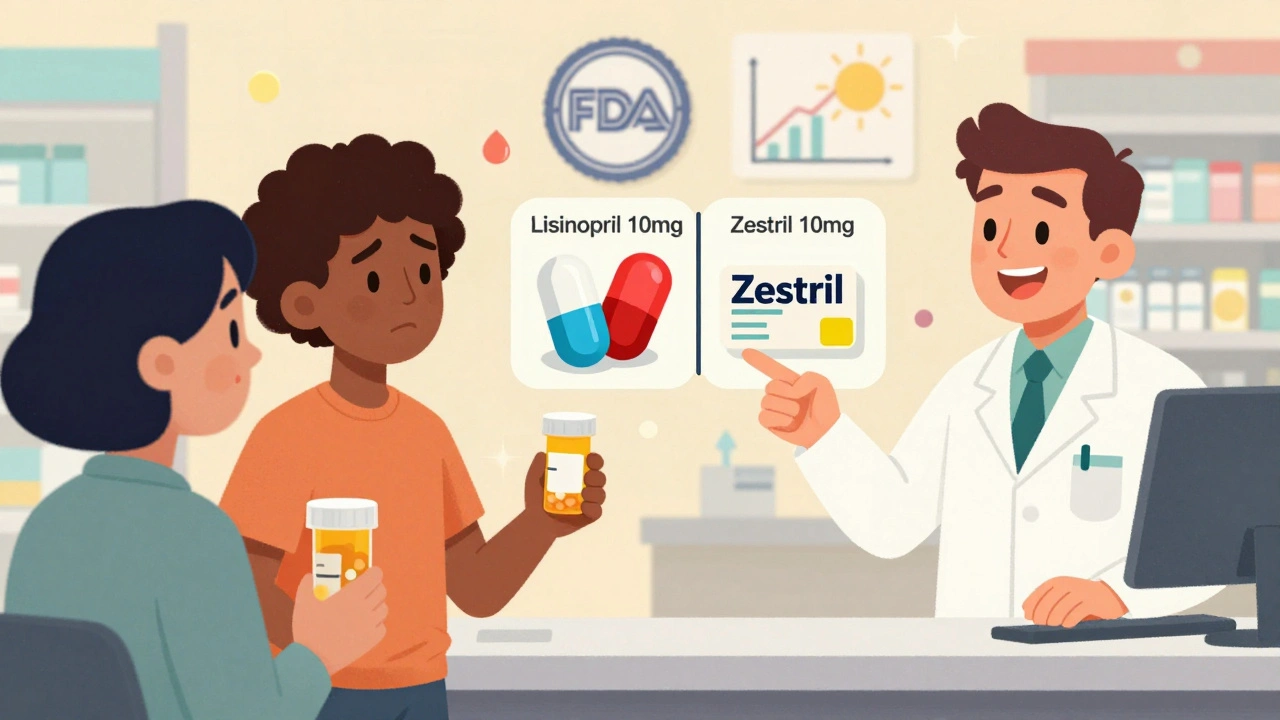
When you pick up a prescription and see a different pill than what you’re used to, it’s normal to pause. Maybe it’s a different color. Maybe it’s shaped differently. Maybe it even has a weird logo on it. You might think, Is this really the same thing? You’re not alone. Most people feel this way - and that’s exactly why pharmacy counseling exists.
Why Generics Look Different But Work the Same
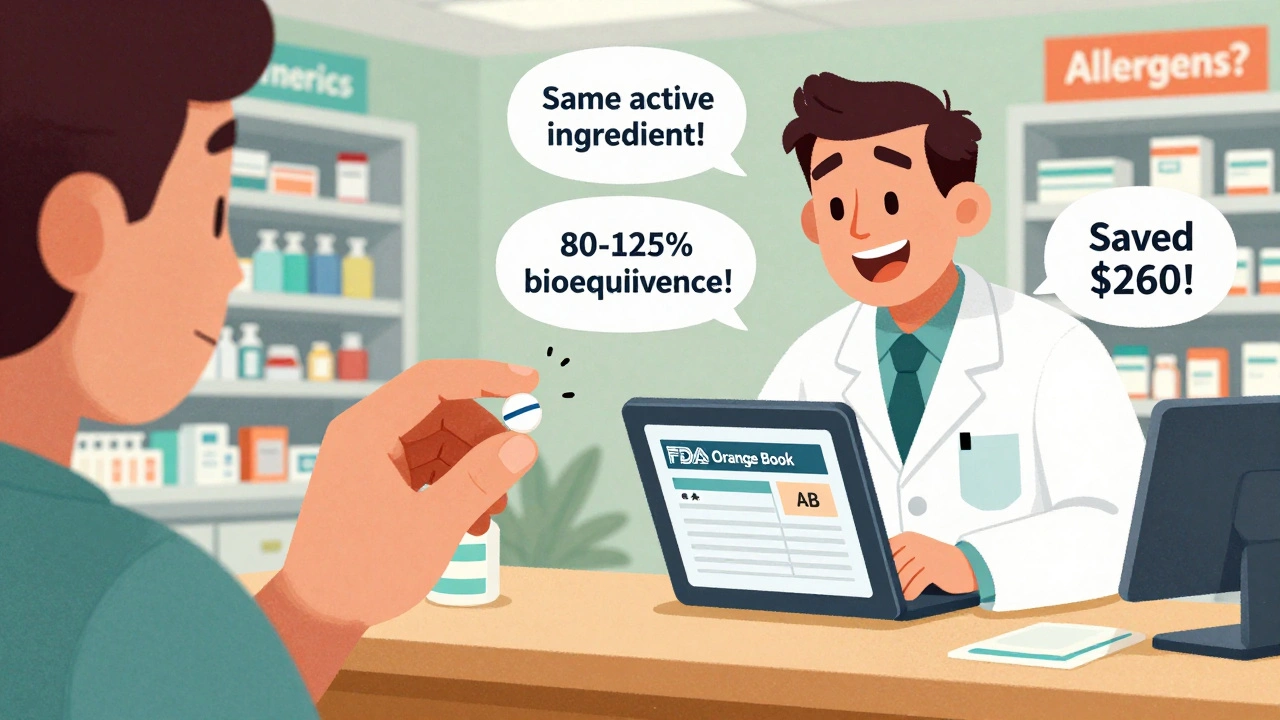
Generic drugs aren’t knockoffs. They’re not cheaper because they’re weaker. They’re cheaper because the patent on the brand-name version expired, and other companies can now make the same medicine without paying for research and marketing. The FDA requires every generic drug to have the same active ingredient, strength, dosage form, and route of administration as the brand-name version. That means if your brand-name pill has 10 mg of lisinopril, the generic has exactly 10 mg of lisinopril - no more, no less.What changes are the inactive ingredients. These are the fillers, dyes, and binders that hold the pill together or make it easier to swallow. That’s why the color, shape, or size might be different. But these ingredients don’t affect how the drug works in your body. The FDA tests every generic to prove it delivers the same amount of medicine into your bloodstream at the same rate as the brand-name version. This is called bioequivalence, and it has to fall within a strict 80-125% range compared to the original. That’s not a guess - it’s science.
What Your Pharmacist Should Tell You
When you get a generic, your pharmacist is legally required to explain a few key things. This isn’t optional. Under the Omnibus Budget Reconciliation Act of 1990, pharmacies that bill Medicaid must provide counseling. Most private insurers and state laws follow the same standard.Here’s what you should hear:
- "This is a generic version of your brand-name drug." They should name both - for example, "This is generic lisinopril, which is the same as Zestril."
- "It works the same way." They should explain that the active ingredient is identical and has been tested to work just as well.
- "It’s much cheaper." Generics can save you 80% or more. If you’re paying $300 a month for a brand, the generic might cost $40.
- "It looks different, but it’s not a different medicine." This is critical. Many patients stop taking their meds because they think the new pill is fake or weaker. A 2019 survey found 31% of patients were confused by appearance changes - and 18% stopped taking the drug because of it.
- "There might be different inactive ingredients." If you have allergies - especially to lactose, gluten, or certain dyes - this matters. The pharmacist should ask if you’ve ever had a reaction to a pill before.
Good pharmacists don’t just talk. They check your understanding. This is called the "teach-back" method. They’ll say: "Can you tell me in your own words how you’ll take this?" or "What would you say to a friend who’s worried about this pill?" If you can explain it back clearly, you’re more likely to take it correctly.
When Generics Might Need Extra Care
Not all drugs are created equal when it comes to substitution. Some medications have what’s called a narrow therapeutic index - meaning the difference between a helpful dose and a harmful one is very small. For these, even tiny variations in how the drug is absorbed can matter.Drugs like warfarin (a blood thinner), levothyroxine (for thyroid issues), and phenytoin (for seizures) fall into this category. While most generics are safe for these, some states restrict automatic substitution unless your doctor specifically approves it. In 23 states, pharmacists can’t switch you to a generic for these drugs without your prescriber’s OK.
If you’re on one of these medications and your pharmacist switches you to a generic, ask: "Has my doctor approved this change?" If they haven’t, push back. It’s not about distrust - it’s about safety.
What to Do If You Feel Something’s Off
Some people report feeling different after switching to a generic. Maybe your blood pressure seems higher. Maybe your mood changed. Maybe you feel more tired. Before you assume the generic is bad, consider this: It’s rarely the active ingredient.More often, it’s the difference in inactive ingredients. For example, one patient on Drugs.com said they had a reaction to a generic blood pressure pill because it contained lactose - and they were allergic. The brand didn’t have it. That’s why pharmacists should always ask about allergies.
If you notice a real change in how you feel after switching, don’t just stop taking it. Call your pharmacist or doctor. Bring the new pill with you. Say: "I switched to the generic, and now I feel [describe symptoms]. Is this normal?"
Many times, the issue is temporary as your body adjusts. Other times, you might need to switch back - or try a different generic brand. Not all generics are made by the same company. Sometimes, one generic works better for you than another, even though both are FDA-approved.
Why Counseling Makes a Real Difference
A 2018 study of 12.7 million people found that when patients were properly counseled about generics, adherence improved by 8.2%. That means more people took their meds as prescribed - and fewer ended up in the hospital.That’s not just good for you. It saves the whole system money. The Association for Accessible Medicines estimates that generics saved the U.S. healthcare system $1.9 trillion between 2009 and 2019. But none of that matters if patients don’t take the pills.
One patient on PatientsLikeMe wrote: "My pharmacist spent 10 minutes showing me the FDA Orange Book entry for my medication. I switched to the generic and saved $300 a month - and didn’t feel any difference." That’s the power of clear, honest counseling.
What You Can Do Right Now
You don’t have to wait for your pharmacist to explain everything. Here’s what you can do next time you pick up a generic:- Ask: "Is this a generic?" Even if it’s obvious, say it out loud. It reminds the pharmacist to counsel you properly.
- Ask: "What’s the brand name?" Write it down. You might need it later for your doctor or for research.
- Ask: "Are there any inactive ingredients I should worry about?" Especially if you have allergies or sensitivities.
- Ask: "Can you show me the FDA’s rating for this?" They can pull up the Orange Book on their computer. Seeing "AB" next to the drug means it’s fully equivalent.
- Ask: "What should I do if I feel different?" Get a clear plan before you leave the pharmacy.
If your pharmacist rushes you or says, "It’s the same thing," push back. You’re not being difficult - you’re being smart. Good counseling takes 2 to 5 minutes. That’s all it takes to prevent a costly mistake.
What’s Changing Now
In 2022, the FDA updated its Orange Book to make therapeutic equivalence ratings clearer. Pharmacies now have better tools to explain exactly which generics are interchangeable. In 2023, new guidelines from ASHP emphasized counseling on inactive ingredients for 14 high-risk drug classes - things like asthma inhalers and epilepsy meds.Some pharmacies are even using short videos to explain generics. A 2022 study found that patients who watched a 90-second video about generics were 37% more likely to accept them than those who only got verbal advice.
These changes aren’t about pushing generics. They’re about making sure you understand them - so you can take them with confidence.
Are generic drugs as effective as brand-name drugs?
Yes. The FDA requires that generic drugs contain the same active ingredient, strength, dosage form, and route of administration as the brand-name version. They must also prove they deliver the same amount of medicine into your bloodstream at the same rate. This is called bioequivalence, and it’s tested in strict clinical studies. For 99.5% of drugs, generics work just as well as brand-name versions.
Why do generic pills look different?
The active ingredient is the same, but the inactive ingredients - like dyes, fillers, and binders - can be different. These affect the pill’s color, shape, or size, but not how it works. U.S. trademark laws also prevent generics from looking exactly like brand-name pills. That’s why your new pill might be blue instead of green, or oval instead of round.
Can I switch back to the brand-name drug if I don’t like the generic?
Yes, but it usually means paying more. Talk to your doctor first. If you feel worse after switching, they can write a prescription that says "Do Not Substitute." Your pharmacist will then dispense the brand-name version. Some insurance plans require you to try the generic first before covering the brand, so check your plan’s rules.
Are there any generics that aren’t safe?
All FDA-approved generics are safe. But some drugs - like warfarin, levothyroxine, and phenytoin - have very narrow therapeutic windows. Even small changes in absorption can matter. In 23 states, pharmacists can’t substitute these automatically without your doctor’s approval. Always ask if your drug is on a restricted list.
What if I’m allergic to something in the generic?
Tell your pharmacist about any allergies - especially to lactose, gluten, or artificial dyes. Inactive ingredients vary between brands. One generic might use lactose as a filler; another might use starch. If you’ve had a reaction before, ask for the list of ingredients. Your pharmacist can check the manufacturer’s package insert and recommend a version that’s safe for you.
Why doesn’t my pharmacist always explain this?
Pharmacists are required to counsel you, but busy pharmacies sometimes rush. If they don’t explain, ask. Say: "Can you tell me about this generic?" Most will be happy to help. If they refuse or seem dismissive, you can ask to speak to the pharmacist in charge. You have the right to understand your medication.
How do I know if a generic is truly FDA-approved?
Look for the "AB" rating in the FDA’s Orange Book. This means the generic is rated as therapeutically equivalent to the brand-name drug. Your pharmacist can pull this up on their computer. You can also search the FDA’s website directly by drug name. If it’s not listed there, it’s not an approved generic.
Next Steps: What to Do Today
If you’re currently taking a generic, take five minutes to check: Did your pharmacist explain it? Do you know what the brand name is? Are you aware of any inactive ingredients you might be sensitive to?If you’re about to pick up a new generic, don’t just walk away. Ask the key questions. Write down the answers. If something feels off later, don’t ignore it - call your pharmacy or doctor. Your health isn’t something to guess about.
Generics aren’t a compromise. They’re a smart, safe, and proven choice - if you understand them. And with the right counseling, you can take them with confidence - and save hundreds a year in the process.


Comments (9)