
Immunosuppressant Probiotic Risk Calculator
This tool helps you understand your risk level based on medical guidelines. Always consult your doctor before taking any supplements.
Your Condition
Current Health Status
Important Safety Note
If you're experiencing any of these symptoms AND have been taking probiotics, stop immediately and contact your doctor.
Your Risk Assessment
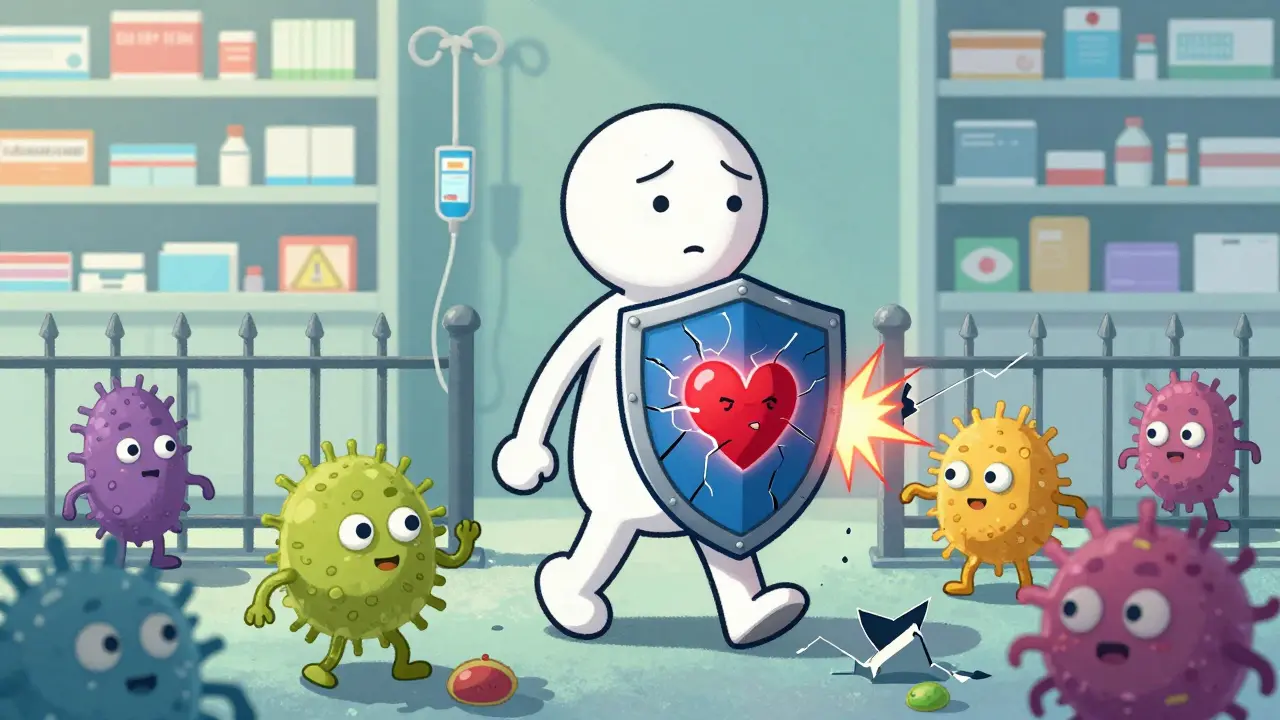
When you're on immunosuppressants-whether after a transplant, for autoimmune disease, or during chemotherapy-your body is already playing defense. Every infection, even a minor one, can become serious fast. Now add probiotics into the mix: those little live bacteria marketed to boost gut health. Sounds harmless, right? But for people with weakened immune systems, what’s safe for most can be dangerous for you.
Why Probiotics Can Be Risky When Your Immune System Is Down
Probiotics aren’t medicine. They’re supplements. That means they don’t go through the same safety checks as drugs. The World Health Organization defines them as live microorganisms that provide a health benefit when taken in the right amount. But in a healthy person, those microbes stay in the gut. In someone on immunosuppressants, they can slip through the intestinal lining and enter the bloodstream. That’s when trouble starts. There are documented cases of people developing Lactobacillus bacteremia, Saccharomyces boulardii fungemia, and even heart infections after taking probiotics. One 2021 review found that 83% of all probiotic-related infections happened in people with weakened immune systems. About 36% of those cases were fatal. It’s not about the probiotic being "bad." It’s about your body losing its ability to keep microbes in check. Think of it like a broken fence. The probiotics aren’t intruders-they’re just neighbors who wandered over when no one was watching. But in an immunosuppressed person, there’s no one left to guard the gate.Which Probiotic Strains Are Most Dangerous?
Not all probiotics are created equal. The most common ones you’ll find in stores are Lactobacillus (in 73% of products), Bifidobacterium (68%), and the yeast Saccharomyces boulardii (32%). But their risk levels vary wildly. Saccharomyces boulardii is the most dangerous for immunosuppressed patients. It’s a yeast, not a bacterium, and it’s especially risky if you have a central venous catheter. A 2019 study in JAMA Internal Medicine showed a 27% higher chance of bloodstream infection when this strain was used with a catheter. Case fatality rates hit 22% in some reports. Even bacterial strains like Lactobacillus rhamnosus GG-often labeled "safe" and "well-studied"-have caused sepsis in transplant patients. A 2020 case series in the Journal of Intensive Care Medicine described three patients with autoimmune diseases who developed bloodstream infections after taking this strain. Two ended up in the ICU. The problem isn’t just the strain. It’s the combination. Multi-strain probiotics (those with 5, 10, or even 20 different bacteria) have a 63% higher chance of causing translocation than single-strain products, according to a 2022 study in Clinical Microbiology and Infection. More strains = more chances for one to slip through.Who’s at Highest Risk?
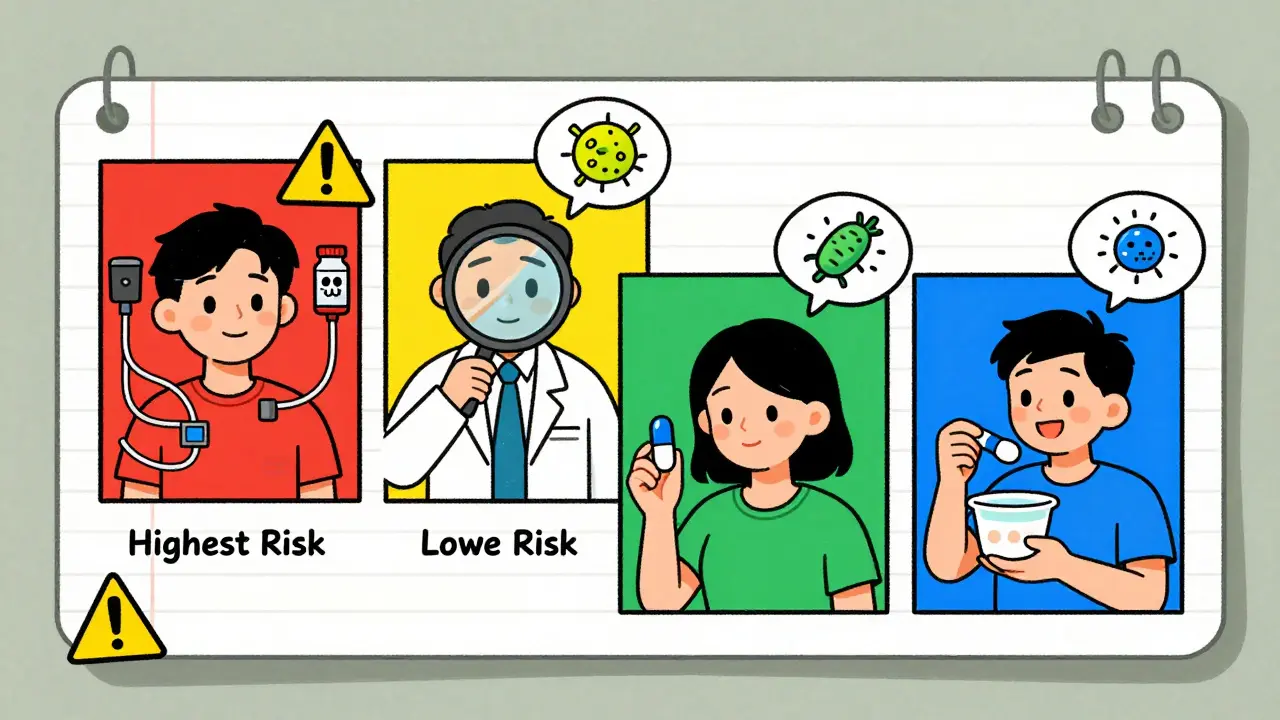
Not every immunosuppressed person needs to avoid probiotics. Risk depends on your condition, your meds, and your current health status.- Category 1 (Highest Risk): Absolute contraindication. This includes patients with neutrophil counts below 500 cells/µL (severe neutropenia), those who’ve had a stem cell transplant in the last 6 months, or anyone with a central line. For these people, probiotics are not an option.
- Category 2 (Moderate Risk): Solid organ transplant recipients within the first 3 months post-surgery. Patients on multiple immunosuppressants for severe autoimmune disease. These individuals should only consider probiotics after consulting an infectious disease specialist.
- Category 3 (Lower Risk): Stable autoimmune patients on one drug (like methotrexate or low-dose prednisone), or HIV patients with CD4 counts above 200. Even here, only single-strain, well-researched probiotics should be used-and only after talking to your doctor.
- Category 4 (Low Risk): No immunosuppression. These are the people who benefit from probiotics without risk.
What About Liver Transplant Patients? Isn’t There a Benefit?
Yes-and that’s where things get complicated. A 2022 meta-analysis in Liver Transplantation found that liver transplant recipients who took probiotics had a 34% lower rate of bacterial infections, with no increase in serious side effects. This is the only group where the benefits appear to clearly outweigh the risks. But here’s the catch: The probiotics used in that study were specific strains-Lactobacillus plantarum and Bifidobacterium longum-given in controlled doses. This wasn’t random store-bought supplements. It was a clinical protocol. That’s why experts stress: Don’t assume what worked for a liver transplant patient will work for you. A bone marrow transplant patient, for example, faces a 4.2-fold higher risk of probiotic-related bacteremia, according to a 2020 study in Blood Advances. Your immune system’s weakness isn’t the same as someone else’s.What Do Medical Guidelines Actually Say?
Guidelines aren’t always aligned. That’s why confusion is so common. The European Society for Clinical Nutrition and Metabolism (ESPEN) strongly recommends against probiotics in critically ill immunocompromised patients. The American Gastroenterological Association (AGA) only conditionally recommends specific strains for liver disease patients with hepatic encephalopathy-and even then, they call it a "weak" recommendation. Meanwhile, the Infectious Diseases Society of America (IDSA) in 2023 gave the clearest practical advice: use a four-tier risk system. If you’re in Category 1 or 2, don’t take them. If you’re in Category 3, proceed with extreme caution and only use single-strain products with documented safety data. The FDA issued a safety alert in July 2023 requiring warning labels on all probiotics containing Saccharomyces boulardii for immunocompromised patients. That’s a big deal. The FDA doesn’t do this lightly.What About Postbiotics? Is There a Safer Alternative?
Yes-and this is where the future is heading. Postbiotics are not live microbes. They’re the harmless byproducts of bacteria: things like short-chain fatty acids, enzymes, or cell fragments. They can still modulate the immune system and protect the gut lining-but without the risk of infection. A Phase 2 clinical trial (NCT04873011) tested a postbiotic formula in immunocompromised patients and found a 40% reduction in C. difficile infections-with zero adverse events. No sepsis. No fungemia. No ICU stays. This isn’t just theory. Companies are already developing postbiotic supplements. While they’re not widely available yet, they represent the next logical step: getting the benefits of probiotics without the danger.
What Should You Do If You’re on Immunosuppressants?
Here’s your action plan:- Stop taking probiotics immediately if you have a central line, neutropenia, or are within 3 months of a transplant.
- Don’t self-prescribe. Even if you read online that "probiotics helped someone with lupus," that doesn’t mean it’s safe for you.
- Ask your doctor for the strain name. If they say "take a probiotic," insist on the exact strain: e.g., Lactobacillus rhamnosus GG ATCC 53103. Generic labels like "Lactobacillus blend" are unsafe.
- Watch for symptoms. If you develop a fever over 101°F, chills, or unexplained fatigue after starting a probiotic, stop it and call your doctor immediately. Blood cultures may be needed.
- Consider postbiotics. Ask if there’s a postbiotic option available. They’re not magic, but they’re far safer.


Comments (15)