
Antidepressant Sexual Side Effects Calculator
Which antidepressant are you taking?
Results
Current Medication:
Sexual Side Effect Risk:
Key Statistics:
Recommended Alternatives:
When you start taking an antidepressant, you expect relief from sadness, fatigue, or panic. You don’t expect to lose interest in sex-or worse, to feel like your body no longer responds the way it used to. Yet for 35 to 70% of people on antidepressants, this is a reality. Sexual side effects aren’t rare. They’re common. And they’re often ignored-by doctors, by patients, and even by the drug labels themselves.
It’s not just about libido. For men, it’s trouble getting or keeping an erection. For women, it’s dryness, delayed or impossible orgasm, or just not caring anymore. And when you’re already fighting depression, losing your sexual connection can make you feel broken, isolated, or even more hopeless. Many people stop taking their meds because of this. One study found 23% of SSRI users quit within 90 days-not because the depression came back, but because sex became a source of stress, not pleasure.
Why Do Antidepressants Kill Your Sex Drive?
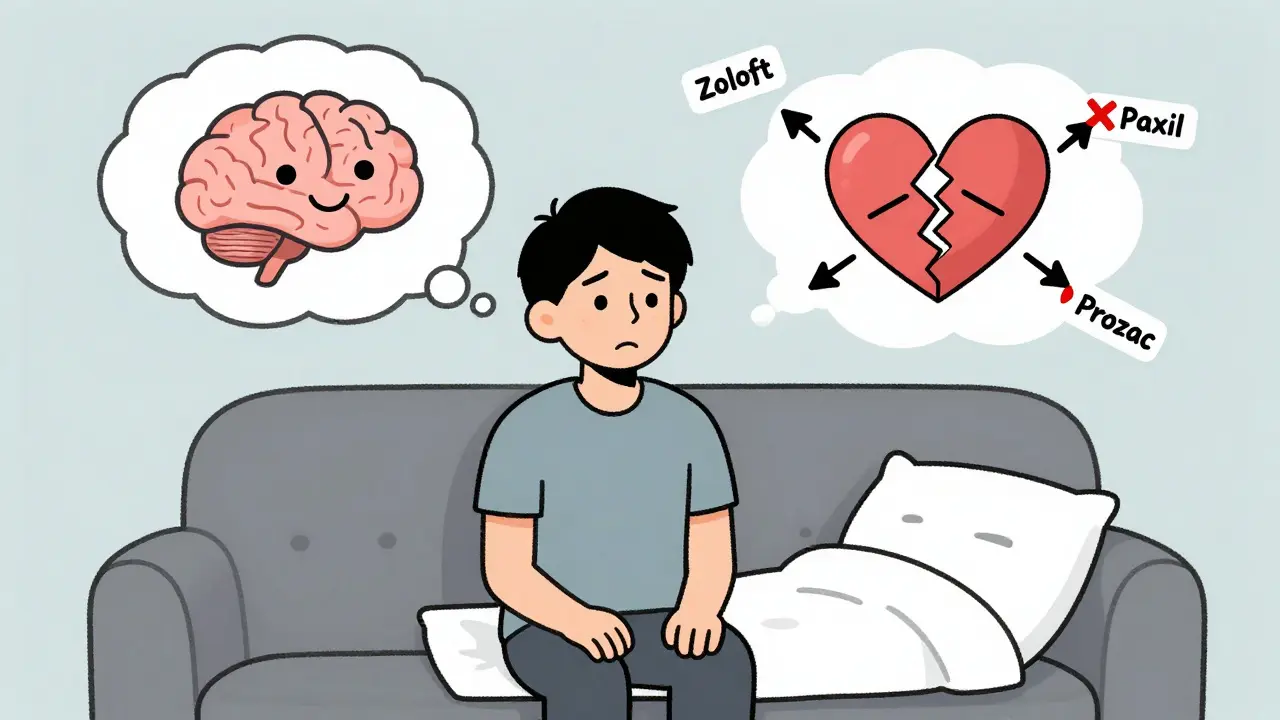
The answer lies in serotonin. SSRIs like sertraline (Zoloft), fluoxetine (Prozac), and paroxetine (Paxil) boost serotonin to lift your mood. But serotonin doesn’t just affect sadness-it shuts down other pathways in your brain that control arousal, desire, and orgasm. Think of it like turning down the volume on your entire sexual response system.
It’s not just the brain. These drugs also interfere with dopamine and norepinephrine, two chemicals critical for sexual excitement and physical response. The result? Men report 64% lower desire, 58% with erectile issues, and 53% with delayed ejaculation. Women report 61% less desire, 52% with inadequate lubrication, and nearly 50% who can’t reach orgasm at all.
And here’s the cruel twist: depression itself causes sexual problems. About 35-50% of people with untreated major depression already have low libido or arousal issues. So when your doctor says, “Your sex life will improve once your mood gets better,” they’re not wrong-but it’s not the whole story. Sometimes, the medicine that fixes your mood breaks your sex life.
Not All Antidepressants Are the Same
Some antidepressants are far worse than others when it comes to sex. Paroxetine (Paxil) is the worst offender. Studies show it causes sexual side effects in nearly 80% of users. Sertraline and citalopram aren’t far behind. But bupropion (Wellbutrin) is a different story.
Bupropion doesn’t boost serotonin. It works on dopamine and norepinephrine instead. And because of that, it’s the only antidepressant with a reputation for improving sexual function. In head-to-head trials, people switching from SSRIs to bupropion saw sexual side effects drop by 68%. One 2019 study found 58% of women on SSRIs who added bupropion saw better arousal and orgasm.
Other lower-risk options include:
- Mirtazapine (Remeron): Often used for sleep and appetite, it has minimal sexual side effects and can even boost desire.
- Agomelatine (Valdoxan): Used in Europe and Australia, it works on melatonin receptors and has near-zero sexual side effects.
- Nefazodone (Serzone): Rarely used now due to liver risks, but it’s one of the few SSRIs that doesn’t wreck sex drive.
And then there’s esketamine (Spravato), the nasal spray approved for treatment-resistant depression. In clinical trials, only 3.2% of users reported sexual side effects-compared to 40-70% on SSRIs. But it’s expensive ($880 per dose) and requires clinic visits. Not practical for most.
What to Do If You’re Already on an SSRI
If you’re on an SSRI and your sex life is suffering, you don’t have to just live with it. Here are four evidence-backed strategies:
1. Switch to a Lower-Risk Antidepressant
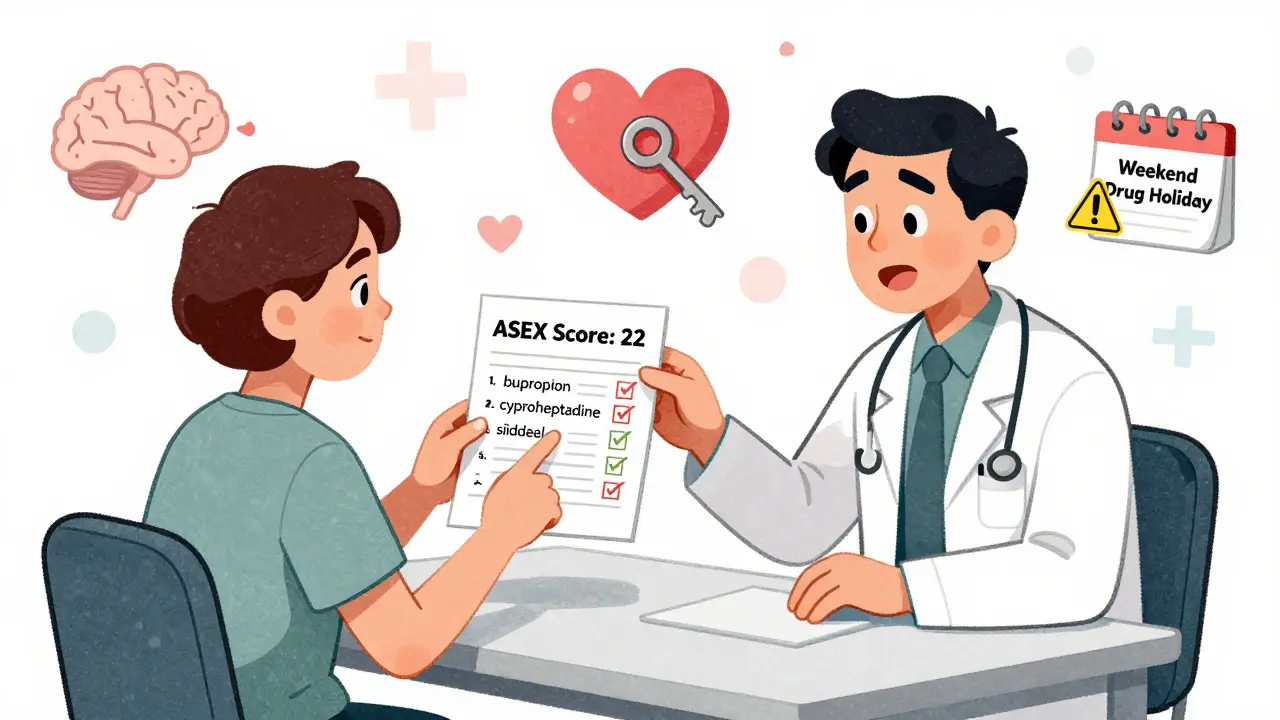
This is the most effective move. Switching from paroxetine or sertraline to bupropion can cut sexual side effects in half. But don’t just stop your current pill. You need a cross-taper: slowly reduce the old drug while gradually increasing the new one. This takes 2-4 weeks and prevents withdrawal symptoms like dizziness, brain zaps, or nausea.
Fluoxetine (Prozac) has a long half-life, so you can taper it more easily. Paroxetine? It leaves your system fast. Tapering slowly is critical. Your doctor should guide this. Never quit cold turkey.
2. Add a Sexual Enhancer
For men with erectile problems, sildenafil (Viagra) works. In trials, 65-70% of men on SSRIs saw improvement with sildenafil-compared to 25% on placebo. Tadalafil (Cialis) works too. It’s longer-lasting and can be taken daily at low doses.
For women, adding bupropion (even while staying on the SSRI) helped 58% regain orgasm and desire. Some doctors also prescribe low-dose testosterone cream, though this is off-label and not FDA-approved for women in the U.S.
3. Try Cyproheptadine
This old antihistamine, used for allergies, has a surprising side effect: it reverses SSRI-induced anorgasmia. A 2021 study gave 4mg nightly to women struggling to climax. 52% improved. Only 18% did on placebo. It’s cheap, available as a generic, and rarely causes drowsiness at this dose. Ask your doctor if it’s right for you.
4. Take a Drug Holiday
Some people take a “weekend off” from their SSRI-skipping doses Friday to Sunday to let their system reset. This works for some, especially with fluoxetine (because it stays in your system longer). But it’s risky. With paroxetine or sertraline, withdrawal symptoms can hit hard. And if you’re prone to relapse, this could trigger a return of depression. Only try this under medical supervision.
The Hidden Risk: Post-SSRI Sexual Dysfunction (PSSD)
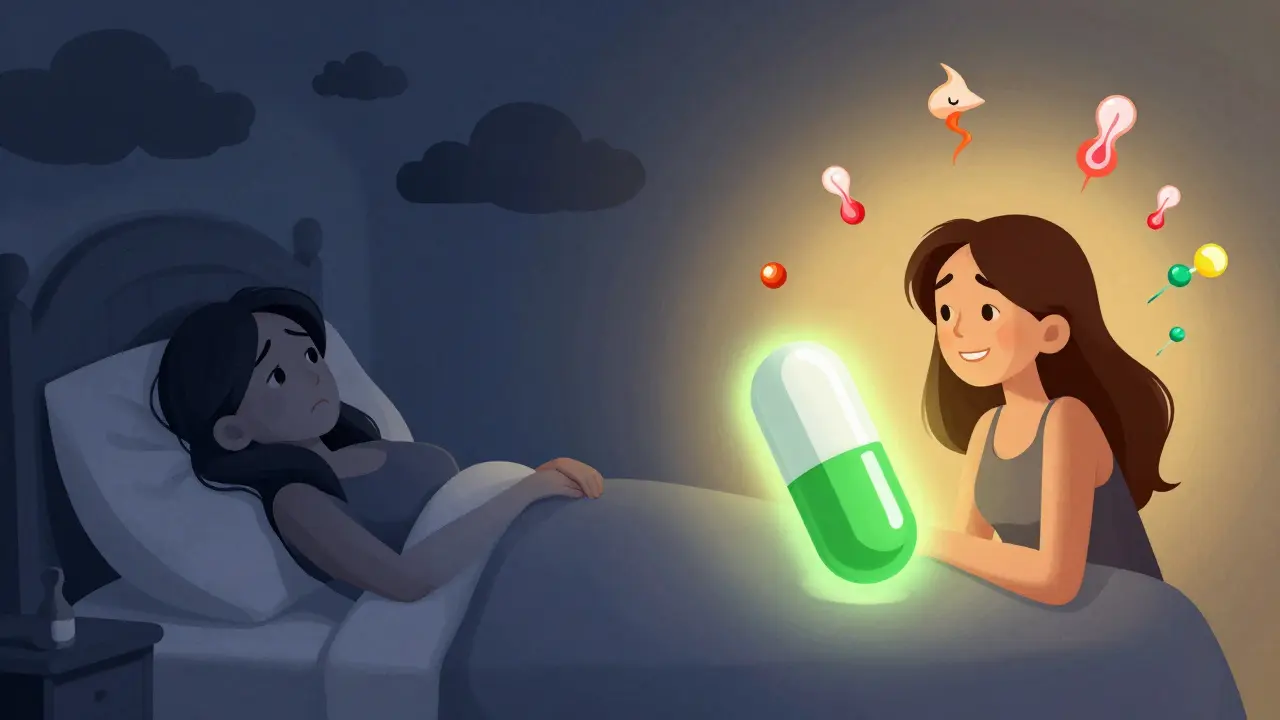
Most people assume that when they stop the drug, their sex life comes back. But for a small group-0.5% to 1.2%-it doesn’t. This is called Post-SSRI Sexual Dysfunction, or PSSD. Symptoms include permanent low desire, genital numbness, or inability to orgasm-even after months or years off the drug.
There are fewer than 30 published case reports since 2010, but patient forums are full of stories. Reddit threads, support groups, and advocacy sites are full of people who stopped their SSRI and never got their sex drive back. The FDA and European regulators are starting to take notice. In 2022, the FDA required stronger warnings on antidepressant labels about persistent sexual side effects.
PSSD is rare, but real. And it’s why you should never rush into antidepressants-or out of them-without understanding the full picture.
How to Talk to Your Doctor
Doctors don’t always ask about sex. They’re busy. They assume you’ll bring it up. But you shouldn’t have to.
Start with: “I’ve noticed my sex drive has dropped since I started this medication. Is this common? Are there alternatives?”
Ask for the Australia Sexual Experience Scale (ASEX). It’s a simple 5-question tool doctors use to measure sexual function. It’s not fancy, but it’s reliable. If your score is above 19, you have clinically significant dysfunction.
Bring data. Print out the numbers: “Studies show bupropion causes 2-3 times fewer sexual side effects than sertraline.” Or: “A 2019 trial showed adding bupropion helped 58% of women on SSRIs.”
And if your doctor dismisses you? Find another one. You deserve care that treats your whole self-not just your mood.
What About Natural Fixes?
Herbs, supplements, and lifestyle changes get a lot of attention. But here’s the truth: none have strong evidence for reversing SSRI-induced sexual dysfunction.
- Macafem, ginseng, L-arginine: No reliable studies show they help.
- Exercise: Improves mood and circulation, which helps-but won’t fix a neurochemical block.
- Reducing alcohol: Smart. Alcohol lowers libido. But if you’re already on an SSRI, cutting alcohol won’t bring back your sex drive.
There’s no magic pill outside of medication changes or add-ons. Don’t waste money on supplements that promise quick fixes. Focus on what actually works: switching meds or adding a proven treatment.
Cost and Accessibility
Switching to bupropion XL 150mg costs about $15.72 a month as a generic. Brand-name Zoloft? $57.84. That’s a 70% savings. And it’s covered by most insurance plans.
Viagra and Cialis are more expensive-$10-$20 per pill-but generic sildenafil is widely available for under $2 per tablet. Cyproheptadine is dirt cheap: under $5 for a 30-day supply.
And while esketamine (Spravato) is powerful, it’s not affordable for most. At $880 per dose, twice a week, it’s a last-resort option.
What’s Next?
Researchers are working on new antidepressants that don’t wreck your sex life. One compound, SEP-227162, is in Phase II trials. It targets serotonin receptors differently-and early data shows 87% lower sexual side effects than sertraline. If it works, it could change everything.
Meanwhile, pharmacogenomic testing is becoming more common. Some people metabolize paroxetine slowly because of a gene variation (CYP2D6 poor metabolizer). That means higher drug levels-and worse side effects. Testing can tell you if you’re at higher risk before you even start.
The bottom line: you’re not broken. Your body isn’t failing you. The medicine is. And there are better choices.
Sexual health matters. It’s not a side note. It’s part of your recovery. If your antidepressant is stealing your pleasure, it’s time to find one that doesn’t.


Comments (9)