
Vitamin D & Thiazide Safety Calculator
This tool helps you understand your risk of hypercalcemia when taking Vitamin D with thiazide diuretics. Based on data from the Mayo Clinic and other studies, it estimates your risk level and provides recommendations.
When you take vitamin D to support bone health and immune function, and your doctor prescribes a thiazide diuretic for high blood pressure, it’s easy to assume these two are harmless together. But for many people, especially older adults, this common combination can push calcium levels into dangerous territory - without warning.
Why This Combination Is Risky
Thiazide diuretics like hydrochlorothiazide and chlorthalidone are among the most prescribed blood pressure medications in the U.S., with over 50 million prescriptions filled each year. They work by helping your kidneys get rid of extra salt and water, which lowers blood pressure. But here’s the twist: while they flush out sodium, they also cause your kidneys to hold onto calcium. That’s not a bug - it’s a feature. Less calcium in your urine means stronger bones. But when you add vitamin D on top, you’re turning up the volume on calcium absorption from your gut. Vitamin D, especially in doses above 2,000 IU daily, boosts your body’s ability to pull calcium from food. In fact, high doses can increase intestinal calcium absorption by up to 80%. When this happens alongside a thiazide, your body ends up with more calcium entering your bloodstream than it can safely handle. The result? Hypercalcemia - a serum calcium level above 10.5 mg/dL. This isn’t theoretical. A 2021 study from the Mayo Clinic found that patients taking high-dose vitamin D (4,000 IU or more) along with thiazides had an 8-12% chance of developing hypercalcemia. That’s more than four times higher than those on thiazides alone. Emergency room data from 2022 shows that 15% of all drug-induced hypercalcemia cases involved this exact combo.How It Happens: The Two-Pronged Effect
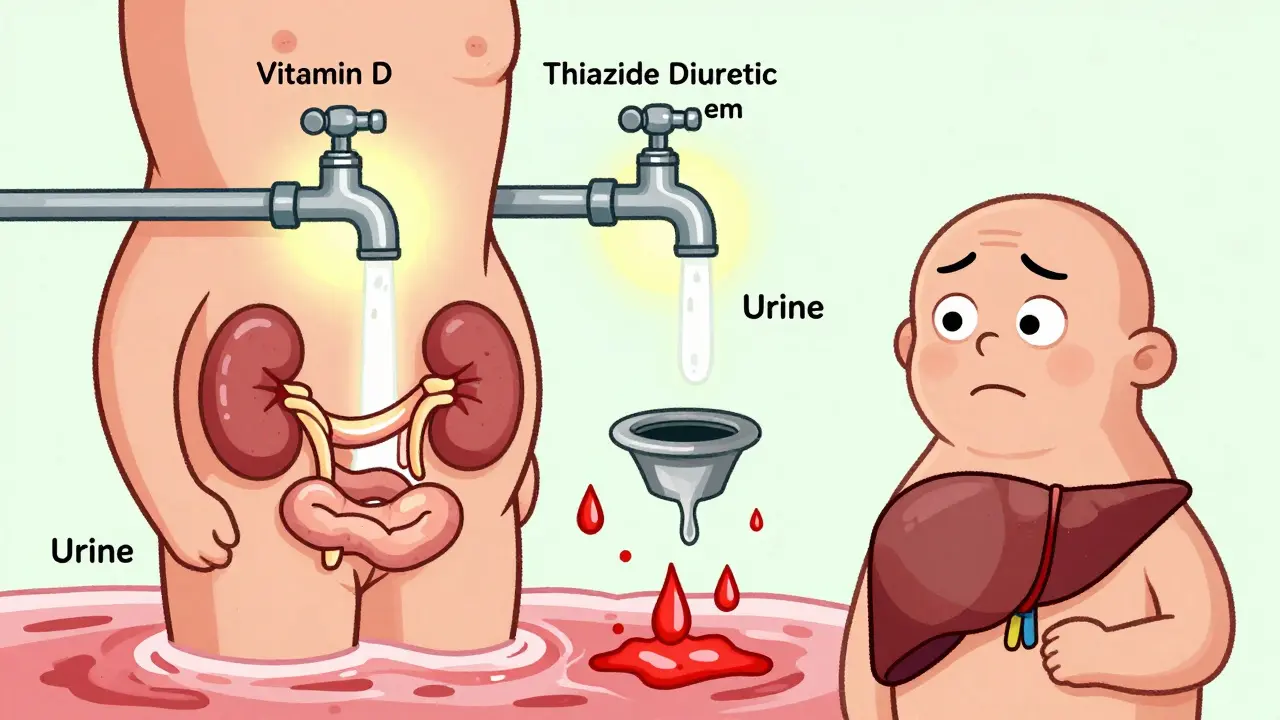
The problem isn’t just that both substances raise calcium - it’s how they do it, together. Thiazides act on the distal convoluted tubule of your kidney. They block the sodium-chloride transporter, which indirectly activates calcium channels (TRPV5) and increases calcium reabsorption. Studies show this reduces urinary calcium loss by 30-40%. Meanwhile, vitamin D’s active form, calcitriol, ramps up production of calbindin-D9k and TRPV6 proteins in your intestines. These proteins act like gates, letting more calcium slip into your blood. It’s like turning on two faucets at once - one from your gut, one from your kidneys - while the drain (urine) is partially clogged. Calcium builds up. And because your body doesn’t have a good way to get rid of the excess, it starts circulating in your blood.Who’s Most at Risk?
This isn’t a risk for everyone. But certain groups are far more vulnerable:- Adults over 65: Nearly 80% of seniors take at least one of these drugs. Their kidneys are less efficient at clearing calcium, and they’re more likely to take high-dose supplements without medical guidance.
- People with borderline high calcium: If your baseline calcium is already above 10.2 mg/dL, adding vitamin D and a thiazide can push you over the edge. The American Geriatrics Society specifically flags this combo as potentially inappropriate in these cases.
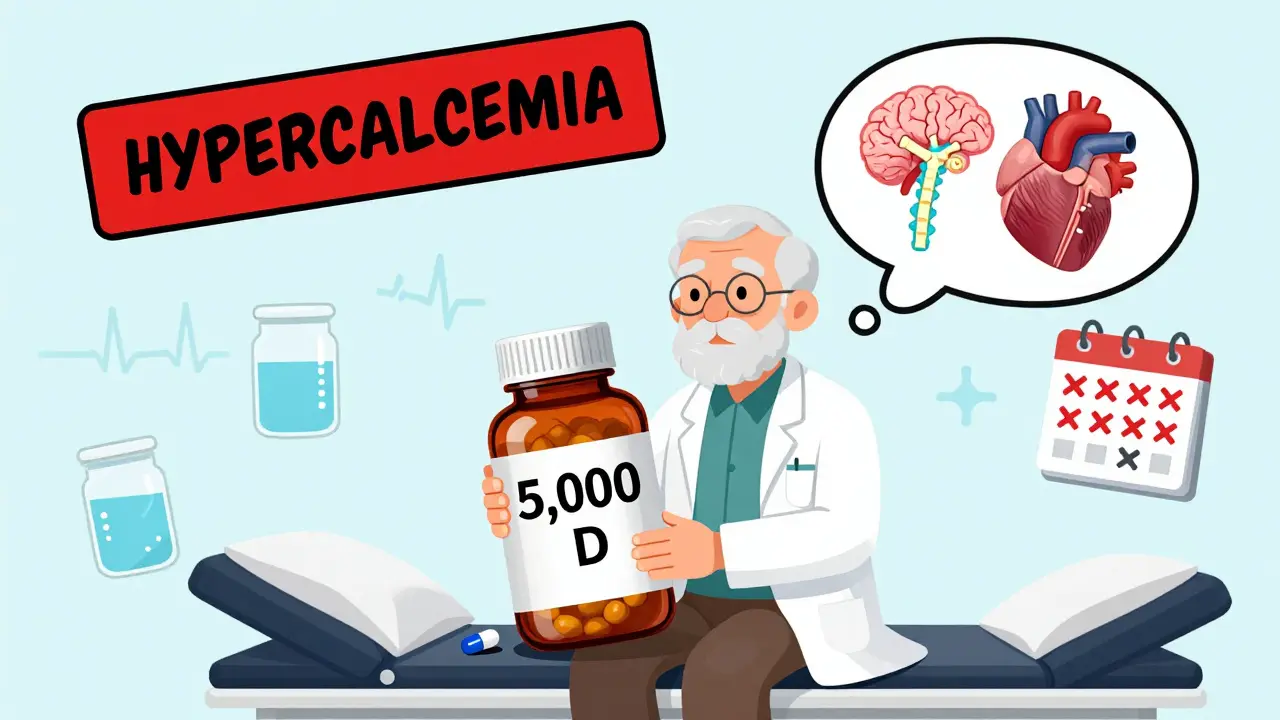
- Those taking 5,000 IU or more of vitamin D daily: Most over-the-counter supplements come in 1,000, 2,000, or 5,000 IU doses. Many people take these without knowing the risks. A 2023 ConsumerLab analysis found that nearly 30% of vitamin D users take 5,000 IU or higher - often based on internet advice, not medical guidance.
- Patients with kidney issues: Even mild kidney impairment reduces the body’s ability to excrete excess calcium.
What Symptoms to Watch For
Hypercalcemia doesn’t always cause obvious symptoms - which is why it’s so dangerous. Many people feel fine until it’s too late. But when symptoms do appear, they’re often mistaken for aging or dehydration:- Extreme fatigue or weakness
- Constipation or nausea
- Frequent urination or thirst
- Confusion or brain fog
- Bone pain or muscle aches
- Heart rhythm changes (like palpitations)
What the Experts Say
There’s disagreement among specialists - but the trend is clear. Dr. John Burnett from Mayo Clinic calls this one of the most underrecognized causes of hospitalization in older adults. His 2023 JAMA commentary cited Medicare data showing 22% of hypercalcemia cases in patients over 65 were tied to this combo. On the other side, Dr. Murray Epstein argues the risk is overstated, citing a 0.8% incidence rate in well-monitored patients. But here’s the catch: most patients aren’t monitored. A 2022 National Council on Aging survey found that 61% of seniors on thiazides didn’t even know they needed to check their calcium levels when taking vitamin D. That’s not negligence - it’s lack of clear communication. The European Society of Cardiology recommends capping vitamin D at 2,000 IU/day for thiazide users. The American Society of Nephrology suggests sticking to 800-1,000 IU daily if you’re on a thiazide. The American Heart Association now includes this warning in its 2023 hypertension guidelines.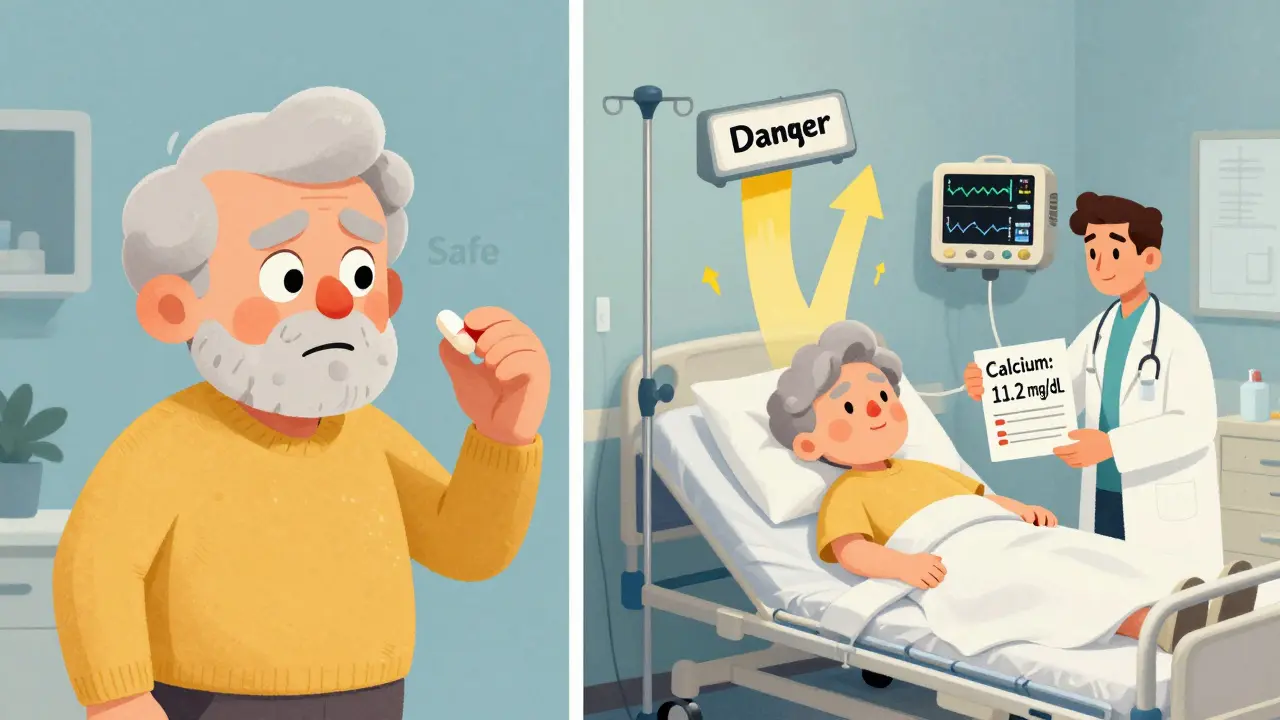
What to Do Instead
You don’t have to stop vitamin D. You don’t have to stop your blood pressure med. But you do need to adjust.- Get your calcium tested: Before starting vitamin D, ask for a serum calcium test. Repeat it 3 months after starting the combo, then every 6-12 months. Don’t wait for symptoms.
- Lower your vitamin D dose: For most people on thiazides, 800-1,000 IU daily is enough to maintain healthy levels. You don’t need 5,000 IU unless you have a diagnosed deficiency and are under medical supervision.
- Consider alternatives: If you’re at high risk, your doctor might switch you to a different blood pressure medication. Loop diuretics like furosemide actually increase calcium excretion, making them safer with vitamin D. Potassium-sparing diuretics like spironolactone have no calcium-sparing effect - another option.
- Use lower-dose thiazides: Hydrochlorothiazide 12.5 mg works just as well for blood pressure as 25 mg - but carries less calcium risk. Chlorthalidone is stronger on calcium retention, so if you’re on that, be extra cautious.
What’s Changing in 2025
The tide is turning. Health systems are catching on. Kaiser Permanente now has EHR alerts that pop up when a patient on a thiazide tries to order a vitamin D dose over 2,000 IU. Since 2022, this has cut inappropriate prescriptions by 63%. In 2023, the FDA approved a new genetic test called CalcCheck that looks at variants in the calcium-sensing receptor gene. It can predict who’s more likely to develop hypercalcemia from this combo - a game-changer for personalized care. The 2024 American Heart Association guidelines, expected in January, will likely make calcium monitoring mandatory for anyone on both drugs. Meanwhile, newer thiazide-like drugs like metolazone may offer a safer profile - they reduce calcium reabsorption by only 25%, compared to 35-42% for traditional thiazides. More research is coming.Bottom Line: Stay Safe, Stay Informed
Vitamin D and thiazide diuretics aren’t dangerous by themselves. Together, they can be. But with smart choices, you can avoid the risk.- Don’t assume supplements are harmless - even if they’re sold over the counter.
- Ask your doctor for a calcium test before starting or increasing vitamin D.
- Stick to 800-1,000 IU of vitamin D daily if you’re on a thiazide - unless your doctor says otherwise.
- Know the symptoms. If you feel unusually tired, constipated, or confused, get your calcium checked.
- Don’t stop your blood pressure med without talking to your doctor - the benefits of controlling hypertension still outweigh the risk, if managed properly.


Comments (10)